
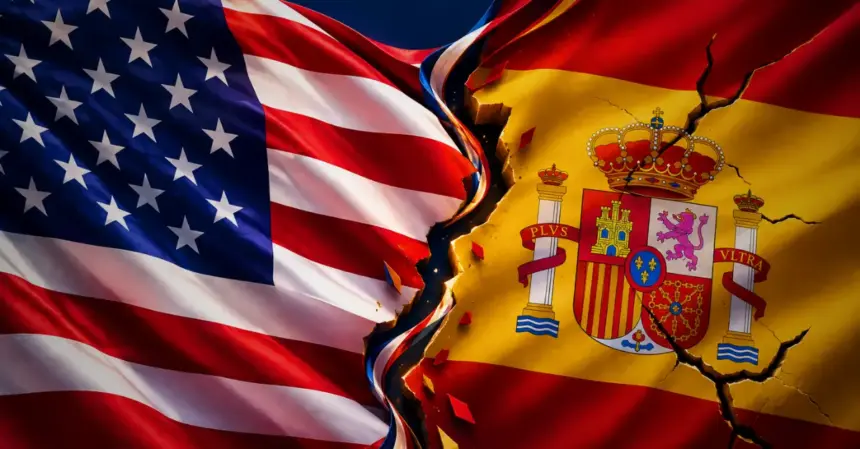
For over a year, Madrid has chosen open confrontation with Washington on two sensitive fronts, its refusal to raise defense spending to 5% of GDP as other Alliance members committed to at the Hague summit, and its outright opposition to the war led by the United States and Israel against Iran, going as far as banning the use of its own military bases for strikes. This choice has a cost, and that cost is starting to materialize.
In April 2026, a Pentagon leak revealed by Reuters exposed internal discussions considering suspending Spain’s participation in leadership positions within NATO. In July, Trump followed through on the commercial front by ordering a halt to trade with Spain. Pedro Sánchez brushed off these reports, saying he was “not worried.” But the accumulation of signals raises questions, at a moment when other regional powers are quietly building their network of military alliances without making waves.
Spain isolating itself while others weave their web
That’s where the contrast becomes striking. While Madrid keeps striking postures that expose it to Washington, Morocco has methodically deepened its network of military partnerships with several NATO members, without ever putting itself at odds with any of them.
With France, the relationship has been explicitly revived. In June 2026, on the sidelines of the Eurosatory trade show in Paris, French and Moroccan defense officials discussed deepening their capability and industrial cooperation, ahead of a major diplomatic milestone planned for July in Rabat. This momentum builds on contracts already signed, notably the delivery of Sherpa military vehicles, and advanced talks on acquiring Caracal H225 helicopters from Airbus.
With Belgium, cooperation rests on a bilateral agreement signed back in 1992 and a technical arrangement from 1998, but it keeps intensifying, as underscored by a meeting between the Inspector General of the Royal Armed Forces and the Belgian Chief of Defence, who praised the track record of this cooperation in training and joint exercises.
Morocco has also signed a defense cooperation roadmap with the United States extending through 2030, forged growing ties with Germany, which has proposed a military cooperation agreement, hosted a joint military workshop with NATO and the African Union on its own soil, and even accelerated its security rapprochement with Israel, with a joint military work plan validated for 2026.
None of these partnerships has exposed Rabat to sanctions or marginalization threats. Morocco advances its pieces with consistency, without provoking, without alienating its interlocutors, accumulating agreements rather than collecting disputes.
The weight of a head-on disagreement with Washington
Spain’s real problem is not so much the substance of its positions, challenging the 5% GDP target or refusing to associate itself with a war in the Middle East are sovereign choices, but the way these positions have been displayed. Banning the use of its own military bases for American operations, publicly, amounts to delivering a slap in the face to its principal ally. Trump took it as such, repeatedly pointing out that Spain was “the only NATO country” that had not accepted this budgetary effort.
The fact that the commercial sanctions threatened in October 2025, February 2026, and then July 2026 have so far never produced lasting effects should not reassure Madrid too much. This repeated pattern mainly shows an American administration testing, at every opportunity, Spain’s resistance and the solidity of its backing, a scenario that could one day stop stopping there. A one-off budgetary or strategic disagreement, should Trump decide to make another show of force, could this time translate into an actual removal from NATO command positions, with no legal mechanism to protect Madrid.
What Madrid risks losing concretely
- Institutional weight. Fewer Spanish officers in NATO’s strategic positions means less influence over the Alliance’s doctrine and operations for years to come.
- Budgetary credibility. Refusing the 5% GDP target while others fall in line isolates Spain in future burden-sharing negotiations.
- Commercial leverage. Each new episode of bilateral trade tension, even without immediate effect, undermines the predictability of economic relations with Washington.
- Regional diplomatic momentum. While Madrid focuses on its standoff with the United States, other players, starting with Morocco, are consolidating their alliance networks without ever being forced to pick a side.
An open-ended conclusion
Spain can keep defending its positions on Iran and on defense spending, that is its sovereign right. But it is currently doing so as a lone wolf, without a solid legal safety net against an American ally accustomed to sanctioning first and negotiating later. Meanwhile, other regional players are advancing their pieces with method and consistency. The question now facing Madrid is no longer whether it is right on the substance, but whether it can afford, in this balance of power, to remain this isolated for much longer.
FAQ
Can Spain be expelled from NATO?
No, the 1949 Washington Treaty provides no mechanism for forced exclusion. But this legal protection does not prevent informal, gradual marginalization.
Why is Trump specifically targeting Spain?
Madrid is presented by Washington as the only NATO country that has not accepted the 5% of GDP defense spending target, on top of its opposition to the war against Iran.
Is Morocco trying to replace Spain within NATO?
No, Morocco is not a NATO member and cannot claim Spain’s status. It acts as a partner, multiplying bilateral agreements with several Alliance members.
Have the American sanctions against Spain had concrete effects so far?
So far, the repeated threats since October 2025 have not translated into lasting sanctions, but the frequency of these episodes reflects mounting pressure.