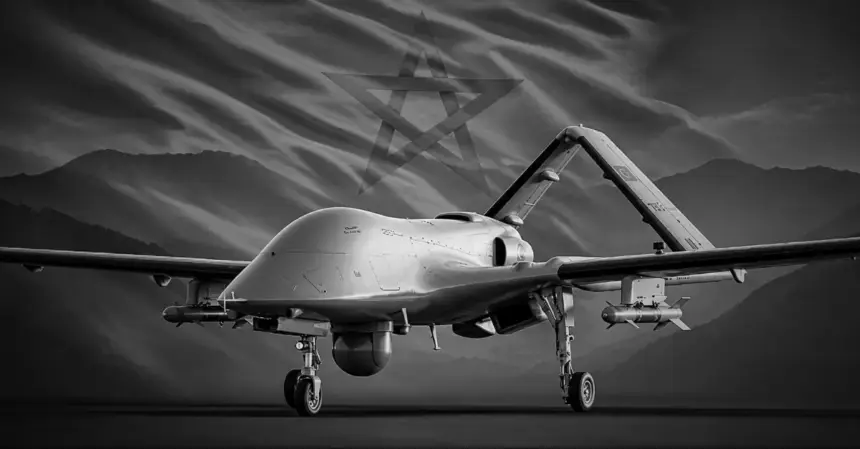
For several days, defense-focused websites have been relaying a piece of information that, if confirmed, marks another step in the relationship between Rabat and Ankara. According to a report by the site Arab Defense (defense-arabic.com) published on November 11, 2026, Morocco has reportedly received a new batch of Turkish Bayraktar TB3 armed drones.
This announcement fits into an already well-documented sequence: the acquisition of the TB2s starting in 2021, the delivery of the Akinci in 2025, and the gradual establishment of an industrial presence for Baykar in Morocco through its subsidiary Atlas Defense. I have found no official Moroccan or Turkish confirmation of this specific TB3 delivery. The report relies in particular on the aircraft’s appearance at the Marrakech Air Show 2026, displayed alongside the Moroccan flag, after an initial presentation to Royal Armed Forces representatives in 2024.
It is precisely this still partially opaque nature that deserves a close look. In a Mediterranean basin where military balances are being redrawn, every addition to Morocco’s drone fleet is never insignificant.
A partnership that has deepened since 2021
The starting point remains the 2021 contract for thirteen Bayraktar TB2s, for an amount often estimated at around $70 million. These aircraft gave the Royal Armed Forces a persistent surveillance and light strike capability they previously lacked, particularly useful for monitoring borders and sensitive areas in the south.
A few years later, Morocco added the Bayraktar Akinci, a heavier and higher-performing platform. Flight observations over Moroccan territory and satellite imagery of the Ben Guerir base confirmed their entry into operational service from early 2025. The exact number has not been made public.
In parallel, Baykar created Atlas Defense in Morocco. A strategic agreement in late 2024 provided for a facility in Benslimane (near Casablanca) intended for assembly, maintenance and, eventually, production tailored to local needs. Recruitment was reported in 2026, and investments of several hundred million dollars have been mentioned in the specialized press. This industrial dimension distinguishes the Moroccan-Turkish partnership from a simple customer-supplier relationship.
What the TB3 concretely changes
The TB3 is not a simple evolution of the TB2. Designed from the outset to operate from short-deck ships (such as the Turkish aircraft carrier TCG Anadolu), it features foldable wings, fully autonomous takeoff and landing, and both line-of-sight and beyond-line-of-sight (satellite) communications.
According to the official specifications published by Baykar, it offers an endurance of over 24 hours, a payload of 280 kg (equipment and munitions), a service ceiling of 25,000 feet and a maximum takeoff weight of around 1,600 kg. Some reports mention up to six hardpoints and an armament load approaching 300 kg. Line-of-sight control range is about 300 km; with a satellite link, control range can reach approximately 2,000 km according to specialized sources.
Key figures of the Bayraktar TB3 (Baykar specifications)
- Endurance: over 24 hours
- Payload: 280 kg
- Communications: LOS and BLOS (satellite)
- Naval capability: autonomous takeoff/landing on short-deck ships
- Possible armament: laser-guided munitions, GPS/INS, mini cruise missiles, ISR options (electro-optical, radar, ELINT)
For Morocco, these characteristics offer several concrete advantages: prolonged surveillance of the southern regions, reconnaissance and targeting beyond direct visual range, and potential maritime use if the Royal Armed Forces decide to fully exploit the naval version. Specialized reports specifically mention a possible use to strengthen surveillance operations in the south.
Strategic stakes in the Mediterranean and North Africa
This potential acquisition is part of a broader strategy of modernization and diversification of arms sources. Morocco combines American (F-16, Apache), European, Israeli and, increasingly, Turkish equipment. This approach reduces dependencies and provides access to technologies that are sometimes less constrained by Western political considerations.
Regionally, the addition of long-endurance platforms with strike capability strengthens the surveillance and deterrence posture, particularly in the context of the Moroccan Sahara and vis-à-vis neighboring Algeria, which is also developing its air and drone capabilities. No immediate escalation is under way, but every new capability is closely watched on both sides of the border.
For Turkey, Morocco represents both an important customer in North Africa and an industrial foothold. The Benslimane plant, if it meets its objectives, could serve as a base for broader African markets. Ankara has multiplied partnerships of this kind in recent years, building on the commercial success of the TB2 and then the Akinci.
On the Moroccan side, the medium-term objective appears to be moving from buyer to partial producer. Local drone projects (including loitering munitions) and agreements with other foreign manufacturers (Emirati, French) point in the same direction. The TB3, if properly delivered, would add to this dynamic without replacing it.
There are limits. The number of aircraft delivered is unknown. Operational integration, crew training, logistical support and the availability of suitable munitions remain critical steps. Finally, satellite capability (BLOS) depends on communication infrastructure that is not entirely sovereign.
Open perspectives
If the Arab Defense report is confirmed in the coming weeks or months, the TB3 will complete an already operational family (TB2 and Akinci). It will not on its own transform the regional military balance, but it illustrates a clear trend: Morocco is investing for the long term in unmanned systems and in an industrial partnership with Turkey.
It remains to be seen whether this delivery will be accompanied by official announcements, additional skills transfers, or interest in other Baykar platforms (such as the Kızılelma, still in development and export phase). In the Mediterranean basin, where surveillance and remote strike technologies are gaining importance, these technical choices are also political and industrial choices.
Frequently asked questions
Has Morocco officially confirmed receiving the Bayraktar TB3?
No. The information comes from specialized media reports (notably Arab Defense) and has not been the subject of an official Moroccan or Turkish announcement to date.
What is the main difference between the TB3 and the TB2 already in service?
The TB3 is heavier, has a larger payload, foldable wings and a native capability to operate from short-deck ships, with more advanced satellite communications.
Does Morocco already produce drones locally?
Production and assembly projects exist, notably through Atlas Defense (Baykar) in Benslimane and other Moroccan or partnership initiatives. Large-scale production is still ramping up.