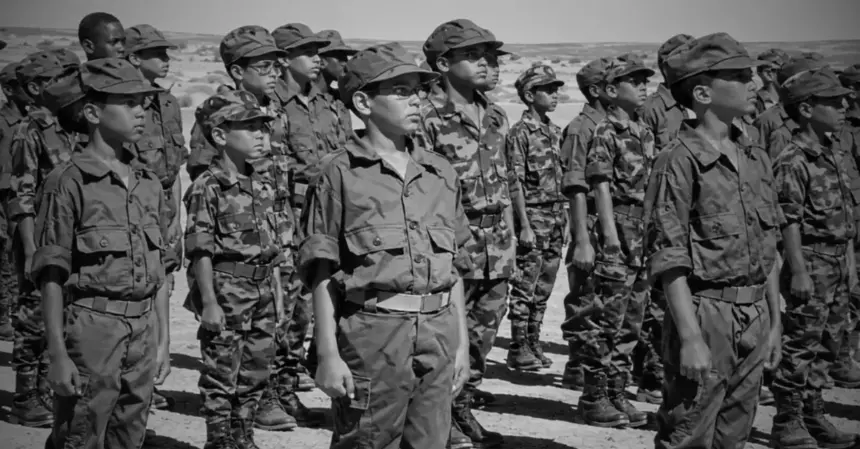
This practice, documented by testimonies from former minors, footage of parades and military training, and numerous NGO submissions to the United Nations Human Rights Council, constitutes a serious and repeated violation of international law. Faced with this reality, the United Nations, and more specifically the United Nations Mission for the Referendum in Western Sahara (MINURSO), has chosen silence. Not a silence born of ignorance, but a deliberate, lasting and institutionalized one.
Algeria’s direct and ongoing responsibility
Algeria is not merely a host country. It has been the Polisario’s main political, diplomatic, logistical and military backer since the Tindouf camps were created. It provides rear bases, command structures, equipment, uniforms and protection of the territory. Independent analyses estimate the cost of this sponsorship at several hundred million dollars a year, and often far more once the military and diplomatic dimensions are included.
As a state party to the Convention on the Rights of the Child and its Optional Protocol on the involvement of children in armed conflict, Algeria has a positive obligation to prevent the recruitment and use of minors on its soil. Under the 1951 Refugee Convention, it is also obliged to ensure that the camps are not militarized.
It has done exactly the opposite: it has de facto delegated the administration of the camps to the Polisario and turned a blind eye to the enlistment of children as young as 7 to 14, their training in the handling of weapons and their indoctrination. This delegation of sovereignty and this blatant inaction engage the international responsibility of the Algerian state. This is no longer mere negligence, but structural complicity.
The silence and inaction of MINURSO
MINURSO was deployed in 1991. For 35 years, its military observers have had a presence on the ground, including in areas under Polisario control. They have witnessed, directly or indirectly, children in uniform, military training sessions, and even the welcoming of the Secretary-General’s Personal Envoy by minors in combat dress. These facts have been reported repeatedly by NGOs, petitioners before the Fourth Committee and former camp residents.
Yet the mission has never made this issue a priority. Unlike nearly all contemporary peacekeeping operations, its mandate has never included a human rights monitoring component. Repeated calls, notably from Human Rights Watch, to broaden the mandate to cover both the territory of Western Sahara and the Tindouf camps have gone unheeded. No serious, systematic report has been produced on the recruitment of children. No pressure has been applied during the annual mandate renewals. No referral has been made to the Secretary-General’s “Children and Armed Conflict” mechanism.
This silence has been compounded by documented incidents of military observers making openly pro-Polisario remarks, which has fueled legitimate suspicions of bias, even infiltration. For three and a half decades, MINURSO has observed without ever seeing, or rather without ever wanting to see.
The institutional hypocrisy of the UN
The United Nations has a dedicated mechanism for children and armed conflict. It compiles lists, imposes sanctions, mobilizes resources and publicly condemns groups that recruit child soldiers in West Africa, the Sahel, the Democratic Republic of the Congo and elsewhere. As soon as the Polisario, an ally of Algeria, is concerned, this mechanism grinds to a halt. There is no listing in the Secretary-General’s reports, no conditionality in Security Council resolutions, no independent investigation imposed.
The referendum provided for in the settlement plan has never taken place. The ceasefire was broken in 2020. In 2026, MINURSO’s mandate expired without ever having protected the children of the camps. This is not a technical failure. It is a policy of double standards, in which the protection of children yields to geopolitical balances and state alliances.
Violations of international law
The recruitment and use of children under 18 by the Polisario violates:
- the Convention on the Rights of the Child and its Optional Protocol;
- Additional Protocol II to the Geneva Conventions (prohibition of recruiting children under 15);
- the Rome Statute of the International Criminal Court, which classifies the recruitment and use of children under 15 as a war crime;
- the Paris Principles (2007) on children associated with armed forces or armed groups.
Algeria, as host state and main backer, bears direct responsibility for failing to prevent these practices on its territory. MINURSO and the Security Council bear institutional responsibility for their willful blindness and for the absence of any protective or punitive measure over 35 years.
Conclusion and demands
It is time to end this impunity. Targeted sanctions must be considered against the Polisario officials involved in recruiting children, as well as against the Algerian officials who have enabled, financed and protected this practice for decades. The “Children and Armed Conflict” mechanism must finally include the situation in the Tindouf camps. The UN cannot keep claiming to defend children’s rights while turning a blind eye to one of the oldest and best-documented cases of the militarization of minors on the African continent.
MINURSO’s silence was not neutral. It was criminal.