

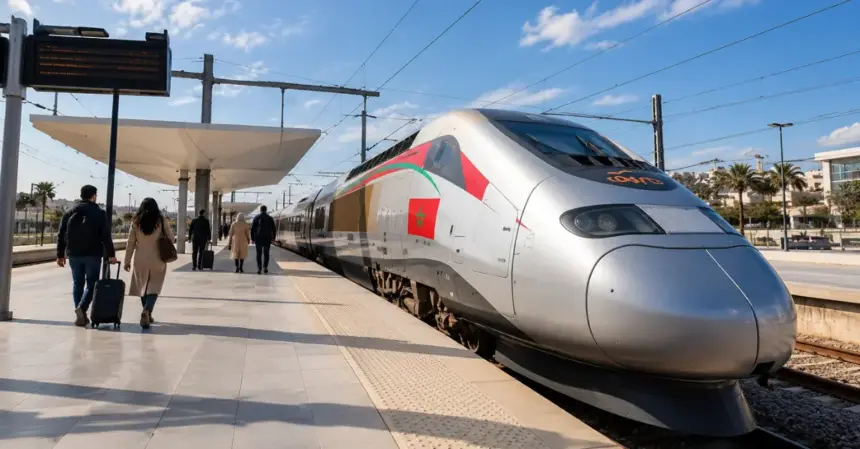
In my view, Morocco’s rail programme belongs to both categories. Around 10 billion dollars in investment has been announced through 2030 to extend high-speed rail beyond Kenitra, towards Rabat, Casablanca and Marrakech. I have followed it for several months, and it is no longer a mere communications exercise: Morocco is choosing a model of territorial planning.
Key takeaways
- Morocco plans around 10 billion dollars of rail investment through 2030.
- High speed will link Kenitra, Rabat, Casablanca and Marrakech.
- Tangier–Marrakech could drop to about 2h40.
- The plan targets 43 cities, 87% of the population served and around 300,000 jobs.
- The far south, with a link to Dakhla, remains the missing piece.
Why this project is about more than trains
Morocco broke new ground in 2018 with Al Boraq, Africa’s first high-speed line, between Tangier and Casablanca. The journey fell from about five hours to a little over two. Beyond the technical achievement, it created new habits: executives who work in Casablanca and live in Rabat, students who go home every weekend, tourists who combine several cities without renting a car.
The extension to Marrakech aims to generalise that effect. If the announced targets are met, Tangier–Marrakech could be covered in about 2h40. In a country where road and air dominate long-distance travel, this is not a detail: it changes the category of journey. A city less than three hours away stops being a distant destination and becomes an extension of one’s daily radius.
The key figures of the rail plan
The programme goes beyond high speed. Authorities present it as a national network strategy, whose main lines, as announced, are the following:
- around 10 billion dollars in investment through 2030;
- a high-speed link between Kenitra, Rabat, Casablanca and Marrakech;
- a Tangier–Marrakech journey time cut to about 2h40;
- 43 cities served and rail access for about 87% of the population;
- 12 ports and 15 airports integrated into the connectivity logic;
- around 300,000 jobs expected.
These orders of magnitude are ambitious, and I read them with the usual caution. The jobs figure generally combines direct, indirect and induced positions. We therefore need to distinguish construction work, temporary by nature, from operations and the activity generated around stations, which is more lasting.
🚆🇲🇦10 milliards $ pour mettre tout le Maroc sur les rails
👉 https://t.co/kx5fCYgh7IIl y a des chantiers qui changent une économie et d’autres qui changent d’abord la manière dont un pays se voit. #alboraq #trainmaroc #trainmorocco #Morocco #Maroc #train #Maroc #ONCF #TGV pic.twitter.com/vN2O7roXaI
— Silicon Valley (@SiliconValleyMa) October 3, 2026
Tourism, mobility and freight, what rail concretely changes
Tourism is the most obvious beneficiary. Marrakech remains the engine of Morocco’s tourism offer, and bringing it closer to Casablanca, Rabat and Tangier makes multi-city itineraries easier. A traveller landing in Casablanca can consider Marrakech a simple next stop, without taking to the road.
For Moroccans, the stakes are more everyday: travelling for work or study without distance becoming a financial or physical constraint. A reliable, affordable network can widen local job markets and partly rebalance property pressure around the big cities. This is a point I will watch closely, because proximity to a high-speed station quickly shifts prices.
Freight is the least visible component, but probably the most structural. Connecting ports and industrial zones more efficiently to the rest of the country can lower logistics costs, a sensitive issue for the competitiveness of Moroccan exporters. Better rail freight also relieves the roads and fits with emissions-reduction goals.
The 2030 World Cup deadline
Morocco will host the 2030 World Cup with Spain and Portugal. That horizon works as a political calendar: it imposes milestones, mobilises funding and gives concrete meaning to projects that might otherwise have moved more slowly. Transport infrastructure is the first test of success for such an event, well before the stadiums.
I remain cautious here. The deadline is an accelerator, but also a risk. Major projects rushed to meet a date often suffer cost overruns or delays. What matters is that the network serves Moroccans long after kick-off, and not only during the weeks of the tournament.
A debate that exists, between ambition and profitability
The project does not command unanimity among economists. Its supporters see an investment in territorial cohesion, one that pays off over the long term through growth, jobs and attractiveness. Sceptics point out that high speed is expensive to build and operate, and that its profitability depends on high occupancy rates and on fares that remain affordable.
Both arguments are valid. The answer will depend on execution: respecting budgets, service quality, punctuality, integration with urban transport. A high-speed station poorly connected to its urban area loses part of its value, and that is often where successes and disappointments are decided.
The far south, the missing piece
While the plan draws a solid axis between the north and the centre of the country, it leaves the question of the far south open. A rail link to Dakhla would connect the Atlantic port to the rest of the territory and open Morocco from north to south. I will say it plainly: it is the piece that would give the strategy its full coherence.
The economic argument is easy to read. Dakhla is developing around fishing, agriculture and tourism, and its planned Atlantic port is designed as a gateway to West Africa. An efficient rail line would make it easier to carry goods north and on to Europe.
The obstacles are no less real. The distances are considerable, population density is low, and passenger demand alone would not justify a high-speed line. A route dedicated first to freight, or a conventional-speed line, would be more realistic. To my knowledge, no confirmed announcement sets a precise timeline for this extension. It should therefore be seen as a desirable prospect, not a commitment.
What I take away, and what I will be watching
Morocco’s rail programme seems coherent to me in its ambition: it connects cities, ports and airports within a single mobility logic. Three points will decide its success. First, keeping to schedules and budgets through 2030. Second, fare affordability, which will determine real usage. Third, the country’s ability to extend the network southwards, so that the north-south opening does not remain a slogan.
One question remains open: once the Kenitra–Marrakech axis is in service, will Morocco keep its momentum towards the least-served regions, or will rail remain first and foremost a tool for the major economic hubs?
FAQ
How much does Morocco’s rail plan cost through 2030?
Around 10 billion dollars has been announced through 2030, according to the figures circulated around the project.
What will the journey time between Tangier and Marrakech be?
The announced target is about 2h40, thanks to the extension of high speed to Marrakech.
How many cities will the network serve?
The plan targets 43 cities and rail access for about 87% of the population.
Is a train to Dakhla planned?
No confirmed timeline at this stage. Such a line remains a discussed prospect for linking the Atlantic port to the rest of the country.