

Visa reinstated unilaterally for Moroccan passport holders, property rights denied to Moroccan nationals, an accusatory official discourse relayed by state media: the list of harsh measures taken by Algeria has grown longer year after year. I’ve been following this issue since the diplomatic rupture began, and rarely has a relationship between two neighboring countries been so unilaterally degraded by one of the two sides.
The visa, Algiers’ first diplomatic weapon
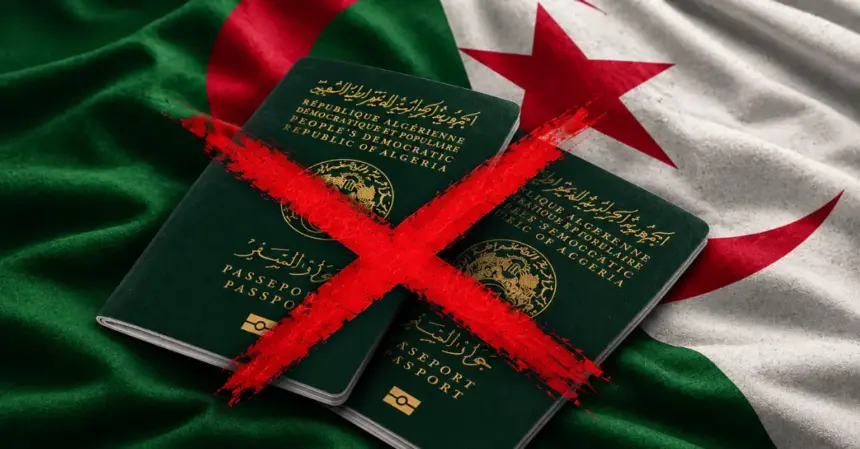
In September 2024, the Algerian government announced the immediate reinstatement of visas for all foreign nationals holding a Moroccan passport, ending nearly two decades of free movement established in 2005. The decision was justified by an official statement citing “organized crime networks,” “drug trafficking,” and accusations of “espionage” — a particularly harsh tone for a measure presented as purely administrative.
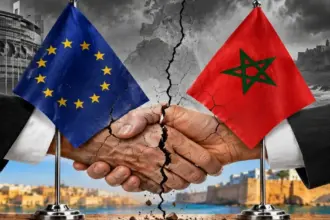
What stands out in this statement is less the measure itself than its wording: Algiers asserts that Morocco “bears full responsibility” for the deterioration of relations, a narrative repeated since the severing of diplomatic ties in August 2021. Given this precedent set by Algiers itself, it becomes logical for Morocco to apply, on its side, an equally strict visa policy.
Owning property or a business, a right denied to Moroccans in Algeria
Beyond the visa issue, an entire branch of Algerian economic law treats Moroccan nationals differently. According to several comparative legal analyses, Moroccans established in Algeria face, barring exceptional exemptions, a ban on property ownership and restrictions on conducting business activities.
The contrast is striking with Morocco, where legislation broadly opens access to real estate ownership to any foreigner, regardless of nationality, with no reciprocity requirement. This legal imbalance reinforces, on the Moroccan side, the sense that caution remains warranted in managing flows coming from Algeria:
- De facto ban on property ownership for Moroccan nationals in Algeria, except in rare exemptions.
- Restrictions on conducting business and entrepreneurial activities.
- Lack of reciprocity, while Morocco imposes no comparable limit on Algerians wishing to invest or settle.
- A decree expropriating Moroccan diplomatic property, cited by the press as evidence of a climate of permanent distrust between the two administrations.
A climate fueled daily by Algerian state media
The tension isn’t limited to legal texts. Algeria’s public media discourse repeats, statement after statement, a resolutely accusatory vocabulary toward the Kingdom: accusations of espionage, complicity with foreign intelligence services, and a direct threat to national security. This rhetoric, echoed unfiltered by state media, sustains a climate in which Morocco is continuously portrayed as a source of danger rather than a regional partner.
On the other side of the closed border, this daily drumbeat contrasts with Morocco’s official stance, which has largely chosen restraint in the face of successive Algerian measures, without systematic reciprocity on visas or property rights — until now.
A rupture that goes beyond a simple disagreement
The severing of diplomatic relations in August 2021 remains the tipping point. Since then, every bilateral issue — visas, real estate, airspace, economic cooperation — has been instrumentalized in a single direction: that of Algerian hardening. The land border, closed since 1994, has never reopened, but it is indeed the post-2021 period that saw Algiers multiply its harshest unilateral measures, from reinstating the visa to closing its airspace to Moroccan planes.
From experience, what sets this sequence apart from previous Morocco-Algeria crises is its duration and systematization: this is no longer an isolated incident, but a sustained policy, year after year, affecting travelers, entrepreneurs, and diplomatic property alike. In this context, Morocco’s introduction of a visa requirement appears less like a provocation than a simple alignment with the logic already applied by Algiers.
The security and migration context, a real but shared issue
Beyond the sheer diplomatic power struggle, the visa question also fits into a regional migration context that Morocco cannot ignore. Like most Mediterranean-rim countries, the Kingdom manages irregular migration flows passing through North Africa toward Europe, a phenomenon documented across the whole region and affecting nationals of many countries. Requiring a visa, with verification of return guarantees (ticket, reservation, financial means), remains a classic migration control tool used by nearly every country in the world.
On the strictly security front, it’s also worth recalling that Algeria itself went through, during the 1990s, a decade of terrorist violence that left a lasting mark on the region and reinforced, in both countries, a culture of heightened border control. This past partly explains why security vigilance remains a shared concern for both Algiers and Rabat, each on their own side of the closed border.
Algerian support for Polisario armed militias
There’s one subject that no one on the Moroccan side handles with kid gloves: Algeria has hosted and armed the Polisario Front for over fifty years, comfortably settled on its own soil, in the Tindouf camps. Not discreet or deniable support: an openly assumed sponsorship, funded and sustained since the 1970s, with recent help from Iran, while Rabat builds roads, ports, and cities in a territory it considers its own.
For Morocco, this isn’t just one more diplomatic dispute added to the pile: it’s the issue that explains everything else. How can one calmly discuss open borders or visa facilitation with a neighbor that hosts, on its own territory, the politico-military structure whose stated goal is to fragment the Kingdom? This question alone is enough to justify a distrust that is nothing new and won’t ease as long as Algiers continues to present this support as a noble cause rather than what it’s perceived as in Rabat: direct interference in Moroccan territorial integrity.
Why major global events reinforce this requirement
Morocco is no longer just a regional tourist destination: it’s a host country for major sporting events, with the Africa Cup of Nations held in 2025 and, above all, the 2030 World Cup, co-hosted with Spain and Portugal. This scale radically changes the security equation.
Welcoming millions of visitors along with the international media attention that comes with such an event requires a significantly stricter level of entry control, regardless of a traveler’s nationality. Morocco already anticipated this during AFCON 2025, imposing an electronic travel authorization (AEVM) on eight countries, including Algeria, for the entire duration of the competition — proof that Rabat views entry screening as a security imperative, not merely a diplomatic matter.
In this context, maintaining a visa requirement for Algerians and Franco-Algerian dual nationals isn’t just a response to deteriorating bilateral relations: it’s also a logical precaution for a country about to be scrutinized by the entire world, in a regional climate where intelligence, the movement of people, and the security of major gatherings have become top priorities for any host nation.
What this requirement changes in practice
For a traveler or a dual national, the consequences are very concrete:
- A Moroccan national must now obtain a visa before any trip to Algeria, which wasn’t the case before September 2024.
- A Moroccan wishing to invest, start a business, or buy property in Algeria faces restrictions that Algerians don’t encounter symmetrically in Morocco.
- Direct flight connections remain suspended, forcing travelers to transit through a third country in both directions.
- As the 2030 World Cup approaches, entry screening into Morocco is expected to remain strict for all nationalities subject to a visa requirement.
FAQ
Since when has Algeria required a visa from Moroccans?
Since September 26, 2024, the date on which the Algerian government announced the immediate reinstatement of visas for all Moroccan passport holders.
Can Moroccans buy real estate in Algeria?
Barring exceptional exemptions, property ownership rights are denied to them, unlike Morocco, which opens this access to all foreigners with no reciprocity requirement.
Why does Morocco maintain a visa requirement for Algerians ahead of the 2030 World Cup?
Hosting an event of this scale requires stricter entry control, a principle already applied during AFCON 2025 with the electronic travel authorization.
Has Morocco taken symmetrical measures against Algeria?
No, Rabat has largely opted for restraint in the face of successive Algerian measures, without systematic reciprocity on visas or property rights.