In a recently released long-form interview, Amir Benmahjoub, Managing Director of Harmattan AI in Morocco, lays out the company’s bet on the Kingdom. The conversation comes shortly after the announcements at the Marrakech Air Show in October 2026, where Harmattan AI signed a letter of intent with Morocco’s Administration of National Defense to develop and produce IRIFI locally, an autonomous deep-strike system announced with a range of up to 2,000 km. This move builds on a strategic partnership signed in June 2026 with the Royal Armed Forces, which provides for an engineering center in Rabat and a factory in the Nouaceur industrial zone.
Founded in 2024 by Franco-Moroccan entrepreneur Mouad M’Ghari, Harmattan AI reached a valuation of $1.4 billion after a $200 million funding round led in particular by Dassault Aviation in January 2026. The remarks of Benmahjoub, a former Palantir executive and École Polytechnique graduate, offer a precise look at how a young defense tech company is trying to turn the lessons of Ukraine into industrial and technological capabilities rooted in Morocco.
A career path focused on autonomous systems
Born in Rabat in 1995, Benmahjoub completed most of his schooling in Morocco before moving to France for preparatory classes and then École Polytechnique. A short period of military service during his studies exposed him to the rigor of military processes and to technologies stemming from defense. After working in AI and data consulting, he spent more than seven years at Palantir, deployed in France, the United Kingdom and the Middle East on civilian and defense projects. That period convinced him that fully autonomous processes, already visible in mature software deployments, would also take hold in the military domain.
In the interview, he explains that his move from Palantir to Harmattan reflects a conviction about the future of warfare: coordinated robotic systems, where humans prepare and validate missions rather than piloting them in real time. The Moroccan project fits this logic, with the ambition of stimulating a local defense industrial base while serving as a lever for the company’s international development.
From cognitive saturation to robot coordination
Benmahjoub describes a break with the paradigms of past decades. Historically, the ratio remained close to one operator per system. Ukraine accelerated the shift: cost-controlled, mass-produced drones came up against far more expensive interception systems. Attrition becomes an operational strategy. The factory itself is presented as a modular weapon, able to be deployed quickly to reduce concentration risks.
Saturation is not only quantitative. It is cognitive: a commander used to handling a few threats over several minutes must now manage hundreds within seconds. Artificial intelligence, born in the civilian world, shortens the observe-orient-decide-act cycle. Command and control software prioritizes alerts, and onboard models enable autonomous execution when communications are jammed. Coordination between robots (reconnaissance, jamming, strike) replaces individual instruction. Humans define the rules and edge cases in advance, and the systems then adapt in the field.
This vision explains Harmattan’s products, from Gobi (a small-drone kinetic interceptor stored in a box and launched within seconds) to IRIFI, designed for deep strikes without continuous GNSS dependence and with optical terminal guidance. The company aims to be vertically integrated, mastering software, certain sensors and subcomponents, as well as production capacity, in order to offer real sovereignty rather than a simple supply of equipment.
Morocco’s strengths and concrete sovereignty
For Benmahjoub, the choice of Morocco rests on several converging factors. The country has a pool of talent in software and in the automotive and aerospace industries, which already know how to produce complex systems at scale. The Royal Armed Forces are professional and provide useful operational feedback. The geography allows for testing. Ties with Europe, the United States and certain Middle Eastern countries facilitate partnerships. Royal directives and emerging regulatory frameworks support a local defense industry.
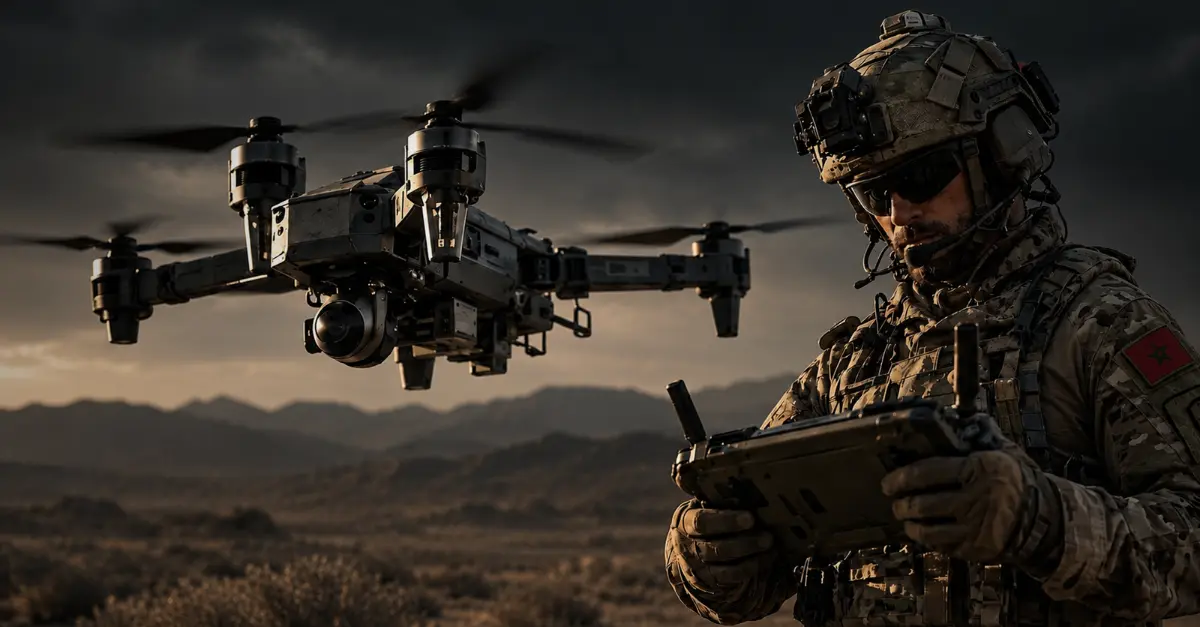
Sovereignty, in his view, is measured by what remains if the company were to disappear: Moroccan engineers capable of designing, a local supply chain stimulated from the design phase, and exportable products. IRIFI illustrates this logic. It is not a final assembly operation: the development and production of critical building blocks take place in Morocco, mostly by local teams. The goal is also to generate export revenue in foreign currency. The company aims for at least a thousand direct and indirect jobs by 2030.
Key figures on the Moroccan expansion
- IRIFI letter of intent signed on October 7, 2026 at the Marrakech Air Show.
- Announced IRIFI range: up to 2,000 km, GNSS-independent navigation.
- Engineering center in Rabat and a factory planned in Nouaceur.
- Target: at least 1,000 direct and indirect jobs by 2030.
- Harmattan AI valuation: $1.4 billion (January 2026).
Recruitment, culture and limits of the model
Benmahjoub stresses recruitment as a priority. The company is looking for Moroccan engineers, members of the diaspora and international profiles willing to relocate. The culture it promotes is built on ambition, maximum ownership and non-linear career paths based on impact. He acknowledges that some candidates turn down the defense sector for personal reasons, while others see it as a way to contribute to national sovereignty in a tense geopolitical environment.
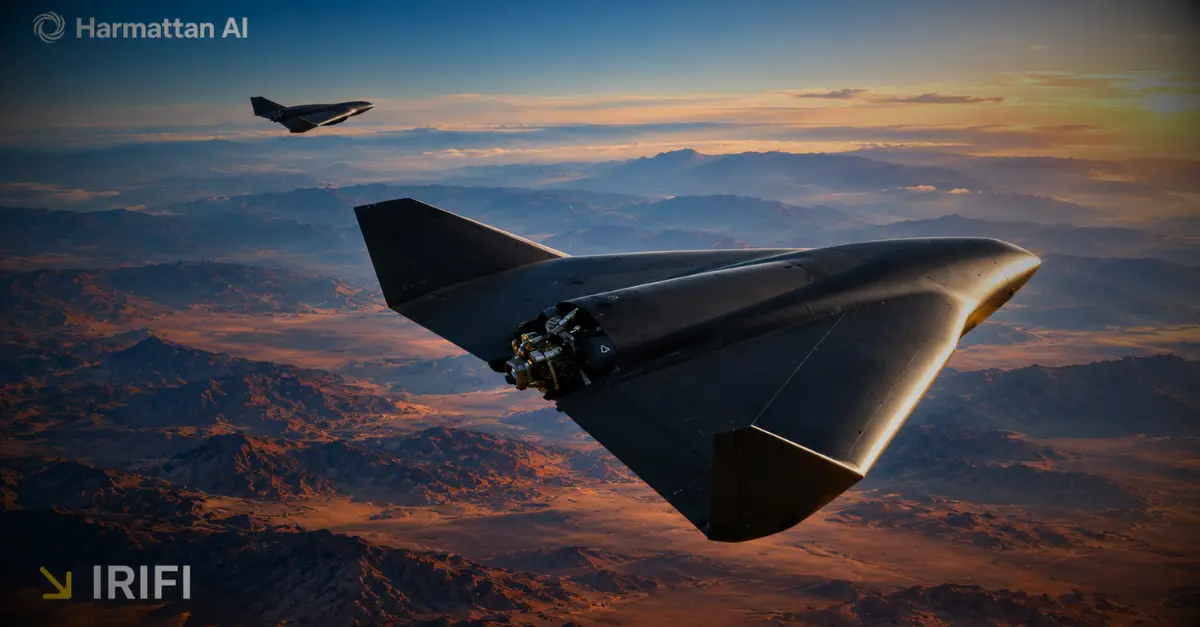
Many challenges remain. IRIFI’s technical performance is announced by the company and has not yet been the subject of detailed public independent validation. Mass production at controlled cost, integration with the armed forces’ existing systems and the adaptation of doctrines will take time. Integrated verticality offers a sovereignty advantage, but it also demands solid industrial mastery. In the Mediterranean basin, where tensions persist and the proliferation of cheap drones is reshaping balances of power, a state’s ability to produce and coordinate its own autonomous systems is becoming a factor of deterrence and strategic autonomy.
Harmattan AI is not the only player. Other Moroccan programs and international partnerships coexist. The company’s approach, starting from a vision of an autonomous robotic army rather than incrementally improving what exists, and anchoring R&D and production locally, deserves to be followed for what it reveals about ongoing shifts: the move from pure technological superiority to a combination of scalable production, software autonomy and industrial sovereignty.
FAQ
What exactly is IRIFI?
An autonomous deep-strike system announced with a range of up to 2,000 km, designed to operate without continuous human control after mission validation and without permanent dependence on satellite signals. Its development and production are planned in Morocco.
Why is Harmattan AI setting up in Morocco rather than elsewhere?
For the local and diaspora talent, the automotive and aerospace industrial base, the professionalism of the Royal Armed Forces, the available test ranges and the country’s geopolitical positioning, as part of a sovereignty and export strategy.
What is the role of humans in these autonomous systems?
Humans prepare and validate the mission, define the rules and edge cases, and train the systems. Execution can then be carried out autonomously, particularly when communications are jammed.
What are Harmattan AI’s valuation and funding?
$1.4 billion after a $200 million round in January 2026, led in particular by Dassault Aviation.