
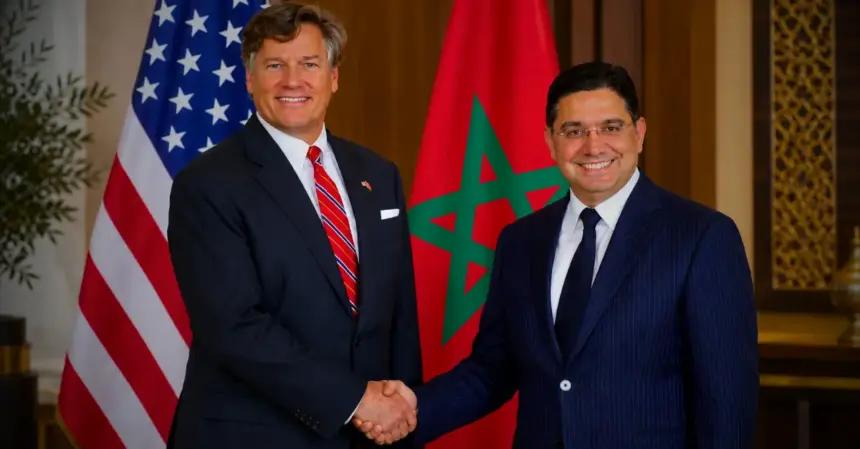
Christopher Landau, US Deputy Secretary of State, reaffirmed Washington’s commitment to the development of the Sahara region under the sovereignty of the Kingdom of Morocco, following a meeting with Morocco’s Minister of Foreign Affairs, African Cooperation and Moroccans Abroad, Nasser Bourita.
Speaking to the press, the senior American official referred to a centuries-old friendship between the two countries and a shared vision for the development of the Sahara region, built on strengthened cooperation under Moroccan sovereignty. A formulation that confirms, once again, the steady alignment of the US administration with Rabat’s position since the initial recognition in 2020.
A clear call to turn the page
What stands out most in this statement is the resolve in Landau’s tone. He noted that the United States looks forward to working with Morocco and other concerned parties to resolve this conflict once and for all. A way for Washington to signal that the time for waiting is over.
The Deputy Secretary of State did not mince words about the length of the dispute either. He lamented that a regional dossier could drag on for more than fifty years, before adding that this status quo cannot continue. That single line sums up the growing impatience within the US administration, which wants to see this file move forward concretely in the months ahead.
A bilateral relationship at its peak
Beyond the Sahara question, the meeting between the two men offered a clear read on the state of relations between Rabat and Washington. Landau reaffirmed that the longstanding friendship between the two capitals would continue going forward, and welcomed the fact that relations between the United States and the Kingdom of Morocco are today at their best level ever.
These words come at a time when the partnership between the two countries extends well beyond the Saharan dossier, spanning security cooperation, the signing of the Artemis Accords, and prospects for American investment in the southern provinces. Here are the key takeaways from this meeting:
- Official reaffirmation of the US commitment to developing the Sahara under Moroccan sovereignty
- Explicit call to resolve the dispute once and for all, after more than fifty years
- The status quo described as untenable by the senior American official
- Bilateral relations described as at their best level ever between Rabat and Washington
- The meeting was held on the sidelines of the 81st session of the UN General Assembly in New York
The UN backdrop giving weight to these statements
This position did not appear out of nowhere. It follows on from Resolution 2797, adopted by the Security Council on October 31, 2025, which recognizes Morocco’s autonomy plan as the reference framework for negotiations. MINURSO’s mandate, the UN mission present on the ground, is set to expire on October 31, 2026, placing the coming weeks under the shadow of a new diplomatic milestone at the Security Council. Landau’s remarks therefore carry particular weight just weeks ahead of that deadline.
This reading of the file, championed by Washington and broadly shared by Rabat, is not consensual on the international stage: Algeria and the Polisario Front continue to contest this framework, a point of friction worth watching ahead of the October vote.
FAQ
Who met with Nasser Bourita in New York?
US Deputy Secretary of State Christopher Landau, on the sidelines of the 81st session of the UN General Assembly.
What is the US position on Moroccan sovereignty over the Sahara?
Washington reaffirms its commitment to developing the region under Moroccan sovereignty and calls for resolving the dispute once and for all.
How long has this regional dispute lasted?
More than fifty years, a status quo that Christopher Landau now considers untenable.
Where do US-Morocco relations stand today?
According to Landau, they are today at their best level ever.