

Foum El Oued is not just a postcard image of the Moroccan Sahara. It has become, over the past decade, one of the most revealing convergence points of the economic transformation under way in the southern provinces.
I looked into this beach for a simple reason: at first glance anecdotal, it condenses nearly all of the region’s stakes — urban planning, energy, tourism, port logistics — within a few kilometers.
A beach shaped by the desert and the Atlantic
Foum El Oued beach has received the international “Blue Flag” label for the eighteenth consecutive year, awarded by the Mohammed VI Foundation for Environmental Protection and the Foundation for Environmental Education. This continuity — eighteen years without interruption — is not a protocol detail. The Blue Flag rewards compliance with bathing-water quality standards and environmental management of the site, based on an audit renewed every year.
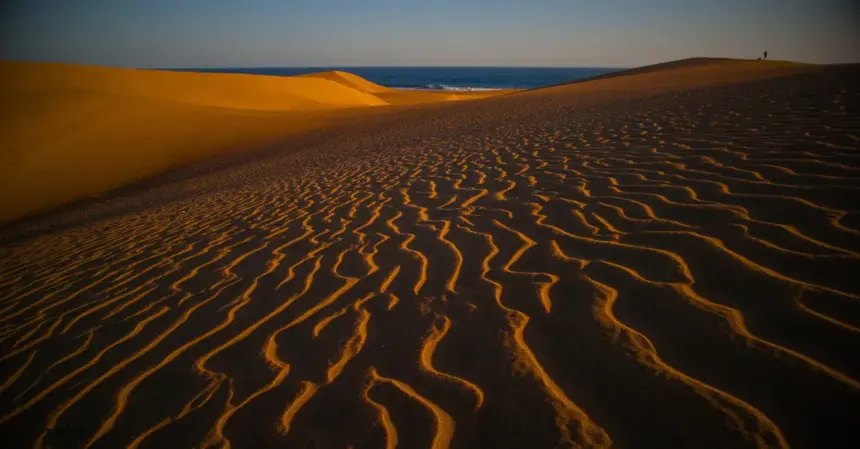
Stretching over roughly seven kilometers, the beach opens onto the Atlantic Ocean and, since the start of each summer season, has been the site of regular clean-up and environmental awareness operations. Distance estimates from downtown Laâyoune vary slightly by source — between 20 and 25 kilometers, depending on whether the measurement starts from the administrative center or the outskirts — but all agree on one point: the immediate proximity to the regional capital, which makes Foum El Oued a daily summer destination rather than a distant vacation spot.
The summer gathering place for Laâyoune’s residents
That is precisely the site’s appeal. Unlike other seaside resorts in the Kingdom designed primarily for international tourism, Foum El Oued remains above all a living space for the local population. Every year, the beach is one of the main places of relaxation for the residents of Laâyoune, according to young visitors interviewed on site. Residents of Laâyoune, Es-Semara, nearby towns and the southern provinces more broadly flock there to share convivial moments with family or friends.
This largely domestic turnout is also explained by the climate. During periods of intense heat, this site with its temperate climate becomes a genuine refuge for those seeking coolness, the sea breeze and a break from urban bustle. The thermal contrast between central Laâyoune, exposed to continental heat, and this coastal strip cooled by Atlantic trade winds, largely explains the site’s steady appeal.
A reception setup that has been professionalized
What stands out when comparing successive reports on Foum El Oued over the past decade is the gradual upgrading of its infrastructure. According to the beach’s director, Slimane Habadi, the municipality has carried out the rehabilitation and development of basic infrastructure, along with strengthened swimming-safety measures.
Facilities currently recorded at the site:
- Signage and public lighting
- Parking areas and surveillance cameras
- Facilities adapted for people with reduced mobility
- Lifeguard watchtowers and first-aid posts
- Dispensaries and sanitary blocks
- Children’s play areas
This list, communicated by local authorities to the MAP news agency, reflects a deliberate effort to structure a reception experience that goes beyond a simple wild beach, moving closer to a proper seaside resort. Beyond swimming, the site is also known for water sports and sport fishing, with an annual competition that draws experienced practitioners to a coastline known for the quality of its waves.
The major works reshaping the surrounding area
Foum El Oued is no longer confined to its role as a beach. It is today the stage for one of the most significant construction projects in the Laâyoune-Sakia El Hamra region. King Mohammed VI launched, in the municipality of Foum El Oued, work on the Foum El Oued-Laâyoune technopole, a knowledge and innovation hub intended to support the development of the southern provinces. This project, comprising a university, a training center and an elite high school, represents a budget of two billion dirhams.
The energy component is no less structural. A wind farm with a capacity of 50.6 megawatts, comprising twenty-two turbines 80 meters tall, has been operating at Foum El Oued since 2013, as part of a regional ambition targeting nearly 950 megawatts of wind power capacity across Laâyoune-Sakia El Hamra — roughly half of the country’s total wind power output. That figure is worth underlining: a single region would eventually account for half of the Kingdom’s wind power capacity.
On the connectivity front, one structure stands out among the ongoing projects. The Sakia El Hamra bridge, described as the largest of its kind in Africa with foundations reaching fifty meters deep, is meant to link the city of Laâyoune to Foum El Oued beach, easing traffic congestion and improving connections between different areas of the region. This project is part of a broader set of coastal protection works and the creation of a modern waterfront promenade, intended to turn the area into an integrated tourist destination combining preserved nature with modern infrastructure.
These investments are not isolated. The port of Laâyoune, historically centered on phosphate exports, is now diversifying its activities with a growing coastal and deep-sea fishing sector, driven by the proliferation of seafood processing units in the industrial zone.
Tourism as a strategic bet for the southern provinces
These local projects are part of a much larger investment program. Close to ten billion dollars have been committed to strengthening growth drivers such as fishing, agriculture, phosphates and tourism in the southern provinces, alongside support for private investment and job creation. Within this framework, seaside tourism is not a mere side note: it is one of four pillars identified to economically anchor the region.
That said, the scale of this momentum should be put into perspective compared with other tourist hubs in the Kingdom. Hotel capacity around Laâyoune and Foum El Oued remains, in absolute terms, modest compared with Agadir or Marrakech — mid-sized hotel and resort projects, carried out by regional developers, have gradually expanded the offering since the mid-2010s. The goal, then, is not to compete with Morocco’s historic seaside resorts, but to build an offering suited to a mostly national and regional clientele, while laying the groundwork for an international opening that current port and air connectivity does not yet fully allow.
What Foum El Oued reveals about the southern provinces in the making
What is playing out at Foum El Oued goes beyond the question of a pleasant beach twenty minutes from town. It is a condensed version of the ambitions displayed by Rabat for the southern provinces: diversifying an economy long dependent on phosphates and fishing, building university and technology hubs far from the Casablanca-Rabat axis, and turning the Saharan Atlantic coastline into a genuine tourism asset. What happens next will depend as much on how quickly the ongoing projects — bridge, technopole, port expansion — are carried out as on other factors shaping the region’s broader trajectory.
FAQ
How far is Foum El Oued from Laâyoune?
About 20 to 25 kilometers, depending on the source and the starting point within the city.
Why did Foum El Oued receive the Blue Flag label?
For the quality of its bathing waters and the site’s environmental management, certified annually through an international audit, for eighteen consecutive years according to the latest available figures.
What major projects are underway near Foum El Oued?
A university technopole, a bridge linking Laâyoune to the beach, the expansion of the port of Laâyoune, and the development of a regional wind farm.
Is Foum El Oued family-friendly?
Yes: the beach has first-aid posts, sanitary blocks, children’s play areas and facilities accessible to people with reduced mobility.