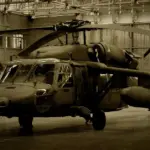

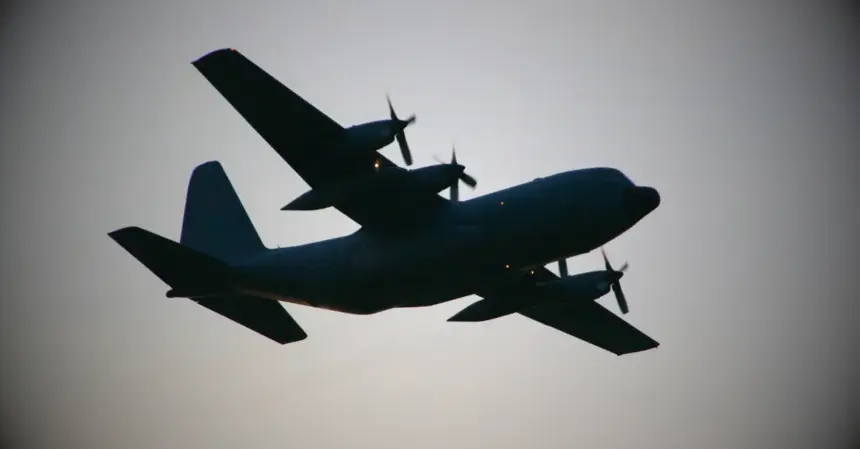
Inside a L3Harris Technologies hangar in Waco, Texas, three C-130H airframes wearing the colors of the Royal Moroccan Air Force (RMAF) tell a story that goes well beyond routine maintenance: a kingdom choosing to extend the life of its transport fleet rather than replace it, methodically pursuing that strategy for more than a decade.
The first aircraft, already through inspection and repair, has received a new standby instrument and a digital engine display. The second has just touched down on the tarmac. The third, expected before year’s end, will leave with something far more dramatic: a fully digital cockpit erasing decades of analog instrumentation.
A contract that took a year to become reality
It all began with a quiet signature on July 3, 2025, from Morocco’s National Defense Administration. L3Harris didn’t make the deal public until eleven days later, at a ceremony in Rabat where the American company put forward two of its senior executives — one leading its Intelligence, Surveillance and Reconnaissance division, the other running the Waco facility. On the diplomatic side, the U.S. representation in Rabat was quick to hail the event as another milestone in defense cooperation between the two countries.
At the time, L3Harris leadership was careful to frame the deal not as a one-off service contract, but as the start of a long-term relationship, one expected to grow through incremental upgrades over the years.
That rhetoric took fifteen months to turn into tangible progress. Only in late August 2026 did L3Harris confirm it had completed inspections on the first Moroccan aircraft in the program — a milestone the company presents as proof the project has moved from paperwork to hangar floor. That same month, the RMAF announced the arrival of a second C-130H at the Texas site, stressing compliance with the strictest international quality and maintenance standards. A third aircraft is due to join the line before the end of 2026, and it will undergo the most extensive transformation of the three.
What’s actually happening under the hood
Nothing about this program is cosmetic. The contract covers structural modifications, programmed depot maintenance, engine overhauls, and the full logistics support needed to keep aging airframes flying well past their original service horizon.
The most visible change is in the cockpit. On the first aircraft, the update was limited to a new standby instrument and a digital engine display — modest on paper, but enough to replace failure-prone analog gauges with reliable digital readouts, even at night or in low visibility. The third aircraft will go much further, with a fully digitized instrument panel comparable to what’s now standard on modern transport aircraft, while leaving the airframe, engines, and mission systems largely untouched.
That philosophy — modernize rather than replace — sits at the heart of L3Harris’s pitch, in Morocco and with most C-130 operators worldwide. The logic is straightforward: upgrading an existing airframe costs far less than buying new, and it’s much faster. Most C-130H operators wanting a brand-new aircraft today face years of waiting for a C-130J Super Hercules to reach the front of Lockheed Martin’s production line.
L3Harris isn’t improvising here. The company points to more than forty years of C-130 modernization work for the U.S. Air Force, the U.S. Coast Guard, and various international customers, and currently leads one of the largest avionics overhauls in the program’s history: Increment 2 of the Air Force’s Avionics Modernization Program (AMP). The firm also highlights a first of its kind: successfully integrating the Collins APS-7000 digital autopilot on a C-130H — expertise being applied directly to the all-glass cockpit promised for Morocco’s third aircraft. This kind of integration carries real risk. Engineers must get modern digital systems talking to wiring, structures, and mission software designed half a century ago, without disturbing flight-critical systems that have operated safely for decades. Get it wrong, and the aircraft sits grounded for months. Get it right, and a Cold War–era Hercules can keep flying reliably into 2040.
A fleet that has passed the half-century mark
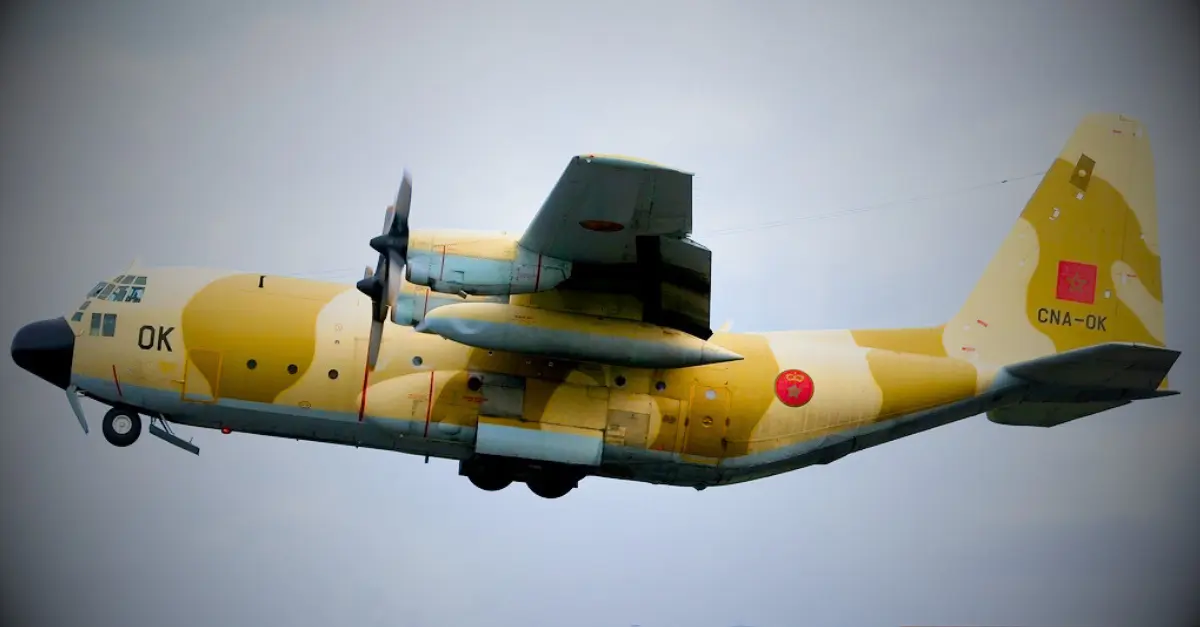
This program touches the backbone of Moroccan military transport. The RMAF currently operates 14 C-130H Hercules and two KC-130H tankers, backed by a smaller transport fleet of C-27J Spartans, CN-235s, and a handful of aging Do 28 utility aircraft. Morocco’s C-130H airframes have logged between 43 and more than 50 years of service — well past the point where most comparable transport fleets worldwide have been retired.
Key milestones in the program:
- July 3, 2025 — Contract signed between Morocco and L3Harris
- July 14, 2025 — Official announcement in Rabat
- Late August 2026 — First aircraft inspected, second arrives at Waco
- Expected end of 2026 — Third aircraft integrated with its digital cockpit
- 2029 — Targeted completion of the modernization program
This choice to extend rather than replace is no accident: replacing fourteen tactical transport aircraft outright would represent a massive budgetary burden, competing directly with every other defense priority the kingdom has. Moroccan pilots are reported to have evaluated Embraer’s C-390 Millennium, and future acquisition of newer C-130J airframes remains a topic of discussion in some circles. But no public documentation confirms that funding has been committed to either path. For now, the L3Harris contract stands as Rabat’s only concrete, funded answer for preserving its Hercules capability — not a stopgap while waiting on something else.
One piece of a much larger defense puzzle
This program didn’t emerge in isolation. It’s part of a broader buildup in Moroccan defense spending, underpinned by an estimated $6.5 billion budget for 2024 — a figure that varies depending on which tracking organization’s methodology is used, since Morocco doesn’t publish a single consolidated line item for military spending. Whatever the exact number, the upward trend is hardly in dispute.
As a major non-NATO U.S. ally, the kingdom holds $8.545 billion in active contracts under the American Foreign Military Sales (FMS) program. That figure spans 25 F-16C/D Block 72 fighters, 36 AH-64E Apache attack helicopters, three CH-47D Chinooks, HIMARS rocket systems, and Harpoon and Sidewinder missiles, among other equipment. Compared to these headline-grabbing acquisitions, the C-130 contract draws far less attention — but it matters just as much, if not more, for day-to-day operational readiness: it’s the transport aircraft that move the troops, fuel, and equipment those fighters and attack helicopters depend on.
The Waco effort isn’t happening in an industrial vacuum, either. Since October 15, 2025, Maintenance Aero Maroc (MAM) has been building a maintenance hangar at Benslimane airport, aimed at bringing some of this heavy work in-house. The project pairs Lockheed Martin — original manufacturer of both the F-16 and the C-130 — with Belgian MRO specialist Sabena Engineering (part of the Orizio group), alongside MEDZ, the infrastructure development arm of Morocco’s state investment fund, the Caisse de Dépôt et de Gestion. The site, expected to become operational in the second half of 2026, aims to become a regional maintenance, repair and overhaul hub, starting precisely with Morocco’s F-16s and C-130s.
A relationship with the Hercules that predates this deal
Morocco’s ties to this aircraft go back well before the current contract. On July 18, 2019, Rabat requested two additional C-130Hs through the U.S. Excess Defense Articles program, which allows Washington to transfer surplus military equipment to allied nations at reduced or minimal cost. The U.S. approved the transfer in June 2020, delivering both aircraft along with several fuel pylons and tanks, for a total of roughly $60.8 million — a fraction of what two new aircraft would have cost.
That episode captures a recurring pattern in how Morocco has managed its Hercules fleet: opportunistically acquiring available airframes at low cost, then investing steadily to keep them flying well beyond typical retirement thresholds. The L3Harris contract is simply the most extensive chapter yet in that same approach.
Globally, the C-130 remains a mainstay of military transport: Lockheed Martin has delivered more than 2,700 since production began in the 1950s, and the type serves in more than 70 countries. Its versatility — tactical transport, humanitarian aid, medical evacuation, weather reconnaissance — makes it a daily workhorse for the RMAF, capable of moving troops one week, delivering earthquake relief the next, and supporting counter-narcotics operations after that.
The program’s next public checkpoint comes at the Marrakech Air Show, running October 7–10, 2026, where L3Harris is listed among the main sponsors. If the current timeline holds, Morocco should by then have one modernized Hercules back in service, a second undergoing work at Waco, and a third about to begin the most extensive of the three overhauls. Whatever else changes in Moroccan military aviation in the years ahead — new fighters, new attack helicopters, or eventually new transport aircraft — the aging C-130Hs now cycling through Texas look set to remain the backbone of Morocco’s military airlift for a long time to come.
FAQ
How many Moroccan C-130s are covered by the modernization program?
The entire fleet: 14 C-130H Hercules aircraft and two KC-130H tankers operated by the Royal Moroccan Air Force.
When is the program expected to finish?
Completion is targeted for 2029, with aircraft returning to service progressively starting in late 2026.
Why modernize instead of buying new aircraft?
Because it’s significantly cheaper and faster than acquiring new C-130Js, which currently involve multi-year waits on Lockheed Martin’s production line.
Is this program standalone or part of a broader defense investment push?
It’s part of a larger effort that includes F-16 Block 72 fighters, Apache attack helicopters, and a new maintenance hub at Benslimane involving Lockheed Martin and Sabena Engineering.