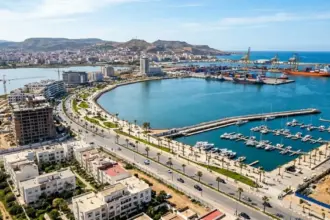
With nearly 694,000 passengers welcomed between January and July 2026, a 3.44% year-on-year increase according to the latest ONDA figures, this airfield sitting 24 kilometers south of Nador is no longer the minor secondary terminal it was seen as a decade ago. It has become the main gateway to the eastern Rif, wedged between the Marchica lagoon and the slopes of Mount Gourougou.
I still remember my first landing there, a spring morning when the pilot traced the coastline before touching down. From the window, the lagoon looked like a blue-green mirror set between dunes and mountains. That kind of first impression sticks with you, and it goes a long way toward explaining why more and more European travelers are now choosing this destination over Morocco’s already-saturated classics.
A strategic airport for the entire eastern Rif
Operated by Airports of Morocco (formerly ONDA), Nador Al Aroui carries the IATA code NDR and the ICAO code GMMW. It ranks as the busiest airport in Morocco’s Oriental region, well ahead of Oujda-Angad. That’s no accident: its location between the Mediterranean and the Rif massif makes it a natural crossing point for two quite different groups of travelers.
On one side, the Moroccan diaspora from northern Europe (Belgium, the Netherlands, Germany) returning each summer to see family. On the other, a growing wave of European tourists drawn in by cheap fares from France. I’ve seen deals under 20 euros one-way from Marseille or Montpellier, which is hard to beat for a destination this different from the usual.
The airport also serves as a base for Air Arabia Maroc, which guarantees regular service and competitive fares year-round, with an obvious peak in summer.
An infrastructure built to absorb seasonal surges
The current terminal was sized to handle summer crowds without becoming a bottleneck. Check-in counters, security, shops, cafés, and car-rental desks are all grouped into a compact, reasonably efficient space. It’s obviously not a hub on the scale of Casablanca, but efficiency wins out over prestige here, and for a traveler eager to reach the beach or the mountain trails, that’s exactly what’s needed.
Why passenger traffic is really taking off in 2026
The numbers speak for themselves. Over the first seven months of 2026, the airport recorded 5,076 flight movements, up from 4,931 a year earlier, a 2.94% increase. July alone saw more than 142,000 passengers pass through. That points to momentum well beyond the usual diaspora effect.
Several factors explain this acceleration, as I see it after following the destination’s evolution over the past few years:
- The gradual opening of new direct routes from smaller French cities, in addition to Paris and Marseille
- A growing number of low-cost offers that are opening up a region long seen as under the radar
- Development of the Marchica lagoon tourism project, which is drawing beach-focused visitors alongside traditional ones
- Rising interest in adventure tourism in the Rif, with hikers discovering trails that still see little traffic
- Better ground transport between the airport and the city, thanks to the Vectalia bus line running since 2023
That last point deserves attention, because it genuinely changes the traveler’s experience. Before this direct link existed, getting from the tarmac to Nador could feel like a bit of an ordeal. Today, a simple bus ticket gets you into the city center in about twenty minutes, no haggling over a taxi fare required.
The key role of ground connections
An airport, however well served by air, is only as good as its ability to connect travelers to the territory around it. On that front, Nador Al Aroui has made real progress. The parking lot, with capacity for 300 vehicles at a modest flat rate, rounds out the offering for visitors who’d rather rent a car and explore the Rif’s mountain roads or the coastline toward Saïdia at their own pace.
I’d strongly recommend renting a car if your goal is to get off the usual tourist track, because some of the best viewpoints over the lagoon are only reachable by private vehicle.
A springboard for beach and cultural tourism
This region’s great strength is its diversity. Within less than an hour’s drive from the airport, you go from the fine sandy beaches of the Marchica lagoon to the busy streets of old Nador, then on to the foothills of Mount Gourougou for hiking enthusiasts. Few Moroccan destinations offer such a quick shortcut between sea and mountain.
The Marchica lagoon, one of the largest in the Mediterranean, has been the subject of an ambitious ecological and seaside development project backed by Moroccan authorities for several years now. Marinas, waterfront promenades, upscale hotels: the stated goal is clearly to turn the area into a credible alternative to already-established resort towns like Agadir or Saïdia.
For my part, I particularly loved the evening light over the lagoon, when the fishing boats come in and the city starts winding up for dinner. It’s a simple moment, but one that stays with you long after the trip.
Economic benefits for local communities
The impact isn’t limited to leisure tourism. Rising air traffic is generating direct economic spillover for the whole region: hospitality, food service, local transport, craftsmanship. Shopkeepers in downtown Nador confirm stronger summer footfall, partly tied to the growing flow of travelers passing through the airport.
This momentum is also indirectly benefiting the surrounding rural areas, where some ecotourism projects are starting to take shape around hiking and the discovery of local Berber heritage. This is exactly the kind of development I like to see emerge: gradual, locally rooted, and not disruptive to the land.
Comparing Nador with other airports in the Oriental region
It’s worth putting these numbers in perspective. Oujda-Angad airport remains a direct competitor in the region, but Nador Al Aroui keeps a clear lead in passenger volume. Errachidia airport, further south, is also seeing sustained growth according to ONDA’s latest reports, which shows that air connectivity across Morocco’s entire Oriental region is expanding, not just in Nador.
This broader regional momentum strengthens the destination’s credibility with European tour operators, who are now less hesitant to add the eastern Rif to their catalogs.
My take after several trips through this airport
I won’t pretend I wasn’t skeptical the first time I planned a Rif trek routing through Nador instead of Fez or Casablanca. The logistics worried me. Turned out the experience was far smoother than expected. The airport-to-city trip is quick, flights are affordable, and best of all, you skip the crowds of the busier hubs.
What I fully endorse is the simplicity-to-price ratio for anyone wanting to branch out across the region without burning hours on domestic connections. If I had to name a downside, it’s that the terminal’s food and service options are still modest compared to Morocco’s larger airports. But honestly, for a destination on the rise, that’s a minor trade-off against the time and money saved.
What to know before booking
Before planning your trip, keep in mind that summer remains the busiest season, with flights filling up fast and prices climbing accordingly. Booking outside of July-August, or several weeks in advance, remains the best strategy to catch the better fares while avoiding the crowds.
Also check the entry requirements: many nationalities benefit from visa-free entry for short stays, which makes planning a long weekend or a full week on the ground much simpler.
FAQ
Is Nador Al Aroui airport well connected from France?
Yes, several airlines including Air Arabia Maroc offer regular routes from cities like Paris, Marseille, and Montpellier, often at very competitive fares outside the summer peak.
How do you get from the airport to downtown Nador?
The Vectalia bus line has connected the terminal directly to central Nador since 2023. Taxis are also a quick option, as long as you agree on the fare before setting off.
What’s the best time to visit the region using this airport?
Spring and early fall offer pleasant weather and softer flight prices, while avoiding the peak-summer crowds around the Marchica lagoon.
Does the airport make it easy to reach the Rif’s hiking areas?
Yes, Mount Gourougou and several trails in the eastern Rif are reachable in under an hour’s drive from the airport, ideally with a rental car.