

On September 17, the US State Department notified Congress of a possible sale of 48 F-35As to Saudi Arabia, at an estimated value of $24.3 billion. The day before, in New York, Rabat and Tel Aviv had committed to upgrading their liaison offices to embassies. The two announcements have no official link, but I read them together, because they change the political parameters of a file that has long been stuck.
One clarification from the outset: to date, Washington has announced no authorization for Morocco. The Moroccan file remains a possible transaction, not a completed purchase.
An old option, a new context
Morocco’s interest in Lockheed Martin’s fighter is not new. Specialist outlets, starting with Military Africa, have reported since 2025 on the acquisition of 32 F-35As for between $17 billion and $18 billion, depending on the estimates. That sum would cover the aircraft, training, equipment and logistical support, and some outlets specify that it would be spread over roughly forty years. Neither government has confirmed these figures. I therefore treat them as estimates, not official data.
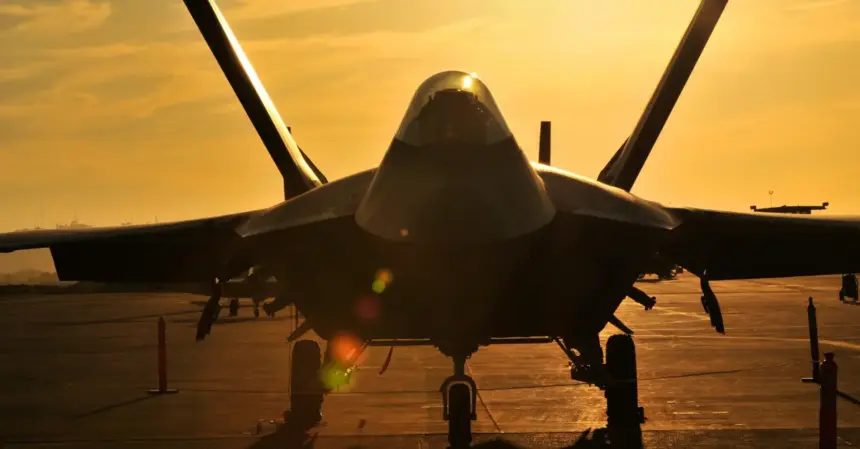
The F-35 is a stealth fighter known as a fifth-generation aircraft. Its low observability, its sensors and its ability to fuse battlefield data make it one of the most sought-after and most tightly controlled aircraft in the world. Washington strictly regulates its export, because it involves sensitive technologies.
What Washington has actually decided for Riyadh
The notification concerning Saudi Arabia covers 48 F-35As, 49 Pratt & Whitney F135 engines, communications equipment, simulators, training and spare parts. The State Department justifies the project by the need to strengthen the kingdom’s deterrence capabilities and its interoperability with US forces. It also states that the sale will not alter the regional military balance.
It is worth measuring the exact scope of this step:
- Congress has thirty days to review the notification and can try to block it through a joint resolution.
- Some lawmakers oppose it, fearing a technology leak to China because of Riyadh’s military and technological ties with Beijing.
- According to the Congressional Research Service, no arms sale has so far been stopped by this procedure. That guarantees nothing, however.
- Price, quantities and timing may still change during negotiations.
There is also a precedent that calls for caution. In 2020, the United Arab Emirates obtained a notification for F-35s, but Abu Dhabi suspended the talks at the end of 2021 over disagreements about the conditions imposed. A notification is therefore a green light in principle, not a delivery.
If the Saudi sale goes through, the kingdom would become the first Arab country to operate the F-35, and Israel would cease to be the aircraft’s only user in the Middle East. That is the point that matters to Rabat: if the United States agrees to widen access to an Arab partner, the very principle of a regional exception is weakened.
The Israeli factor and the relationship with Washington
The F-35 is not sold in the region without regard for Israel’s qualitative military edge, a principle Washington says it intends to preserve. Until now, Israeli reservations have been one of the main obstacles to any sale to an Arab state. In Morocco’s case, however, several specialist outlets report that Tel Aviv would not oppose the transaction, though no official position confirms it. I therefore stick to that wording.
The diplomatic calendar points in the same direction. On Wednesday, September 16, Nasser Bourita, Gideon Saar and the US ambassador to the United Nations, Mike Waltz, met in New York. According to a statement from Israel’s Foreign Ministry, the three countries committed to upgrading their missions to embassies and appointing ambassadors, without a precise timetable. Jerusalem also announced economic agreements before the end of 2026 and an expansion of direct flights. Morocco had not commented immediately.
It is worth remembering that the relationship had slowed markedly after the start of the Gaza war in October 2023. This announcement therefore marks a revival, in a regional context that remains tense.
Western Sahara in the background
The rapprochement of December 2020 rested on an exchange: US recognition of Moroccan sovereignty over Western Sahara on one side, and the resumption of relations with Israel on the other. Since then, Rabat has sought to consolidate internationally its autonomy plan as the framework for a definitive settlement of the dispute.
Within that framework, defense has become one of the pillars of the relationship with Washington. An F-35 would be not only a military tool: it would symbolize the level of political and technological trust the United States places in a partner. That also explains why the file draws attention well beyond military circles.
The Algerian factor
The other variable is Algerian, but it needs to be measured precisely. In November 2025, at the Dubai Airshow, the CEO of United Aircraft Corporation announced the delivery of the first two Su-57Es, the export version of the Russian stealth fighter, to a foreign customer he did not name. Algeria is widely identified as that customer, but Algiers has not communicated officially on the matter.
On the basis of that information, Algeria would for now have only two Su-57Es, with limited options. The immediate military significance of this acquisition should therefore be put in perspective. Some sources do mention a contract that would eventually cover a larger number of aircraft, which nothing official confirms.
That leaves the political dimension. The arrival of a Russian fifth-generation fighter in North Africa is a signal Rabat cannot ignore when planning its future air capabilities. The rivalry between the two neighbors, fueled by the Sahara issue, has driven an arms race for years, and each acquisition on one side is immediately read on the other.
A modernization already under way
Morocco is not approaching this file from scratch. Its F-16 fleet is being modernized, and Washington approved in 2019 the sale of latest-generation F-16s. Add to that training programs and joint exercises that have strengthened interoperability with US forces. The kingdom has also built an industrial and technological partnership with Israel, notably in drones and defense systems.
A Moroccan F-35 would fit within that continuity. It would nonetheless demand a considerable leap in maintenance skills, facility security, crew training and data protection, under Washington’s close scrutiny. The full operational capability, placed around 2035 by some sources, gives an idea of the scale.
The skeptics’ arguments
Not every analyst sees this prospect as a given. Three criticisms recur:
- Cost. A contract of this size weighs heavily on a defense budget, and the F-35 has a reputation for being expensive to operate and maintain over the long term.
- Dependence. The aircraft implies a level of US control over maintenance, software and employment that limits its user’s autonomy.
- Escalation. A Moroccan acquisition could accelerate the arms race in North Africa rather than stabilize it.
These reservations do not invalidate the approach, but they are a reminder that the F-35 is a long-term commitment as much as a piece of equipment.
What I take from this
Morocco holds several assets: a consolidated military relationship with the United States, a partnership with Israel, decades of cooperation with Western military structures, and a modernization of its forces that has made defense a pillar of its link with Washington. The opening granted to Riyadh removes an argument from those who considered the exception impossible.
But the line between aspiration and decision remains clear. Rabat has not received US authorization, and any transaction will have to clear the relevant US political and administrative steps, starting with a possible passage through Congress. The fate of the Saudi sale in the coming weeks will offer a first indication of how solid this new line is. The real question is no longer whether an Arab country can gain access to the F-35, but which partners will meet the political and security conditions to do so.
FAQ
Has Morocco bought F-35s?
No. No US authorization has been announced for Morocco. The figures cited, 32 aircraft for $17 billion to $18 billion, come from specialist outlets and neither government has confirmed them.
What has Washington decided for Saudi Arabia?
The State Department notified Congress on September 17 of a possible sale of 48 F-35As for $24.3 billion. Congress has thirty days to review it, and the sale is not yet final.
Why does Israel matter in this file?
The United States says it wants to preserve Israel’s qualitative military edge in the region. According to specialist outlets, Tel Aviv would not oppose a sale to Morocco, but no official position backs that up.
Where does Algeria stand with the Su-57E?
It would for now have only two Su-57Es, with limited options. The Russian manufacturer announced in November 2025 the delivery of two aircraft to an unnamed customer, widely identified as Algeria, which has not communicated anything officially.