

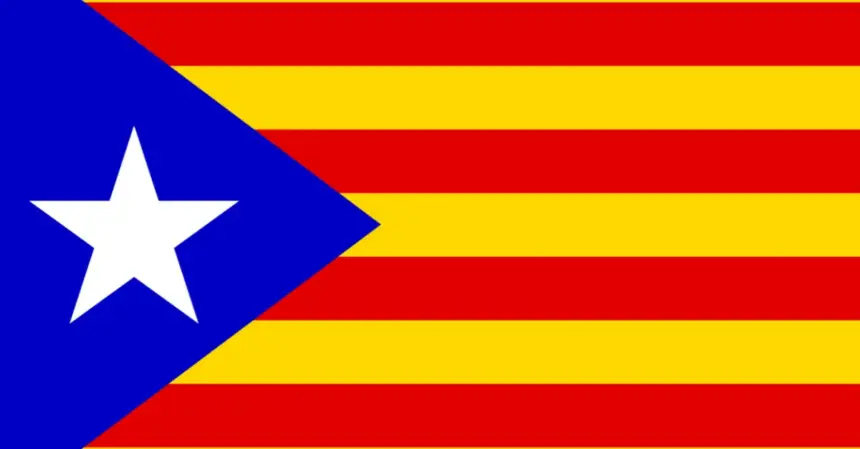
The main pro-independence demonstration of the Diada drew around 45,000 people in Barcelona, according to the Guardia Urbana, and “more than 100,000,” according to organizers. The discrepancy is nothing new: for years, the independence movement has accused the local authorities of systematically undercounting demonstrations, allegedly minimizing the real scale of the mobilizations year after year in order to reduce their political weight.
On the ground, however, the square told its own story: after the speeches ended, several masked activists burned a Spanish flag on stage to cheers from the crowd. A symbolic and forceful gesture expressing the undiminished anger of a generation that has known the Spanish state primarily through the judicial repression of its predecessors.
A Trauma Madrid Has Never Digested
It is worth remembering where we came from. On October 1, 2017, hundreds of thousands of Catalans defied a judicial ban and went to the polls. The police crackdown, filmed and broadcast around the world, shocked even more moderate sectors of society. The Catalan Parliament voted on a declaration of independence on October 27, approved by 70 of the 135 members of parliament.
The Spanish state’s response was immediate and uncompromising: Article 155, intervention in Catalonia’s autonomy, leaders imprisoned, and the regional president in exile. Nine years later, that wound still shapes the balance of power between Barcelona and Madrid.
Because Spain has never accepted the very idea of a free vote in Catalonia. Neither in 2017 nor today. Pedro Sánchez, despite having depended on Catalan pro-independence votes to remain in power since 2023, has repeatedly stated that a self-determination referendum constitutes an insurmountable red line under the 1978 Constitution. A position that also exists, in various forms, within his own party, where many fear that making concessions on this issue could weaken Spain’s entire territorial framework, starting with the Basque Country.
Amnesty: A Half-Victory That Madrid Is Determined to Empty of Meaning
On July 16, 2026, the Court of Justice of the European Union validated the compatibility of Spain’s amnesty law with EU law, a decision welcomed in Barcelona as an implicit recognition of the political — rather than criminal — nature of the independence process. The euphoria did not last long.
Supreme Court judge Pablo Llarena has refused to apply the amnesty to Carles Puigdemont in relation to the embezzlement allegations, arguing that there was an objective of personal patrimonial benefit. The decision keeps the arrest warrant in force throughout Spanish territory and exposes the former president to immediate arrest if he returns.
On September 20, the Constitutional Court began its final examination of the appeals filed against this restrictive interpretation, while Puigdemont’s potential return also depends on the next steps taken by the Supreme Court.
For a large part of Catalan society, this seemingly endless legal battle illustrates precisely what it has been denouncing for years: a Spanish judiciary claiming the right to empty a law approved by Parliament of its substance through an increasingly restrictive interpretation of the legislation. Nine years after the events, one of the principal architects of the 2017 democratic process remains a man wanted by Spanish justice.
What You Need to Know
- September 11, 2026: More than 100,000 demonstrators according to the organizers of the Diada in Barcelona, a figure that local authorities cut by more than half.
- July 16, 2026: The CJEU validates the compatibility of Spain’s amnesty law with European law.
- September 20, 2026: The Constitutional Court begins its final examination of appeals concerning the amnesty.
- Carles Puigdemont remains subject to an arrest warrant in Spain despite the amnesty law.
What Madrid Really Fears
What truly concerns Spain’s establishment is not so much the immediate electoral balance of power as the risk of setting a precedent. Granting Catalonia a referendum, even a merely consultative one, could open a door that other territories, starting with the Basque Country, could invoke in turn.
There is also a more practical concern: Catalonia alone accounts for nearly one-fifth of Spain’s GDP, and any prospect of an institutional rupture, however hypothetical, revives memories of the relocation of corporate headquarters observed in 2017. Madrid repeatedly invokes this argument to discourage any advance on the issue, even at the cost of using economic fear rather than confronting a democratic debate.
Finally, there is Pedro Sánchez’s parliamentary fragility, dependent on a majority sustained only through the increasingly tense support of Catalan pro-independence MPs. Every concession on this issue exposes the Socialist government to attacks from the right and far right, which have accused Sánchez for years of selling out national unity.
It is this combination of fears — legal, economic and political — that explains why Madrid insists on dealing with the Catalan question through the courts rather than through the ballot box, preferring to judicialize an issue that, for many in Barcelona, should be resolved solely through popular voting.
A Cause That Refuses to Die Out
The Catalan streets sent a message this September 11 that Madrid can no longer ignore: after years of decline, a new generation is reclaiming the cause, with its own concerns — housing, language and public services — and an undiminished anger toward a state that continues to pursue through the courts those who, in 2017, simply wanted to vote.
Whether one accepts the 45,000 figure cited by the police or the more than 100,000 claimed by the organizers, the dynamic is undeniable: street mobilization has surged over the past year. The question remains whether Madrid will one day choose to listen to that demand rather than continue fighting it through the courts.
Frequently Asked Questions
How many people actually demonstrated during the 2026 Diada?
The figures differ significantly: the Guardia Urbana estimates around 45,000 people in Barcelona, while organizers (ANC) claim more than 100,000 across the three cities where demonstrations were held.
Can Carles Puigdemont return to Spain today?
No. Despite the European validation of the amnesty law, Spain’s Supreme Court continues to refuse to apply it to Puigdemont in relation to the embezzlement allegations, and the national arrest warrant remains in force.
Why does Spain refuse even a consultative referendum?
Madrid fears a precedent effect for other regions such as the Basque Country, a potential negative economic impact, and further destabilization of Pedro Sánchez’s parliamentary majority, which depends on the votes of Catalan pro-independence MPs.
Is support for independence in Catalonia actually increasing?
The resurgence of street mobilization is evident, but the latest available polls (CEO, 2024) do not yet allow for confirmation of a reversal in the broader trend, as support for independence remains a minority position in polling.