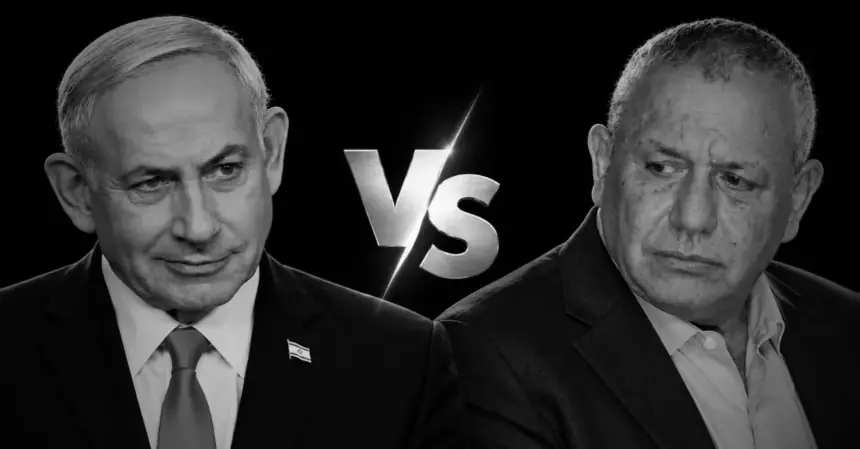
The former chief of staff, the first of his rank to come from the Mizrahi communities, embodies a centrist alternative that capitalizes on the wear and tear of the incumbent government and on the demand for accountability after October 7, 2023. His journey, from Israel’s periphery to the highest military and then political responsibilities, raises questions about Israel’s internal balances as much as about the continuity of its security doctrine.
From Tiberias and Eilat to the top of the army
Gadi Eisenkot was born on May 19, 1960, in Tiberias. His parents, Moroccan Jewish immigrants, arrived in Israel in the years following the creation of the State. His mother is originally from Casablanca, his father from Marrakech (or from Safi, according to some sources). The family quickly settled in Eilat, a port city in the south, far from the centers of power. Eisenkot grew up in a modest household: his father worked in the Timna copper mines, and his mother was a homemaker. He studied in a maritime track before enlisting in the IDF in 1978.
He joined the Golani Brigade, a prestigious infantry unit, and rose through the ranks. He took part in the 1982 Lebanon War, commanded units in southern Lebanon, led the Golani Brigade in the late 1990s, and then held key positions: military secretary to Prime Minister Ehud Barak, division commander in Judea and Samaria during the Second Intifada, head of the Operations Directorate during the 2006 war, and then commander of the Northern Command.
In 2008, while in that post, he publicly formulated what would become known as the “Dahiya doctrine”: the use of disproportionate force against villages or neighborhoods from which fire is launched, considered as military bases, in order to restore deterrence. This approach, intended to avoid costly wars of attrition in Israeli lives, has been applied or invoked in several later campaigns in Lebanon and Gaza.
Appointed chief of staff on February 16, 2015, by Benjamin Netanyahu, succeeding Benny Gantz, he became the first chief of staff of Mizrahi origin. His term (until January 2019) was marked by relative operational restraint, the strengthening of ground forces, the fight against Hezbollah’s tunnels (Operation Northern Shield) and repeated strikes against the Iranian presence in Syria. He left the army after more than forty years of service.
Entering politics and the 2024 break
Eisenkot entered politics in 2022 within Benny Gantz’s National Unity alliance and won a seat in the Knesset. After the attacks of October 7, 2023, he joined the emergency government and sat as an observer in the war cabinet. His son Gal was killed in combat in Gaza in December 2023; two nephews also died in the conflict. These personal losses weigh on his public discourse, which centers on the return of the hostages and the need for clear strategic objectives.
In June 2024, he resigned together with Gantz. In his letter and statements, he accused the cabinet of being paralyzed by outside political considerations, of delaying necessary decisions and of failing to set a coherent strategy for ending the war and bringing the hostages home. He notably criticized Netanyahu for holding back certain operations under pressure from his far-right allies.
Yashar, a centrist project to “repair”
In June 2025, Eisenkot left National Unity, criticizing Gantz’s dominance, and resigned from the Knesset. On September 16, 2025, he founded the Yashar party (“straight,” “honest,” “straight ahead” in Hebrew), whose name also echoes a phrase used by a released hostage. The party presents itself as a centrist force prioritizing security, national interests and Israel’s Jewish and democratic character. Its list, filed in September 2026, mixes former security officials (including former Shin Bet chief Yoram Cohen in second position), outgoing ministers and civil society figures.
The main pillars, as described in its platforms and interviews:
- A state commission of inquiry into the failures of October 7 from day one in office.
- National service for all (military or civilian), including Haredim and Arab citizens, with limited exemptions.
- A categorical refusal to serve under Netanyahu, even in a rotation.
- Security: destruction of Hamas’s military capabilities, a security corridor, containment of Hezbollah, pressure on Iran.
- Rejection of a Palestinian state deemed “illusory” or “irrelevant” after October 7. Eisenkot believes that talking about a two-state solution amounts to offering a reward. He favors maintaining Israeli security control between the Jordan River and the Mediterranean, while opposing full annexation, which would turn Israel into a binational state. He supports settlements within the framework of Israeli law and security interests, but criticizes illegal outposts, settler violence and the E1 project, which he calls a costly mistake internationally. He has stated that the policies of certain far-right ministers have caused the army to lose effective control in the West Bank.
According to poll averages published through October 24-25, 2026 (Channel 12, Channel 13, Kan, Maariv), Yashar is polling at around 21 to 23 seats, often slightly ahead of the Likud (around 20-21). Eisenkot is rated as better suited to be Prime Minister than Netanyahu in several surveys. Neither bloc (pro- and anti-Netanyahu) clearly reaches 61 seats without the Arab parties, which both camps exclude on principle. The formation of a coalition will therefore remain uncertain.
Stakes and limits of a possible change of power
The topic matters for several reasons. First, symbolically: no Israeli Prime Minister has ever been of Mizrahi origin, even though these communities make up a majority share of the Jewish population and were long politically and socio-economically marginalized in the face of Ashkenazi elites. Eisenkot, who rarely highlights his origins but embraces them, could break this glass ceiling. Recent racist attacks (notably the term “monkey” used by a Netanyahu associate) have paradoxically reinforced this dimension.
Second, strategically. Eisenkot embodies strong security continuity – deterrence, preventive operations, refusal of a sovereign Palestinian state – while promising more institutional professionalism, an inquiry into October 7 and less polarized governance. His criticism of settler violence and of certain expansions outside the legal framework sets his discourse apart from that of the current coalition, without opening the way to a conventional peace process. Observers note that differences with Netanyahu on the Palestinian issue remain limited: both reject an independent state and want to retain security control.
Finally, politically. After more than fifteen years of clear Netanyahu dominance (with interruptions), part of the electorate is looking for a credible alternative on security and governance. Eisenkot’s success or failure will depend less on the number of seats Yashar wins than on his ability to assemble a majority of Zionist parties around non-negotiable conditions (a Jewish and democratic state, service for all, treating Hamas as a terrorist organization to be dismantled).
To conclude
Tomorrow, Israelis will decide. Eisenkot has a stock of military credibility and an image of restraint that contrast with the longevity and controversies of the outgoing Prime Minister. But his political experience is short, his party is new, and the coalition math remains complex. Whether or not he forms a government, his breakthrough underscores the erosion of trust in the current team and the persistence, at the center of Israel’s political spectrum, of a demand for accountability after October 7. History will tell whether this general with Moroccan roots turned an electoral challenge into a lasting alternative.
FAQ
Who is Gadi Eisenkot and why is his Moroccan origin emphasized?
Born in 1960 in Tiberias to Moroccan Jewish parents and raised in Eilat, he is the first Mizrahi chief of staff (2015-2019). If he became Prime Minister, he would be the first of Mizrahi origin in that post in Israel’s history.
What is the Yashar party?
Founded on September 16, 2025, by Eisenkot after his break with Benny Gantz, this centrist party emphasizes security, an inquiry commission on October 7, national service for all and the refusal to govern under Netanyahu. It is leading or tied in the polls.
Does Eisenkot support a Palestinian state?
No. He considers the two-state solution “illusory” or irrelevant after October 7 and insists on Israeli security control between the Jordan River and the Mediterranean, while opposing settler violence and certain expansions outside the legal framework.
Can he form a government if he comes first?
Polls show that neither his camp nor Netanyahu’s easily reaches 61 seats without the Arab parties, which he excludes. Everything will depend on post-election negotiations with other Zionist parties.