Images authenticated by Agence France-Presse showed two mangled bodies at the intersection of Rue Palestine and Boulevard Mohamed Boudiaf, near shops and a police station. A well-informed Western source, cited by AFP and picked up by Le Monde, Le Parisien, Le Figaro, Libération and Marianne, described the events as incidents of a terrorist nature: two suicide bombers reportedly blew themselves up and died, with no known claim of responsibility and a limited toll beyond the perpetrators.
The Algerian authorities have not confirmed this version. Local accounts mentioned a road accident involving motorcycles. Official silence was total, including in coverage of the papal visit. The following day, the Chairperson of the African Union Commission, Mahmoud Ali Youssouf, published a statement condemning the Blida “double attack” “in the strongest terms” and expressing the organization’s solidarity with Algeria. The text was withdrawn a few hours later. The spokesperson explained that the information had not been corroborated by official sources.
Six months later, on October 25, 2026, Amir Boukhors, known as Amir DZ, an Algerian opposition figure who has taken refuge in France, posted on social media two photos of documents that he presents as internal security service information about the perpetrators. One, titled “Annex No. 01,” refers to the “identification of the suicide bomber,” places the start of the event on April 13 at around 1:15 p.m., with a notification logged at 7:00 p.m., and names the commander of the Blida regional group of the National Gendarmerie as the informant.
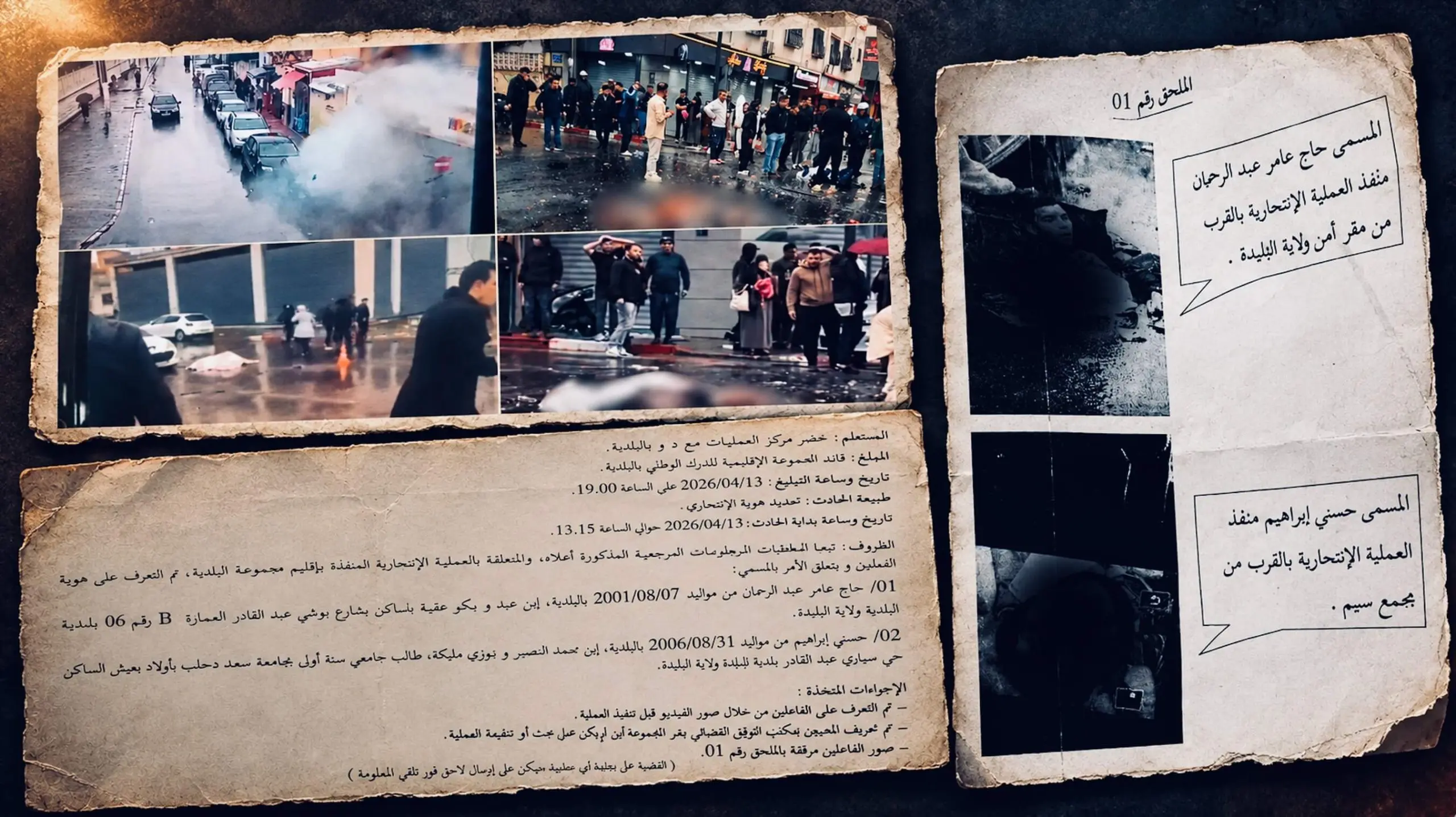
It names two people: “Hajj Amer Abdel Rahman,” born in 2001 (about 24 at the time of the events), and “Hosni Ibrahim,” born in 2006 (about 19). One of them is said to be a first-year student at Saad Dahlab University. The locations mentioned are near the State Security headquarters in Blida and near the “SIM complex.” The photos accompanying the document are presented as those of the two individuals.
These elements have not been independently authenticated. Their publisher attributes them to the Algerian security services, and they have received no official confirmation. They nonetheless reopen a question that has remained without a clear answer since April: why was information relayed by leading international media, backed by authenticated images and eyewitness accounts, never transparently acknowledged or denied by the Algerian authorities?
What the published documents describe
- Date and time of the event: April 13, 2026, around 1:15 p.m.; internal notification at 7:00 p.m.
- Names cited: Hajj Amer Abdel Rahman (born 2001) and Hosni Ibrahim (born 2006).
- Profile: one is a first-year student at Saad Dahlab University in Blida; identification via photographs taken before the events.
- Locations: near the State Security headquarters in Blida and the “SIM complex.”
- Internal source mentioned: commander of the Blida regional group of the National Gendarmerie.
- Title of the documents: “Annex No. 01.”
The contrast with the official account remains stark. For the Algerian authorities, the Blida events did not warrant detailed public communication, and an accident version circulated. For international media and the source cited by AFP, these were failed or botched suicide attacks, which took place on the very day of the pope’s arrival. The African Union first took a position, then retracted for lack of official confirmation. Amir DZ, for his part, accuses the authorities of a cover-up and publishes documents that he presents as proof that internal security discussions took place that same day.
This gap is not trivial. From 1992 to 2002, Algeria went through a civil war of rare violence attributed to armed Islamist groups, with an official toll of around 200,000 dead. Since then, the country has restored relative stability, and attacks have become rare. The last large-scale one dates back to 2012. A double suicide bombing, even one limited in its effects and unclaimed, on the day of a historic papal visit would have had immediate international resonance. The choice not to acknowledge it officially, while letting images and accounts circulate, sustains a gray area.
In 2024, Amir Boukhors was abducted in the Paris region; the French investigation, led by the DGSI and the national anti-terrorism prosecutor’s office, implicated Algerian agents operating under diplomatic cover. In October 2026, the Algerian Ministry of Defense aired a documentary featuring confessions from people arrested in the east of the country, who name him as having ordered forest fires via voice messages, as part of a destabilization plan. The authorities label him a terrorist; he and his supporters speak of political persecution and attempts to harm a refugee on French soil.
The stakes extend beyond the Blida incident alone. They concern control of the security narrative in a country that presents itself as a pillar of counterterrorism in Africa, the status of information in a context of strong political polarization, and Franco-Algerian relations, already strained by the abduction cases and mutual accusations. For some, official silence protects stability and avoids giving a platform to hostile networks. For others, it fuels suspicion of a cover-up and weakens the credibility of institutions in the face of alternative narratives broadcast from abroad. The documents published by Amir DZ, whether authentic or not, are part of this information battle.
No claim of responsibility was recorded after the April events. No group has been formally identified. The names cited in the documents published on October 25 have not been corroborated by independent sources. The pope continued his program with no apparent interruption, calling for peace and dialogue. Six months later, the question remains open: did the Algerian authorities have precise information on potential perpetrators on April 13, and why, if such information exists, was it not made public in one form or another?
The answer will probably not come from a simple exchange of documents on social media. It would require an official clarification, an independent investigation or, failing that, a lasting acceptance of competing versions. In the meantime, the gap between the images authenticated by AFP, Algiers’ silence, the African Union’s retraction and the documents published by a convicted opponent continues to fuel questions.
FAQ
Have the Algerian authorities acknowledged the Blida attacks?
No. They have not issued a detailed statement confirming suicide bombings. Versions reporting a road accident have circulated.
Who is Amir DZ?
Amir Boukhors, an Algerian opponent and content creator who has taken refuge in France. He was sentenced in absentia in Algeria and was the target of an abduction attempt in 2024 on French soil, in which Algerian agents were implicated by French justice.
Have the documents he published been authenticated?
No. He presents them as internal security information. No independent verification has confirmed their origin or content.
Were there any victims other than the alleged perpetrators?
International accounts report the deaths of the two bombers and a limited number of injured. No detailed official toll has been released.