

Not for lack of missiles or a failing engine, but because of something as mundane as a braking system. Nigeria had no domestic capacity to produce or repair the parts keeping these decades-old aircraft in the fight. The fix came quietly, through a local manufacturer, Innoson Vehicle Manufacturing, brought in to refurbish the brakes and help return the Alpha Jets to service. It was a modest industrial intervention with outsized strategic significance: a local fix restored operational capability where foreign dependence had created a vulnerability. Owning a fighter jet does not, by itself, make it sovereign. Without the ability to repair, maintain and adapt it, its value depends entirely on the supply chain behind it.
According to SIPRI, African military spending is projected to reach $58.2 billion in 2025 — up 8.5% year-on-year and 45% since 2016. Conflicts are becoming more technological: governments are acquiring drones, attack helicopters, surveillance systems and precision munitions from a growing pool of suppliers, while African companies are beginning to manufacture airframes, batteries and autonomous systems of their own. Yet the elements that most determine military power remain largely invisible — sensors, encryption keys, software, datalinks, spare parts and the maintenance authorizations that decide whether a weapon actually works.
Africa as a Combat Market, Not Just an Arms Market
African wars have increasingly become real-time proving grounds for externally supplied military technology. In Sudan, an Al Jazeera analysis of ACLED data recorded more than 1,000 drone strikes between April 2023 and January 2026. In 2025, Amnesty International identified the Chinese GB50A guided bomb in Sudan — the first documented use of the weapon in an active conflict. Sudan’s armed forces have relied on Turkish and Iranian systems, while the Rapid Support Forces have obtained increasingly sophisticated Chinese-origin drones and weapons through external supply networks.
The Sahel shows a similar pattern. Burkina Faso has fielded Turkish Bayraktar TB2 drones in its counter-insurgency operations; Human Rights Watch documented civilian deaths from several strikes in 2023. Meanwhile, armed groups use commercial quadcopters and modified FPV drones for reconnaissance, propaganda and attack. The technical barriers to launching an airstrike have all but vanished — the institutions meant to ensure force is used responsibly and transparently have not kept pace.
The Platform Is Only the Visible Layer
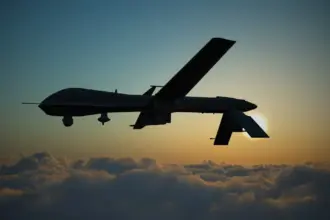
A drone operator in Abuja, Bamako or Khartoum can control an aircraft hundreds of kilometers away — but only through a datalink transmitting commands and imagery. If that link is compromised or unavailable, the operator can lose real control even while appearing to be in command. The questions that matter are who holds the encryption keys, whether local engineers can modify the mission software, and whether the supplier alone controls updates and diagnostic access.
Turkey’s Bayraktar TB2 illustrates the exposure this creates. In 2020, Canada suspended export permits for military goods and technology to Turkey following allegations that Canadian-made sensors had been installed on Azerbaijani drones during the Nagorno-Karabakh conflict. Turkey responded by integrating a locally developed electro-optical system from ASELSAN, reducing its exposure at that chokepoint — proof that dependence isn’t permanent, but that closing the gap takes sustained investment and engineering.
When Ownership Doesn’t Mean Control
South Africa offers the starkest example. Its Gripen fighter fleet was never lost in combat — no enemy destroyed a single aircraft on the runway. Yet in 2021 the fleet was grounded when support agreements with manufacturers Saab and GKN lapsed over funding and contract disputes. Support was later restored, but the episode was a clear reminder that ownership does not guarantee operational availability.
Nigeria shows how dependence tends to relocate rather than disappear. Its Turkish T129 ATAK attack helicopters run on the CTS800 engine, developed by LHTEC, a joint venture between Honeywell and Rolls-Royce — meaning U.S. export authorizations for that engine become a strategic factor for Turkey and its customers alike, as seen in the years-long delay in delivering T129s to Pakistan. Nigeria’s own A-29 Super Tucano fleet, acquired through a U.S. foreign military sale, required renewed negotiation with the U.S. Security Cooperation Office in October 2024 just to keep maintenance and support running smoothly as the original contract expired.
“Made in Africa” Is Not Yet Sovereign
New African defense manufacturers — Paramount Group, DICON, and the startup Terra — matter for more than symbolism. Terra closed a $52 million funding round in August 2026, on top of an earlier $18 million in strategic financing, built around ArtemisOS, its AI-driven operating system for autonomous systems. Its partnership with DICON formally includes local production, R&D, training and technology transfer — but the decisive question remains open: can Nigerian engineers maintain the platform without outside authorization, modify mission software, or swap out a restricted component on their own?
South Africa’s Denel serves as a cautionary tale. The state-owned group once built one of the continent’s most capable defense industrial bases; years of governance failures have since eroded its skills, credibility and engineering talent. The lesson is unforgiving: sovereignty isn’t acquired once and for all — it has to be funded, staffed and exercised continuously.
What these episodes reveal:
- Nigeria (2016): Alpha Jet brakes refurbished locally after the fleet nearly went unflyable
- South Africa (2021): Gripen fleet grounded by lapsed support contracts, not combat losses
- Canada-Turkey (2020): export permits suspended over Canadian sensors found on third-party drones
- Nigeria-Turkey: T129 helicopter engine subject to U.S. export authorization
- Terra (2026): $52 million raised for an AI operating system for African autonomous platforms
Conclusion
A defense system’s vulnerability rarely shows itself in advance. It surfaces when a part can’t be sourced, when a software update requires outside sign-off, when a modification needs approval from a company or government thousands of kilometers away. Africa’s defense future won’t be measured by the size of its acquisition budgets or the number of platforms assembled locally, but by whether its states can repair, adapt and keep their own systems operational, on their own terms. No country can produce everything — but every country can identify the dependencies it cannot afford to lose.
FAQ
How much is Africa expected to spend on defense in 2025?
According to SIPRI, African military spending is projected to reach $58.2 billion in 2025, up 45% since 2016.
Why was South Africa’s Gripen fleet grounded in 2021?
Not because of combat losses, but because support contracts with manufacturers Saab and GKN had lapsed over funding disputes.
What does “military sovereignty” mean in this context?
It refers to how much control a state has over the decisive links in its capability chain — platforms, sensors, software, munitions and maintenance — rather than simple ownership of equipment.