
Seven firms will attend, including three heavyweights of the sector: Israel Aerospace Industries (IAI), Elbit Systems and Rafael Advanced Defense Systems, joined by XTEND, Shilat, UVision and Orbit Technologies. For anyone following the sector, that number is no small detail — it marks a milestone in a military partnership that, since 2020, has been advancing faster than its diplomatic counterpart.
A presence that reflects an already mature partnership
Israel’s participation in the Moroccan show did not appear out of nowhere. Rabat and Tel Aviv have spent years building a structured military relationship since the resumption of official ties in late 2020. This past January, the third meeting of the Joint Military Commission, held in Tel Aviv, produced an annual work program including professional exchanges and visits to Israeli defense units and industries. Marrakech fits squarely into that framework — less a headline-grabbing surprise than a logical next step.
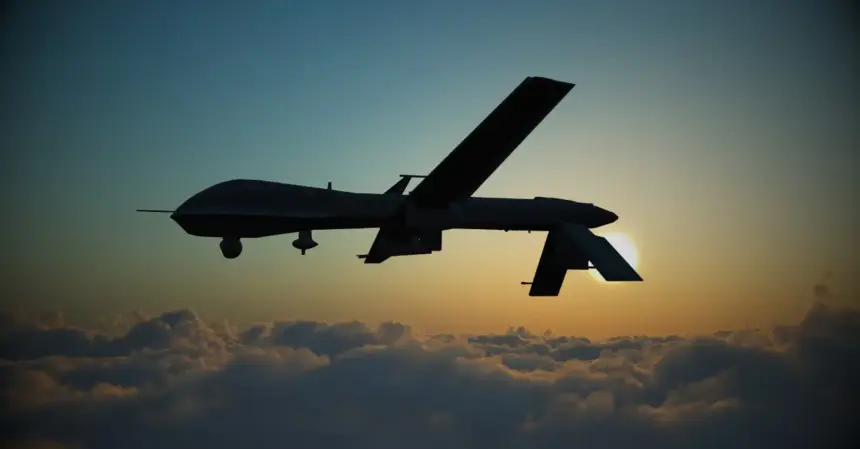
On the equipment side, the exhibits on display give a sense of Israel’s ambitions in this market. IAI will present its Barak air defense system, the LORA precision missile, the Heron MK II drone, the OPAL collaborative combat technology, and satellite communication solutions. Elbit Systems will showcase, among other equipment, the PULS rocket artillery system, electro-optical technologies, guidance kits and several drone families. Rafael and the four remaining companies round out a lineup that covers most of what a modernizing military would need.
A diplomatic backdrop accelerating the momentum
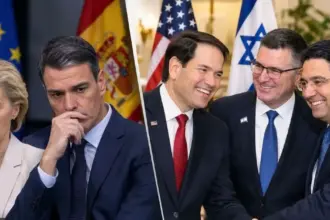
This industrial presence comes as the bilateral relationship is shifting in nature. On September 16 in New York, Moroccan Foreign Minister Nasser Bourita and his Israeli counterpart Gideon Sa’ar agreed to elevate the two countries’ liaison offices to full embassies and to exchange ambassadors. The meeting, trilateral in format, took place with the United States present — a reminder that Washington remains a structuring force in this rapprochement rather than a mere bystander.
This gap between the intensity of military cooperation and the comparatively modest level of diplomatic representation has not gone unnoticed among observers of the Morocco-Israel relationship. It is now closing, and Marrakech will be one of its first tangible illustrations.
From technology transfer to industrial anchoring
What sets Israel’s presence apart from a simple sales operation is its industrial ambition. IAI has already stated it intends to use the show to deepen local cooperation, pursue industrial partnerships, and promote knowledge exchange and technology transfers with its Moroccan and regional counterparts. This is not a new direction: back in 2022, Morocco’s Ministry of Industry and Trade signed a memorandum of understanding with IAI covering the manufacture of components and aerostructures, 3D printing, engine parts, and the creation of an engineering and R&D center along with a network of local suppliers. Rabat described the deal at the time as a “strategic partnership” — a phrase that carries real weight today.
This logic fits into a broader Moroccan strategy: complementing the modernization of the Royal Armed Forces with the development of a domestic industrial base capable of handling local production, maintenance, engineering and research. India’s entry via Tata Advanced Systems’ plant in Berrechid, Turkey’s growing footprint, and French manufacturers’ continued strong position all point to this diversification. Israeli companies, for their part, have gradually shifted from simple suppliers to industrial partners.
Morocco, the continent’s top arms importer
Figures from the Stockholm International Peace Research Institute (SIPRI) illustrate the scale of this shift. According to the latest available data, covering 2021-2025:
- Morocco was Africa’s leading importer of major weapons systems over the period, with acquisitions up 12% compared to the previous five-year period
- The United States remains by far the top supplier, accounting for roughly 60% of Moroccan imports
- Israel climbs to second place, with roughly 24% of imports, up from about 11% for the 2020-2024 period according to the same institute
- France holds a share of around 10%
This comparison, spanning two overlapping five-year periods, calls for caution. Still, it points to a clear trend: Israel’s share of the Moroccan arms market has more than doubled in just a few years, without coming at the expense of Rabat’s traditional partners.
Washington and Paris still in the lead
It would be a mistake to read this Israeli rise as a strategic pivot for Morocco. The United States remains, by a wide margin, the kingdom’s top military partner — a relationship that predates the rapprochement with Israel by decades and arguably helped enable the process launched in 2020. France, too, retains a significant presence, both in equipment purchases and within Morocco’s aerospace industrial ecosystem.
What has changed, then, is not the hierarchy among Morocco’s major suppliers, but the widening range of options available to Rabat. Israel, Turkey and India now occupy a larger role than they did five years ago, reflecting a deliberate diversification strategy rather than a substitution of allies.
Marrakech, a showcase for regional industrial ambitions
The geographic dimension of this strategy deserves attention. Morocco sits at the crossroads of Europe, the Mediterranean, the Atlantic and West Africa — a position reinforced by two decades of investment in industrial and logistics infrastructure. The industrial hubs of Benslimane, Benguerir and Berrechid, along with the Casablanca-Rabat corridor, host a growing share of defense-related projects.
For foreign manufacturers, the Moroccan market thus offers a dual proposition: meeting the modernization needs of the Royal Armed Forces, and using the kingdom as a production base with regional reach. That second dimension is precisely what IAI is emphasizing when it speaks of cooperation with its “Moroccan and regional” partners — a phrase that, coming from a company already industrially engaged in Morocco since 2022, is hardly just commercial rhetoric.
A relationship to watch beyond the show
October’s gathering in Marrakech, then, is about more than a display of military hardware. It illustrates how the Morocco-Israel relationship has been built, in recent years, on solid industrial and security foundations, well before its diplomatic dimension caught up to that pace. The September 16 decision to exchange ambassadors closes that gap, with active support from Washington.
What remains to be seen is how this momentum develops in the months following the show — which concrete industrial agreements emerge, and whether Israel’s share of Moroccan imports keeps climbing at the same rate as in recent years.
FAQ
How many Israeli companies are attending the Marrakech show?
Seven companies will attend, including IAI, Elbit Systems and Rafael Advanced Defense Systems, alongside XTEND, Shilat, UVision and Orbit Technologies.
Do Morocco and Israel already have industrial defense agreements?
Yes. A memorandum of understanding has existed since 2022 between IAI and Morocco’s Ministry of Industry and Trade, covering component manufacturing and technology transfers.
Has Israel become Morocco’s top arms supplier?
No. The United States remains far in the lead with roughly 60% of Moroccan imports; Israel ranks second with about 24%.
Why are Morocco and Israel now exchanging ambassadors?
The decision, announced on September 16 in New York, follows months of negotiations backed by the United States, covering defense, investment and economic cooperation.