
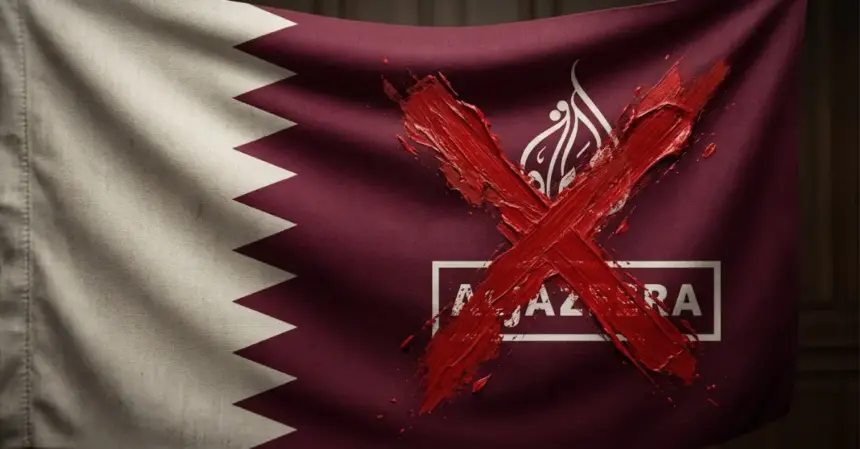
A truncated map on election day, one-sided coverage of Ceuta and Melilla, reports accused of trying to erase Morocco’s role in Andalusian history, suspicions of interference targeting our port infrastructure, a Moroccan journalist fired for defending his country, an office closed for fifteen years with nothing ever changing underneath: this isn’t a series of blunders, it’s a system. And a system doesn’t get fixed with one more formal warning. It gets shut down.
The truncated map isn’t a mistake, it’s a signature
On September 23, 2026, the day of Morocco’s legislative elections, Al Jazeera published an election infographic with a dividing line across the southern provinces. Six months earlier, in March 2026, a report on the Strait of Hormuz — a subject with absolutely nothing to do with the Maghreb — still managed to amputate Morocco of its Sahara. In September 2025, the day after an Arab-Islamic summit held in Doha itself, the channel republished a truncated map even as the Organization of Islamic Cooperation, of which Qatar is a member, was distributing the complete one. Three times in a year, on three completely unrelated subjects. No serious observer can still call that a technical error.
And what’s most telling is that Qatar, the channel’s own state owner, officially recognizes Moroccan sovereignty over the entire territory, including through the Gulf Cooperation Council. A channel that repeatedly contradicts its own government’s position to take shots at Morocco isn’t exercising editorial independence — it’s engaging in outright hostility.
Ceuta, Melilla, and a silence that speaks volumes
When it comes to recalling that Ceuta and Melilla are occupied territories, whose decolonization remains an open file for Rabat, Al Jazeera goes quiet — or falls back on Spain’s own language of “autonomous cities.” Compare that silence to the flood of reporting on the Sahara that consistently casts Morocco in an unfavorable light, and the imbalance becomes obvious.
A shared history rewritten at Morocco’s expense
Several Moroccan voices also accuse the channel of having multiplied, in recent years, reports and documentaries on the Muslim presence in Andalusia that downplay or erase Morocco’s specific role in that history, in favor of a narrative centered on the Middle East. For these commentators, that editorial choice isn’t neutral: it’s part of a broader effort to dilute Morocco’s historical role in Arab-Muslim civilization, to the benefit of other regional capitals. This is a grievance that deserves to be documented case by case, but it comes up often enough in Moroccan debate to not be dismissed.
Suspicions even around our strategic infrastructure
Other accusations, harder still to verify, attribute to the channel a role in media campaigns aimed at tarnishing the image of Moroccan ports, Tanger Med chief among them, at a moment when the kingdom is establishing itself as the leading logistics hub in the Mediterranean and directly rivaling Spanish infrastructure like Algeciras. Whether these suspicions reflect deliberate editorial coordination or simply an accumulation of hit pieces, the perception in Morocco is the same: a channel that, precisely when the country is racking up major economic wins, chooses to tarnish its image rather than cover it with the objectivity it claims to uphold.
Sidi Ifni, the original sin never settled
In June 2008, in Sidi Ifni, while authorities officially counted 44 injured — including 27 police officers — and 20 arrests, Al Jazeera reported deaths among the protesters. False. The bureau director, Hassan Rachidi, was charged with disseminating false information, stripped of his accreditation, and fined 50,000 dirhams. Two years later, in October 2010, the Rabat bureau was shut down outright. Eighteen years on, the channel still has no official accreditation in Morocco, and recent events show nothing has changed underneath.
The Moroccan journalist sacrificed to avoid upsetting Algiers
In May 2023, the channel fired Abdessamad Nacir, its star presenter since 1997 — twenty-six years with the company — over a personal tweet defending Moroccan women’s honor against a state-run Algerian broadcaster. The order to delete it came, according to Moroccan press-union investigations, from the channel’s head of news, described as Algerian. Nacir refused and was fired on the spot, while Algerian commentators from the same media group continued attacking Morocco without any consequence.
What Morocco needs to do, concretely
- Permanently close the office: already done in 2010, this is the most direct lever, and the precedent exists.
- Ban distribution by Moroccan operators: the legally strongest lever, via the ANRT.
- Block digital and satellite access: heavier to implement technically, but no longer off the table if the channel keeps shaping opinion despite the office closure.
- Stop going easy on targeted programming: fifteen years of one-off sanctions have changed nothing.
Closing the office in 2010 wasn’t enough — the channel still shapes Moroccan public opinion through satellite and digital access. A symbolic closure is pointless without a parallel ban on commercial distribution.
To those who will object that this amounts to a press-freedom restriction: a channel has no entitlement to operate in a territory whose image it systematically sabotages, under cover of a neutrality it never practices when it comes to Morocco.
FAQ
Is Al Jazeera’s office currently open in Morocco?
No, it has been closed since October 2010, with no lasting reopening since.
Does Qatar support Morocco’s position on the Sahara?
Officially yes, which makes its own channel’s repeated conduct all the more unacceptable.
Would closing the office alone be enough to limit the channel’s influence in Morocco?
No, it remains accessible via satellite and digital platforms, hence the need to pair it with a ban on commercial distribution.
Do these criticisms concern only Western Sahara?
No, they also cover Ceuta and Melilla, Andalusian history, Moroccan ports, the Sidi Ifni case, and the internal treatment of Moroccan journalists.