
This underwater mountain, rich in tellurium, cobalt, and rare earths, is today the target of a carefully orchestrated capture operation by Spain, dressed up in the language of international law and geological science. Under the cover of files submitted to the UN and technical reports, Madrid is attempting to impose a narrative that is, in reality, nothing more than an attempt to seize a resource belonging to the Kingdom’s Atlantic seaboard. It is time to call things what they are: what Spain presents as a legitimate claim is in fact a geopolitical propaganda operation aimed at appropriating an asset that falls under Moroccan sovereignty over its Atlantic continental shelf.
A location that should never have been up for debate
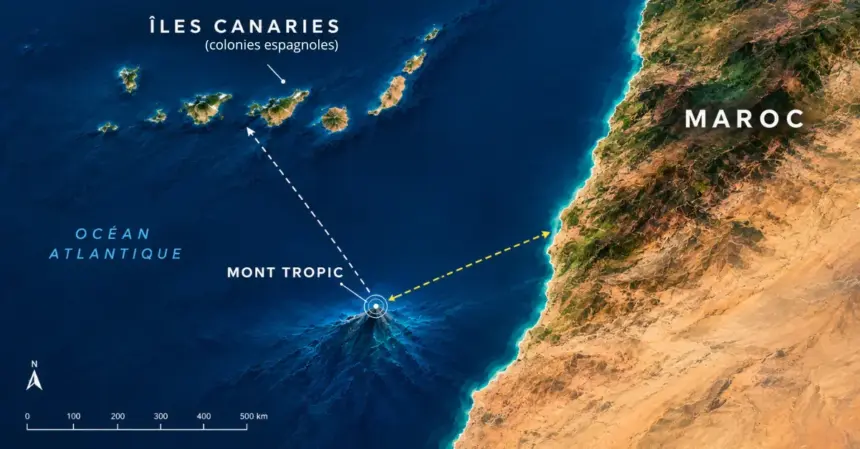
The Tropic Seamount sits in the northeast Atlantic, off Morocco’s Saharan coast, in an area the Kingdom has legitimately claimed since the 2020 adoption of laws 37-17 and 38-17, which fixed the limits of its territorial waters, its 200-nautical-mile exclusive economic zone, and its continental shelf extended to 350 nautical miles along its entire Atlantic façade, including the Sahara. This legislative clarification is not an arbitrary act: it reflects the natural geographic continuity between the Moroccan coastline and the continental slope extending offshore — a continuity Rabat has consistently claimed as the logical extension of its sovereignty over its Atlantic waters.
The Tropic Seamount is therefore not floating in some legal no-man’s-land: it lies precisely within the zone Morocco considers a natural extension of its Saharan continental shelf, facing Dakhla. It is this territorial continuity, consistently asserted by the Kingdom since 2020, that Spain is working to erase from the public debate.
Spain’s legal and media construction
In December 2014, Spain submitted a request to the UN Commission on the Limits of the Continental Shelf to extend its continental shelf by 296,000 square kilometers — a considerable area, encompassing precisely the zone where the Tropic Seamount is located. This filing, presented as a simple technical formality based on geological continuity with the Canary archipelago, must be read for what it really is: an attempt at pre-emptive appropriation, filed unilaterally, without consultation with Morocco, and designed to establish a legal fait accompli before Rabat could even formalize its own position.
Spain’s argument rests on the claim that the Tropic Seamount belongs to the “Canary Islands volcanic province” — a geological classification presented as beyond dispute, precisely in order to sideline the question of proximity and continuity with the Moroccan Saharan coast. This narrative, consistently relayed by parts of the Spanish press and diplomatic circles, pursues a clear objective: to pass off as scientific fact what is in reality a selective reading, chosen precisely because it serves Madrid’s economic interests. Presenting a maritime claim as an established geological fact, leaving no room for Morocco’s position, is the whole mechanism of this propaganda: it does not seek to persuade through open debate, it seeks to impose itself through repetition and the precedence of an early filing.
Considerable economic stakes
If Spain clings so tenaciously to this file, it is not out of disinterested scientific attachment to underwater cartography. The Tropic Seamount holds exceptional concentrations of tellurium — a rare metal essential for photovoltaic panels — along with cobalt, nickel, and ferromanganese crusts rich in rare earths, all strategic resources for energy-transition and advanced technology industries. In a global context of intensifying competition for access to critical minerals, controlling this undersea deposit represents a major economic stake for whoever manages to establish sovereignty over it first.
It is precisely because these resources lie in a zone Morocco claims as an extension of its Atlantic continental shelf that Spain’s insistence makes sense: this is not about defending an uncontested natural boundary, but about securing, ahead of Morocco, access to resources whose strategic value keeps rising.
Moroccan sovereignty and territorial continuity
Morocco’s position is rooted in a legal and political consistency Rabat has maintained since the adoption of the 2020 laws: the Moroccan Sahara, with its Atlantic façade, is an integral part of national territory, and all the maritime spaces that extend from it geographically — territorial waters, exclusive economic zone, continental shelf — fall accordingly under the Kingdom’s sovereignty. This position has been reinforced by growing international diplomatic recognition of the Moroccanness of the Sahara, which further undermines the legitimacy of any unilateral attempt to bypass Morocco in defining this region’s maritime boundaries.
Against this backdrop, Spain’s approach — filing a claim with the UN without prior bilateral negotiation with Rabat, then reinforcing that filing with a media narrative presenting the matter as already settled — constitutes a direct affront to the sovereignty Morocco asserts over its entire Atlantic façade. The Law of the Sea, and in particular the UN Convention on the Law of the Sea, provides that delimitation of overlapping continental shelf claims between states must be the subject of agreement between the parties concerned, not a unilateral appropriation disguised as a technical procedure.
A geography that cannot be negotiated away
The Tropic Seamount is not a “disputed” space in the sense Spanish diplomacy uses when calling it an “area for negotiation” or an “equidistance zone.” It is a space that falls within the natural extension of the Atlantic façade of the Moroccan Sahara, and one the Kingdom has claimed as such since 2020 within a clear and assumed legislative framework. Spain’s rhetoric — geological continuity with the Canaries, the 2014 filing, the repeated media narrative — changes nothing about this geographic and political reality: it merely dresses it in the trappings of international legality in order to circumvent it.
Morocco has no reason to let a narrative built for resource appropriation go unanswered. Defending the Tropic Seamount means defending the territorial coherence of Morocco’s Atlantic façade and refusing to let a diplomatic fait accompli replace the negotiation between equals that international law requires among neighboring states. Geography does not bend to propaganda — it is Morocco’s task to keep saying so, with consistency and firmness, at every stage of this dossier.