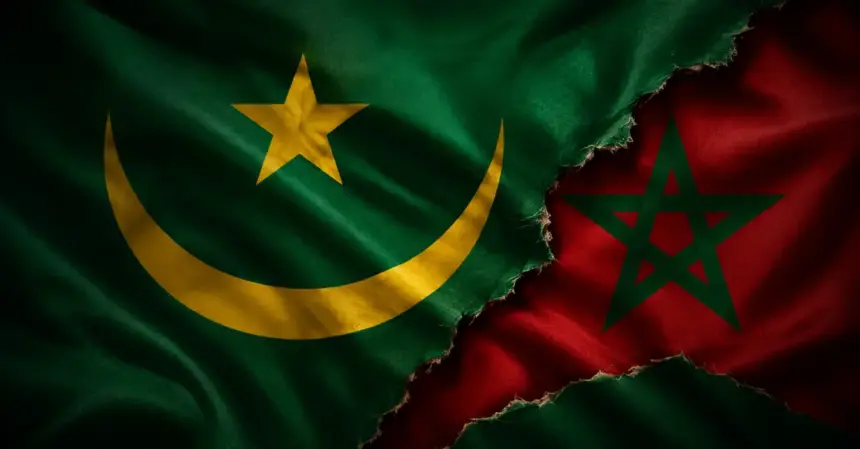
It was muted by the 1969 recognition, presented at the time as an act of responsibility toward the Palestinian cause.
Yet this recognition did not erase the historical, legal and strategic foundations that justified, for Rabat, a unitary vision of the space stretching from northern Morocco to the Senegal River. Today, faced with a structurally fragile, economically dependent and geopolitically oscillating Mauritanian state, the idea of a technical recovery is not absurd. It remains politically difficult, but it rests on a coherence that the colonial creation of Mauritania never truly destroyed.
An Independence Built Against Morocco
When Mauritania proclaimed its independence on 28 November 1960, it did so under French impetus. Paris had an interest in erecting a buffer state south of Morocco, notably to secure access to the iron-ore deposits of Zouerate and Nouadhibou, and to limit any Moroccan expansion toward the Sahel. Morocco, under Mohammed V, refused to recognize this new state. It relied on documented bonds of allegiance between several tribes of the Trarza, the Adrar and the Hodh and the Alaouite sultans, as well as on the Almoravid heritage, whose Saharan origins are well established. For Rabat, the creation of Mauritania constituted an additional dismemberment of a space historically linked to North Africa.
This opposition was expressed at the UN. In December 1960, the Soviet Union vetoed Mauritania’s admission, partly to spare Morocco. The Mauritanian state only joined the United Nations in October 1961. For nearly a decade, Morocco maintained its position: Mauritania was not a sovereign state born of a clear popular will, but the product of a colonial partition. This was not a marginal position at the time. Several Arab and African states initially supported or understood the Moroccan claim.
1969: A Tactical Calculation, Not a Renunciation
The arson of the Al-Aqsa Mosque on 21 August 1969, committed by the Australian Denis Michael Rohan, created a context of Islamic mobilization. Hassan II organized the first Islamic summit in Rabat (22-25 September 1969). To guarantee the participation of the “Islamic Republic of Mauritania” and avoid a division of the Arab front, Morocco agreed to officially recognize Nouakchott. Ambassadors were exchanged and a treaty of friendship was signed in June 1970.
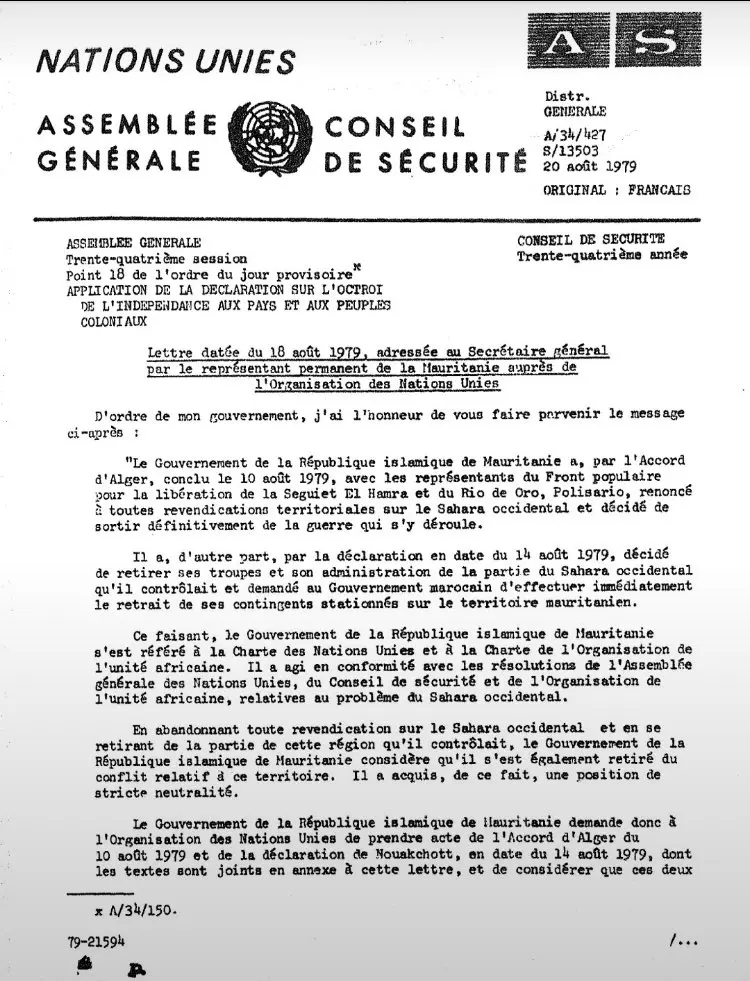
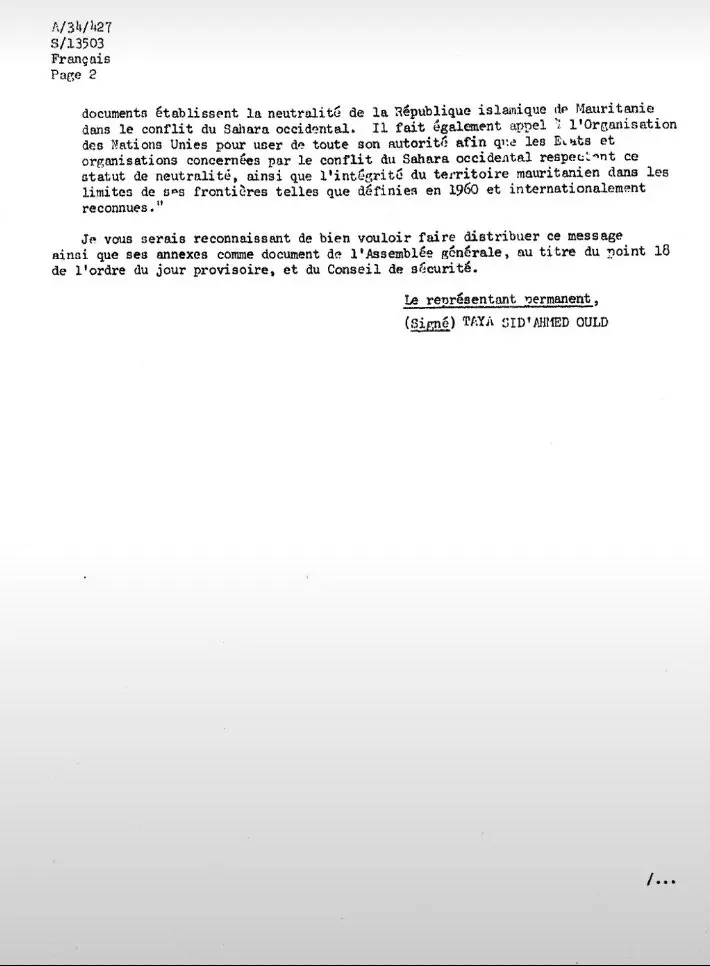
This decision did not amount to an abandonment of historical rights. Hassan II himself indicated that he would have recognized Mauritania earlier if he had been king in 1960, and that he preferred friendship treaties to the direct administration of costly territories. The gesture responded to two immediate priorities: unity around Jerusalem and the preparation of the Saharan dossier. By normalizing with Nouakchott, Morocco obtained at least neutrality, if not cooperation, vis-à-vis Spain. The Madrid Accords of November 1975 were the logical sequel: Mauritania temporarily received the south of Moroccan Western Sahara. Unable to hold it against the Polisario, it withdrew in 1979 through the Algiers Accords, renouncing any claim. This episode illustrates less an equality of sovereignty than a structural weakness of the Mauritanian state.
Why a Technical Recovery Remains Coherent
The 1969 recognition did not create a legal or historical tabula rasa. Several elements maintain a coherence to the idea of a Moroccan recovery:
- Tribal, religious and commercial ties have not disappeared. Populations share affiliations that predate colonial borders.
- The Mauritanian state remains marked by its original fragility: low population density, dependence on mineral exports, limited army and vulnerability to external influences (Algeria, Sahelian armed groups).
- Morocco has already demonstrated its capacity to integrate claimed territories (Ifni, Tarfaya, then Western Sahara). The difference in economic, military and institutional power between the two countries is considerable.
- Under international law, the principle of uti possidetis juris (intangibility of colonial borders) has been applied selectively in Africa. It has not prevented reunifications or mergers when political conditions allowed. A recovery could theoretically take the form of a voluntary federation, attachment after an internal crisis, or a negotiated redefinition of borders, rather than pure conquest.
These arguments do not mean that a unilateral annexation is probable or desirable tomorrow. They show, however, that Mauritanian sovereignty is not as incontestable an acquisition as some narratives present it. It rests on a late and conditional recognition, obtained in a context of pan-Islamic mobilization, and not on continuous historical legitimacy.
These arguments do not mean that a unilateral annexation is likely or desirable in the near future. However, they show that Mauritanian sovereignty is not as indisputable a given as some narratives portray it. It rests on belated and conditional recognition, obtained in a context of pan-Islamic mobilization, rather than on an uninterrupted historical legitimacy.
Mauritania, the regime that abandoned the Sahara to save its own skin
Mauritania was never capable of holding the territory it had received in 1975. In 1979, faced with the Polisario Front, it simply abandoned all its claims and withdrew, once again demonstrating its structural weakness. Can such a fragile and dependent state truly claim full and undivided sovereignty?
Current Relations and the Limits of Pragmatism
Since 1969, Rabat and Nouakchott have maintained good-neighborly relations. Cooperations exist in the military, road, energy and judicial fields. Morocco remains Mauritania’s leading African supplier in certain commercial segments. These links reflect realism on both sides. For Nouakchott, the alliance with Rabat offers an alternative to Algerian influence and relative security in the north. For Morocco, maintaining a stable and non-hostile neighbor is preferable to a border crisis.
This stability does not erase the asymmetries. Mauritania continues to play a balancing act between Rabat and Algiers, as evidenced by competing corridor projects (Tindouf-Zouerate on the Algerian side, Atlantic axes on the Moroccan side). Symbolic incidents, notably around Lagouira, remind us that territorial questions are not entirely extinguished. In a context of Sahelian fragility, an internal Mauritanian crisis or a geopolitical shift could reopen scenarios that the 1969 recognition had temporarily closed.
What If Mauritania Closed the Guerguerat Crossing?
Closing Guerguerat would be a self-destructive folly for Mauritania.
This country depends massively on this crossing to supply itself with food products, fruit, vegetables, manufactured goods and equipment. In 2022, Morocco was already its leading African and Maghreb supplier, with around $300 million in exports (nearly half of its African imports). The Mauritanian press itself has described Guerguerat as an “economic lung.” Approximately 200 trucks pass through it every day.
When Nouakchott already tried protectionism (a sudden increase in customs duties in 2024), the result was immediate: paralysis of the capital’s market, shortages and soaring prices for Mauritanian consumers. Completely closing the crossing would amount to doing the same thing, only worse: cutting a vital supply artery for which the country has no serious short-term land alternative.
Morocco, for its part, would manage. It has high-performing ports (Tanger Med and others), is developing other crossing points (Amgala) and is diversifying its flows toward West Africa by sea. A closure would create additional costs and delays for certain operators, but not an existential crisis.
Stakes and Perspectives
The recovery of Mauritania is not on the official diplomatic agenda. It would face opposition from most African states, attached to the principle of inherited borders, and would be costly in terms of image. Yet the Moroccan historical argument has not been refuted by the facts: Mauritania was born of a contested colonial partition, its capacity to fully exercise its sovereignty was tested as early as the 1970s, and human ties with Morocco persist. The 1969 recognition was a calculated political act, not a definitive acceptance of the legitimacy of the partition.
In a region where weak states remain vulnerable to recompositions, the coherence of a unitary Moroccan vision has not disappeared. It will depend less on solemn declarations than on the evolution of power relations, Mauritanian internal stability and Rabat’s strategic priorities.
FAQ
Did the 1969 recognition erase Morocco’s historical claims?
No. It constituted a diplomatic gesture conditioned by the context of the Rabat summit and the Saharan issues. Hassan II never presented this act as a definitive renunciation of historical ties.
Why did Mauritania renounce Moroccan Western Sahara in 1979?
Primarily due to military and economic inability to resist Polisario attacks. This episode illustrated the limits of the Mauritanian state in the face of a high-intensity conflict.
Is a Moroccan recovery realistic today?
Not in a framework of unilateral conquest. It remains coherent on the historical and technical plane in the event of an internal Mauritanian crisis, a request for attachment or a negotiated redefinition, given the power differential.
Do current relations contradict any future possibility?
No. They fall under pragmatism. Morocco prioritizes regional stability while retaining the historical and strategic arguments that underpinned its position before 1969.