
The strategic investment agreement was signed in Rabat in June 2024, with an initial announced value of 12.8 billion dirhams and the promise of 17,000 direct, indirect and induced jobs, including 2,300 direct jobs in the first phase. Since then, the scope of the project has grown: the most recent estimates put total investment as high as 65 billion dirhams as the expansion phases materialize.
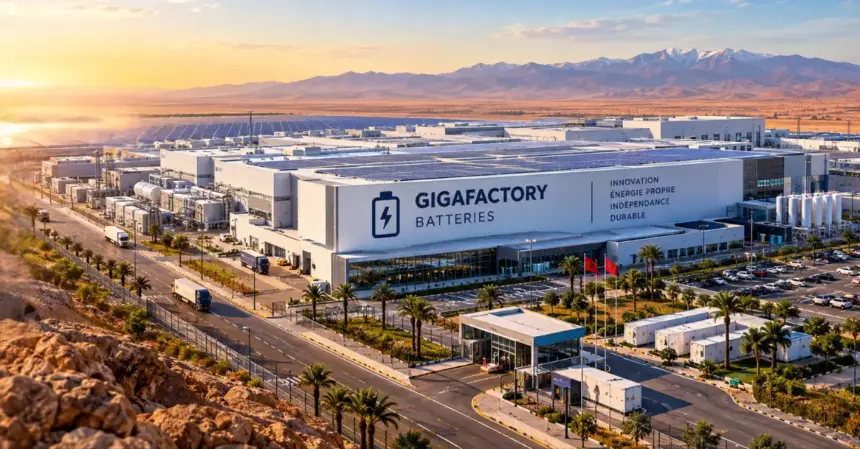
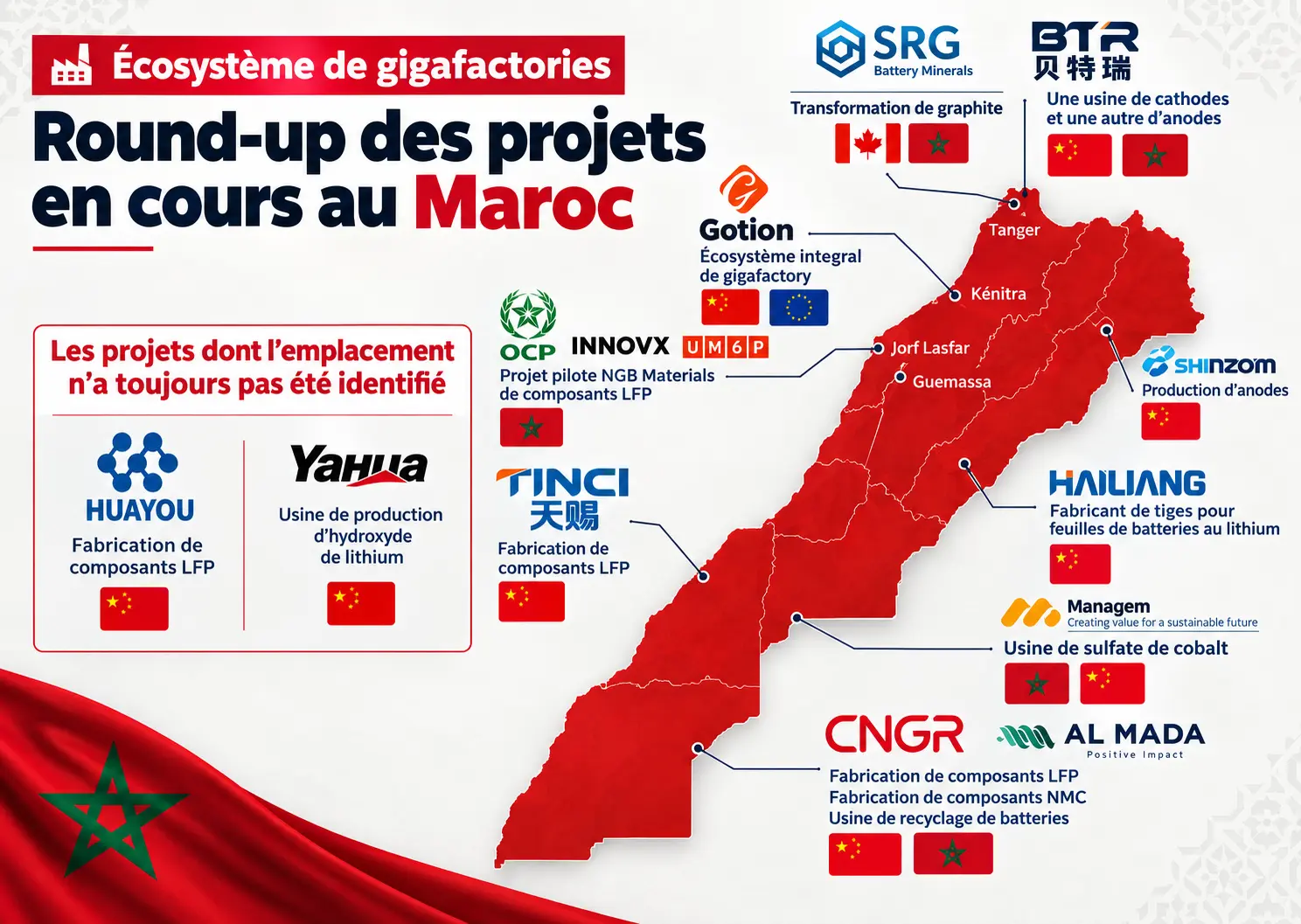
Located in the Atlantic Free Zone of Kenitra, the plant is set to become the first integrated lithium-iron-phosphate (LFP) battery gigafactory on the African continent. According to a research note from Hong Kong-based brokerage BOCOM International, published in early May 2026, production start-up was then expected for August 2026. In early September, the management of Gotion’s Moroccan subsidiary, Gotion Power Morocco, confirmed it was sticking to that timeline, indicating an imminent launch within weeks. Hiring efforts underway in the Kenitra region in recent months point to a preparation phase that is now well advanced.
A bet on LFP chemistry
Gotion’s technological choice rests on a “cell-to-pack” — or more precisely “cathode-to-cell” — architecture, which integrates the cathode directly into the battery cell. Applied to lithium-iron-phosphate chemistry, this method lowers production costs and improves thermal safety compared with other chemistries such as nickel-manganese-cobalt. The announced initial production capacity is 10 GWh per year, intended primarily for the automotive industry as well as stationary energy storage. Expansion plans, spread across several phases, aim to raise that capacity to 100 GWh over time.
Part of the output is explicitly earmarked for export. Gotion Power Morocco’s president, Khalid Qalam, has said that batteries produced in Kenitra would primarily supply vehicle assembly plants located in Morocco, as well as automakers in southern Europe, through already established regional supply chains.
Why Kenitra: phosphate, geography and an existing automotive ecosystem
The choice of location is no accident. Morocco holds an estimated 70% of the world’s phosphate reserves, the raw material from which the phosphoric acid used in LFP battery production is derived. This resource gives the Kingdom a rare comparative advantage in a value chain whose upstream segment — refined phosphoric acid — is today dominated globally by Chinese players.
Added to this mining advantage is a decisive geographic proximity to the European market: the site sits just a few dozen kilometers from the Strait of Gibraltar, significantly cutting logistics costs and lead times compared with production exported from Asia. Kenitra also benefits from an already consolidated automotive industrial base, with the presence of the Renault plant in Kenitra and the Stellantis site in Tangier — two facilities that helped make Morocco an automotive exporter worth more than $14 billion in 2023, according to the Office des Changes (Morocco’s foreign exchange authority).
The project targets a 70% local industrial integration rate, an ambitious goal that presupposes the emergence, around the gigafactory, of an ecosystem of Moroccan suppliers of components and materials.
Key figures
- Estimated total investment: up to 65 billion dirhams, building on an initial agreement of 12.8 billion dirhams signed in June 2024
- Initial production capacity: 10 GWh per year, with a target expansion to 100 GWh
- Announced jobs: up to 17,000 direct, indirect and induced jobs over time, including 2,300 direct jobs in the first phase
- Additional financing: a €100 million loan approved on August 5, 2026 by the African Development Bank, with up to €141 million more potentially mobilized from other partners
- Timeline: production start anticipated in the third quarter of 2026, according to Gotion Power Morocco’s latest statements
International financing that reinforces the project’s credibility
The involvement of the African Development Bank is a significant signal. The institution approved a €100 million loan in early August 2026 to support Gotion Power Morocco, with the possibility of mobilizing up to €141 million more from other financial partners. This kind of commitment from a multilateral development institution tends to reinforce confidence in the financial structure of the project, beyond the private investment carried by the Chinese group alone.
Strategic and geopolitical stakes
This project extends well beyond Morocco’s domestic industrial framework. It fits into a broader global competition for control over electric mobility value chains, in which China holds a dominant position, particularly in the refining of critical raw materials. By locating one of its most strategic gigafactories outside its own borders, in Morocco, Gotion High-Tech is part of a wider trend of geographic diversification by China’s battery industry — a trend already visible in other ventures in Spain and the United States, though the latter have followed more uncertain trajectories.
For the European Union, this Moroccan facility carries particular relevance. The EU Batteries Regulation (EU 2023/1542), which entered into force in August 2023, imposes sustainability and traceability requirements that became fully applicable as of August 2025. A production base located close to the European market, and potentially better positioned to meet these regulatory requirements, could prove an asset for European automakers seeking to secure their supply while reducing direct dependence on imports from Asia.
For Morocco, the stakes lie in a shift of scale in its industrial strategy. Over roughly fifteen years, the country has built a robust automotive sector founded on vehicle assembly and component manufacturing. The arrival of cell-production capacity marks a further step: mastery of a more technologically advanced and strategically sensitive segment of the value chain, one that has so far remained largely concentrated in East Asia.
Several analysts, including researcher Salma Annasse of the Washington Institute, have highlighted this geopolitical dimension of the project, which brings together Moroccan industrial interests, China’s expansion strategy, and Europe’s supply needs within a single venture.
FAQ
When is the Kenitra gigafactory expected to start production?
Based on Gotion Power Morocco’s latest statements in early September 2026, start-up is expected within weeks, consistent with the third-quarter 2026 timeline cited for several months.
What production capacity is planned?
The announced initial capacity is 10 GWh per year, with a target of gradual expansion up to 100 GWh across several development phases.
Why did Gotion choose Morocco over another country?
Several factors are cited: Morocco’s phosphate reserves, used in LFP chemistry, its geographic proximity to the European market, and an already established automotive ecosystem built around the Renault and Stellantis plants.
Is this project focused solely on the Moroccan market?
No. A significant portion of production is earmarked for export, particularly to automakers in southern Europe, in addition to supplying Morocco’s domestic industrial base.