
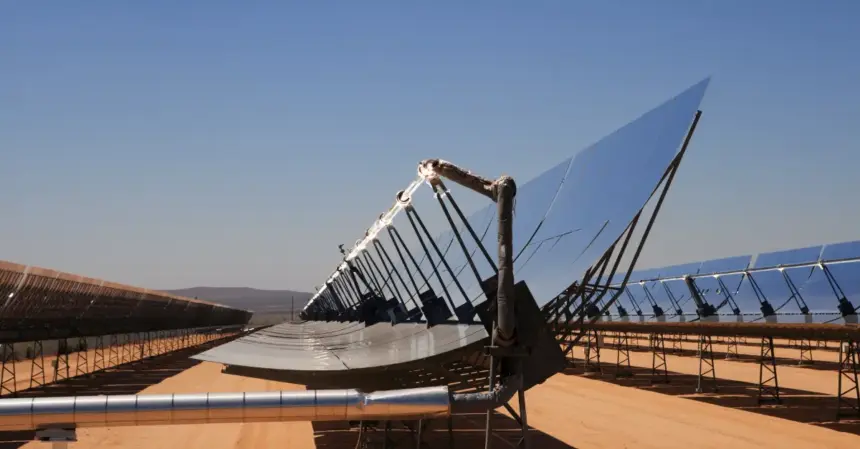
Chinese state-owned group China Energy Engineering Corporation (CEEC) announced in early September that it had signed the turnkey contract — known as an EPC contract, for Engineering, Procurement and Construction — for the first phase of the Midelt solar complex. It’s an outcome that closes years of uncertainty while cementing a technological and geopolitical shift whose implications extend well beyond the energy sector alone.
A project seven years in the making
To grasp the significance of this announcement, it helps to recall the troubled history of Noor Midelt I. In May 2019, the Moroccan Agency for Sustainable Energy (Masen) selected a consortium led by France’s EDF Renouvelables, alongside UAE-based Masdar and Moroccan firm Green of Africa, to build an 800-megawatt hybrid plant combining photovoltaic solar with concentrated solar power (CSP). At the time, the project was billed as the largest multi-technology solar complex in the world, with commissioning targeted for 2022.
That deadline was never met. According to several sources close to the matter cited by trade press, Morocco’s national electricity and water utility (ONEE) and the Ministry of Energy declined, after the contract award, to commit to purchase terms for electricity from the CSP component, deemed too costly. This disagreement among Moroccan stakeholders, compounded by the Covid-19 crisis, stalled the project for years — even though preparatory works, including access roads and grid connections, had already begun on the site on the Haute Moulouya plateau, roughly 20 kilometers northeast of the town of Midelt.
A complete technological overhaul
It was against this backdrop of prolonged stagnation that the project was substantially redesigned. The CSP component, considered too expensive and too complex to finance, was dropped entirely in favor of an all-photovoltaic setup paired with battery storage. This shift mirrors a broader trend seen across the global solar sector: the sustained decline in lithium-ion battery costs has gradually made electrochemical storage competitive against concentrated solar technologies, which are costlier to build and maintain.
The new design, as announced by CEEC, calls for roughly 630 megawatts-peak of photovoltaic capacity paired with a battery storage system with a capacity of approximately 1,300 megawatt-hours. The contract covers the full scope of work: engineering studies, equipment supply, construction, installation and commissioning. It has been awarded to a grouping of three CEEC entities — China Energy International Group, the Southwest Electric Power Design Institute, and China Energy Engineering Group — while supply of the photovoltaic panels is reportedly going to manufacturer LONGi and the battery storage systems to Sungrow, two major Chinese players in their respective fields.
CEEC states that Noor Midelt I is expected to become, once completed, the largest single-site solar-plus-storage complex in Africa. That claim, made by the contractor itself, remains at this stage a commercial assertion rather than a ranking established by an independent source.
What remains unclear
Despite the announcement of the signing, several key details remain undisclosed. CEEC has released neither the value of its contract, nor a precise construction timeline, nor an expected commissioning date. The project’s overall financial structure is also not fully settled: according to reporting from specialist platform ION Analytics, EDF Power Solutions and Masdar — who remain the project’s shareholders through the project company, alongside Green of Africa and Masen — are said to be nearing financial close, seven years after the contract was first awarded. The stakes reportedly involved are 35% for EDF Power Solutions, 30% for Masdar, 25% for Masen and 10% for Green of Africa.
This multi-layered structure illustrates the complexity of the deal: while CEEC is now responsible for the physical construction of the plant as EPC contractor, ownership and financing remain, for the most part, in the hands of the same Western and Gulf shareholders as in 2019. The project therefore does not represent a takeover by a Chinese entity, but rather the award of a construction contract to a Chinese group by shareholders who remain largely unchanged since 2019.
What’s at stake for Morocco’s energy strategy
Noor Midelt I fits within Morocco’s goal of raising the share of renewables to over 52% of installed electricity generation capacity by 2030, up from just under 38% in recent years. The project adds to a broader pipeline of solar and storage capacity, after Masen awarded the contracts for the Noor Midelt II and III phases in 2024 — 400 megawatts of photovoltaic capacity each, paired with two hours of storage — to Saudi group ACWA Power. Neither of those phases has yet reached financial close either.
- Announced photovoltaic capacity: approximately 630 megawatts-peak
- Battery storage: approximately 1,300 megawatt-hours
- Original technology (2019): 800 MW hybrid photovoltaic + CSP, 5 hours of storage
- Project shareholders: EDF Power Solutions (35%), Masdar (30%), Masen (25%), Green of Africa (10%)
- Announced suppliers: LONGi (photovoltaic modules), Sungrow (batteries)
- National target: over 52% renewable installed capacity by 2030
Beyond the figures, the stakes for Morocco also concern the reliability of its electricity grid. A storage system of this scale is meant to release, in the evening and at night, electricity generated during daylight hours, reducing reliance on conventional thermal plants during peak demand. That was precisely the role the CSP component was meant to play in the original design — a role batteries are now set to fill, at a different cost and through different technical means.
Growing technological dependence on China
The choice of CEEC to build Noor Midelt I is not an isolated case. It fits within a broader trend of closer ties between Morocco and Chinese industrial players in renewable energy and battery storage, at a time when China dominates global value chains in photovoltaics and electrochemical storage. This evolution raises a fundamental question for Moroccan authorities: how to balance diversifying industrial partnerships against growing dependence on suppliers based outside the country, in segments considered strategically sensitive.
This choice can be read two ways. On one hand, it reflects a pragmatic approach: Chinese manufacturers currently offer the most competitive costs on solar panels and battery systems, which has helped unlock a project that had been stalled for seven years. On the other, it illustrates a pattern already observed elsewhere in the world, where the cost savings achieved through Chinese suppliers come alongside a growing concentration of the energy supply chain in the hands of a small number of industrial players.
Outlook
The signing of the EPC contract marks a significant milestone, but it does not by itself guarantee the project’s success. The recent history of Noor Midelt I calls for caution: between the original 2019 award and the 2026 relaunch, several announced deadlines were missed, for reasons tied as much to technological trade-offs as to institutional deadlock. The real test now begins with the actual start of construction, under ONEE oversight, and with the finalization of the financial arrangement among the project’s shareholders. The commissioning timeline, still not officially disclosed, will be the key indicator of whether this solar megaproject finally gets off the ground.
FAQ
Who is building the Noor Midelt I plant?
The construction (EPC) contract was awarded to a consortium of three entities from Chinese state-owned group China Energy Engineering Corporation (CEEC). The project’s shareholders remain EDF Power Solutions, Masdar, Masen and Green of Africa.
What is the capacity of the redesigned plant?
The reconfigured project calls for approximately 630 megawatts-peak of photovoltaic capacity, paired with a battery storage system of roughly 1,300 megawatt-hours.
Why was CSP technology dropped?
A disagreement between ONEE, the Ministry of Energy and Masen over the cost of electricity from the concentrated solar power component stalled the project for years, leading to its replacement with an all-photovoltaic-plus-battery design.
When will the plant be commissioned?
No official commissioning date has been disclosed so far, either by CEEC or by Masen.