
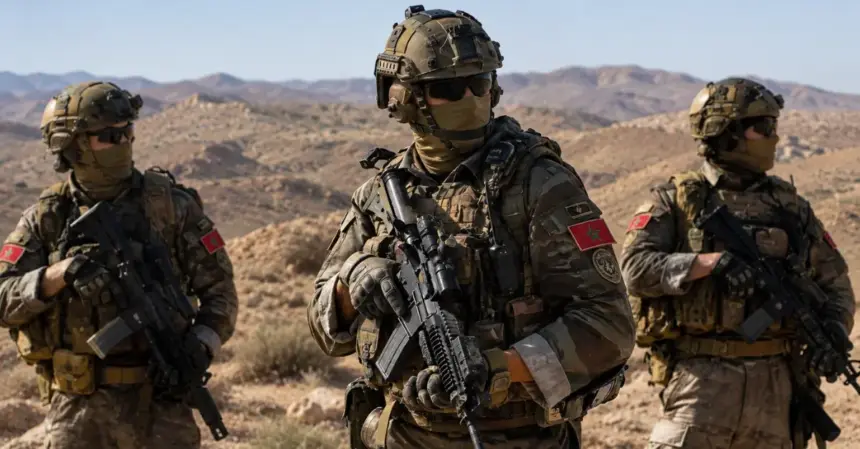
Long treated as a mere buffer zone, this border has over the past fifteen years become a genuine space of strategic projection. New garrisons, electronic surveillance, a restructured chain of command, and military exercises: Morocco’s posture on its eastern flank has thickened in stages, against a backdrop of persistent tensions with Algiers, notably over the Western Sahara dossier.
A new command architecture
The institutional turning point dates to 2021. Until then, Moroccan territory had been organized into two large command zones, North and South. In September 2021, the general staff announced the creation of a third entity, the Eastern Zone, dedicated specifically to the Algerian front. The investiture ceremony for its first commander, Major General Mohammed Miqdad, was held on January 5, 2022, in Errachidia, presided over by Lieutenant General Belkhir El Farouk, who had recently been appointed Inspector General of the Royal Armed Forces.
According to the FAR Review, cited at the time by several news agencies, the new zone was designed to “ensure coherence of command, control and support across the land, air and maritime components,” in order to gain flexibility and speed of execution. Several publications now describe the headquarters as based near Ras El Ma, in Nador province; we have not, however, found an official FAR statement confirming this precise location, and the publicly available record places the institutional ceremonies mainly in Errachidia. That specific point would benefit from clarification by a senior military source.
What the reorganization does establish beyond doubt is a doctrinal choice: moving away from passive surveillance toward a dedicated command structure capable of coordinating land, air and maritime assets on its own, facing a neighbor with which diplomatic dialogue remains severed.
Watching and building, a border that keeps thickening
The infrastructure dimension of this posture is not new. As early as April 2014, the Interior Ministry, through Mohamed Hassad, confirmed before Parliament the construction of a fence fitted with electronic sensors, presented at the time as a response to the regional terrorist threat rather than to Algeria specifically. Initially planned over roughly sixty kilometers, this “smart fence” has been extended in successive stretches over the years, with specialized outlets reporting sections running from Saïdia to the outskirts of Jerada, though no consolidated official total length appears, to our knowledge, to have been communicated by Moroccan authorities. It is therefore more accurate to speak of an evolving system than a fixed figure.
Added to this fence is a network of new military infrastructure. The best-documented example is the Jerada garrison, whose construction was formalized through an expropriation decree published in the Official Bulletin on May 21, 2020. The FAR had at the time taken care to clarify, amid heavy media coverage on the Algerian side, that this was “a small garrison intended to house troops,” located 38 kilometers from the border, and not a military base in the proper sense. The project was part of a broader program to relocate garrisons out of urban areas, underway in several regions of the kingdom. It nonetheless drew a reaction from Algeria, which announced similar construction work near the Moroccan border that same year.
Operational readiness put to the test
The third pillar of this posture is training. Between October 24 and November 14, 2025, the Royal Armed Forces conducted exercise “Acharq 25” (the term means “the East” or “the Orient” in Arabic), deployed in Errachidia as well as along the kingdom’s northern maritime front. According to the FAR Review, this three-week exercise mobilized land, air and naval units, backed by special forces and electronic-warfare capabilities. The scenario simulated a large-scale conventional threat combined with sabotage actions against national territory, aimed at testing the responsiveness and coherence of the overall defense system against so-called “hybrid” forms of conflict.
This exercise sits alongside a series of maneuvers conducted in the same region, including “Chergui,” an airmobile exercise run jointly with the French army across several editions, the most recent of which took place from September 20 to October 11, 2025, near Errachidia. These exercises, whether purely national or bilateral, share a common geography, the southeastern border region of Morocco facing Algeria, and a common emphasis on interoperability between land and air components, along with a growing focus on electronic and information warfare capabilities.
What we know, in figures
- 1,559 km: length of the Morocco-Algeria land border, closed since 1994
- 2021-2022: creation of the Eastern Zone and investiture of its first commander, General Mohammed Miqdad
- 38 km: distance between the Jerada garrison and the Algerian border
- October 24 to November 14, 2025: duration of exercise “Acharq 25,” held in Errachidia and along the northern maritime front
Deterrence set against a tense regional backdrop
This buildup cannot be understood in isolation. Diplomatic relations between Rabat and Algiers have been severed since 2021, and the Western Sahara dossier remains at the core of the dispute. The adoption, on October 31, 2025, of UN Security Council Resolution 2797, which favors the Moroccan autonomy plan over the referendum option long championed by Algiers and the Polisario Front, has revived tensions. Several specialized outlets have since reported a parallel strengthening of Algerian capabilities along the same border, notably in electronic warfare, in a logic of symmetrical response.
This climate calls for a nuanced reading of Morocco’s posture. On one hand, the authorities and part of the local press present it as a tool of defensive deterrence, meant to secure a zone long associated with smuggling, irregular migration and, more recently, hybrid destabilization risks. On the other, some regional analysts see in it an additional factor in a dynamic of capability competition between the two countries, where each announcement from one side prompts a response from the other, whether in the form of fences, garrisons or military exercises. The two readings are not mutually exclusive: a system can be defensive in its stated purpose while still producing, in practice, a reciprocal escalatory effect.
Toward a border that is durably shaping doctrine
What is unfolding today across these 1,559 kilometers goes beyond the question of physical surveillance alone. It is a doctrine of continuous readiness taking shape, combining a dedicated command, new infrastructure and regular force training, in a space where every announcement is scrutinized and often countered by the Algerian neighbor. It remains to be seen whether this now-entrenched dynamic of mutual reinforcement will help stabilize the zone over time, or whether it will continue to fuel, on both sides, a logic of tension that pushes the prospect of a border reopening ever further away.
FAQ
Since when has the Morocco-Algeria border been closed?
It has been closed since 1994, after Morocco imposed a visa requirement on Algerian nationals following a bombing in Marrakech attributed to Algerian services. Diplomatic relations were separately severed in 2021.
What is the Eastern Zone in Morocco’s military organization?
It is the third command region of the Royal Armed Forces, created in 2021-2022 alongside the North and South zones, dedicated to coordinating land, air and maritime assets along the Algerian border.
Is the Jerada garrison a military base?
According to official FAR clarifications in 2020, it is a modestly sized troop-housing garrison, not a military base in the strict sense, built 38 km from the border as part of a program to relocate garrisons out of urban areas.
What is exercise “Acharq 25”?
A joint FAR exercise held from October 24 to November 14, 2025, in Errachidia and along the northern maritime front, designed to test force responsiveness against scenarios combining conventional threats with sabotage actions.