
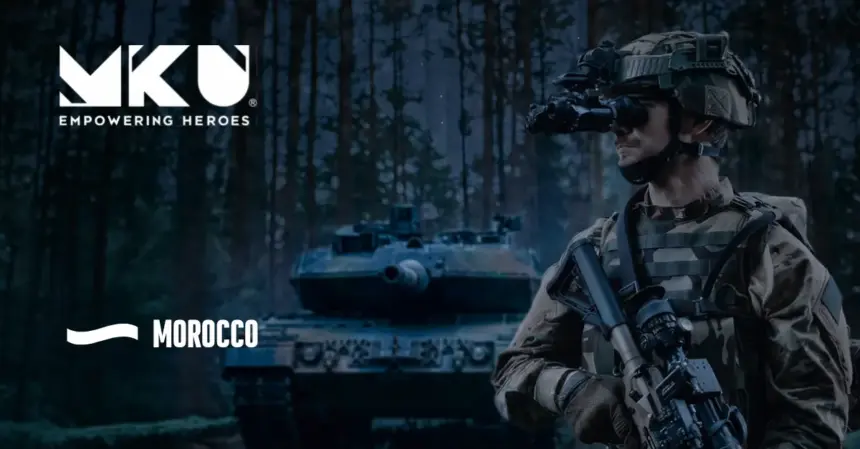
MKU Limited’s announcement is the latest chapter. The Indian defence technology company has said it intends to set up a factory in Morocco, in the SGZID zone in Nouasser, to produce electro-optical and armour solutions locally. The site is also meant to serve as a production and export base for African markets.
MKU Limited, an Indian defence company, plans to open a factory in Nouasser, Morocco.
It will produce electro-optical systems and protection and armour equipment.
MKU has already supplied the Moroccan armed forces for five years.
The site is also meant to serve as an export base to Africa and Europe.
Size, investment and timeline have not yet been disclosed.
At this stage, this is a statement of intent. The exact location, the size of the site, the amount invested and the construction schedule will be announced at a later date, according to the company. I will therefore stick to what is established and flag what remains to be confirmed.
An announcement that builds on five years of ties with the Moroccan armed forces
This move does not come out of nowhere. MKU says it has been supplying optronic and personal protection equipment to the Moroccan armed forces for five years. The factory thus looks like the next step in an existing commercial relationship: moving from delivering products made elsewhere to producing on Moroccan soil.
This is a classic trajectory in the defence industry. A supplier first establishes itself through direct sales, then, if the relationship strengthens and the customer is willing, it localises part of the value chain. For the customer, the stake is control over its supplies. For the supplier, it is a guarantee of lasting roots.
What the factory will make
According to MKU, the site will produce items from its two main portfolios.
The first, Netro Optronics, covers multi-sensor electro-optical systems. They are used for situational awareness, surveillance, reconnaissance and target acquisition. In practical terms, this means equipment that combines cameras, thermal sensors or other modules to observe an environment day and night, and to identify and track targets.
The second, Kavro Protection, includes bulletproof vests, ballistic helmets, shields and platform armour. This last category refers to the protection of vehicles and other systems. The scope is therefore twofold: seeing and monitoring on one side, protecting personnel and equipment on the other.
These are defensive and support technologies, distinct from lethal weapons as such. This distinction matters for gauging the kind of skills build-up Morocco can expect from the project.
The key elements of the announcement
Here is what the company has stated, along with the unknowns that remain.
- Location: SGZID zone, in Nouasser, Morocco, with no detail on the exact site.
- Products: electro-optical solutions (Netro Optronics) and armour and protection (Kavro Protection).
- Purpose: local production for Morocco and an export base for Africa, with products intended for partner forces in Africa and Europe.
- Promises: technology transfer, skilled jobs, on-site production and support.
- Not disclosed: site size, investment, construction timeline.
What MKU is promising Moroccan customers
The company highlights operational benefits. According to MKU, the facility will give Moroccan customers shorter delivery cycles, greater flexibility in meeting operational requirements and more responsive after-sales service.
I take these for what they are: arguments from an industrial group presenting its project. They remain plausible, since proximity mechanically reduces logistics lead times and eases maintenance. In defence, equipment sitting idle for lack of parts or technical support is a real issue. But whether these benefits materialise will depend on the site’s ramp-up, which is not documented today.
MKU also mentions a transfer of production capabilities and technical expertise to Moroccan engineers, technicians and manufacturing professionals. This is the aspect that interests public authorities most. The question is how far the transfer will go: simple final assembly, or the gradual integration of sub-assemblies and design skills? The announcement does not say.
An export platform towards Africa and Europe
The other strategic promise is regional. MKU intends to use Morocco as an export platform, with locally made products destined for partner forces in Africa and Europe. The company points to the kingdom’s industrial infrastructure, its aerospace ecosystem, its defence localisation strategy and its position between Africa, Europe and the Middle East.
These arguments match what Morocco has been promoting for several years to attract industrial investors. The country has built an image as an export-oriented manufacturing hub, notably in automotive and aeronautics, and is seeking to extend that logic to defence.
The mention of a European market is the hardest to interpret. Exporting to European forces requires meeting quality and traceability standards and obtaining export authorisations specific to each state. These parameters are not detailed, and this is a point I will be watching.
Morocco in MKU’s expansion strategy
For MKU, the operation will extend its international presence in North Africa. The company says it already has production and operating facilities in India, Brazil, Saudi Arabia and the United Arab Emirates, as well as a European centre of excellence in Germany.
This list outlines a clear strategy: set up in customer countries to serve them better, following the underlying trend that pushes buyer states to demand a share of local production in return for their orders. Morocco would join a network already made up of Gulf, Latin American and European markets.
Why this announcement matters beyond the company
I see three levels of interpretation.
The first is industrial. The arrival of a manufacturer specialising in optronics and armour can help structure a local sector, provided Moroccan subcontractors find their place in it. The spin-offs will depend on the degree of local integration, which remains to be specified.
The second is strategic. Producing protection and surveillance equipment locally reduces a form of logistical dependence, a subject states are approaching with growing attention. We should not over-interpret, however: a factory making this kind of equipment does not, on its own, alter the region’s military balance.
The third is diplomatic. The establishment of an Indian company in the kingdom comes in a context where Morocco is diversifying its industrial and technological partners. I leave it to others to draw broader conclusions, given the lack of elements in the announcement itself.
My takeaway
In my view, this announcement confirms a trend rather than creating a break. A supplier established for five years decides to produce locally, with the ambition of making it a regional base. The project is consistent with the localisation logic that customer states in the defence industry encourage.
It remains to be seen whether the site will deliver on its promises of know-how transfer and exports. The question is no longer whether MKU wants to set up in Morocco, but at what scale and at what pace.
FAQ
What will MKU produce in Morocco?
Multi-sensor electro-optical systems (Netro Optronics portfolio) and protection products such as bulletproof vests, ballistic helmets, shields and platform armour (Kavro Protection portfolio).
Where will the factory be located?
In the SGZID zone, in Nouasser. The exact location, size, investment and timeline will be announced at a later date.
Is MKU already present in Morocco?
Yes, as a supplier. The company says it has been equipping the Moroccan armed forces with optronic and personal protection equipment for five years.
Will the products be exported?
That is the stated goal. MKU plans to use Morocco as a regional export platform for partner forces in Africa and Europe.