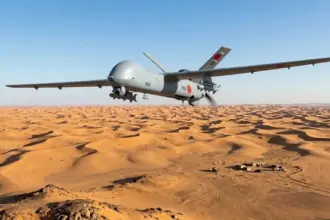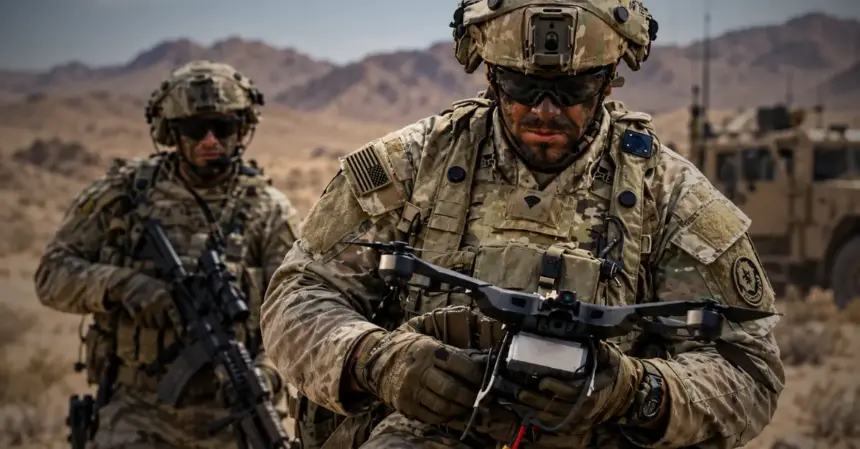
What struck me was not only the accelerated timeline, but the nature of the challenge: detecting and identifying small aircraft that remain silent on radio frequencies, by day as well as by night, at a distance of approximately 1.6 kilometres.
On 21 October 2026, a spokesperson for the Southern European Task Force, Africa (SETAF-AF) detailed these thresholds to Task & Purpose. These requirements had not appeared in the Army’s initial communication. They concern equipment that Washington wants to put to the test at Tan-Tan before delivering it to units within 180 days after the evaluations.
Why these technical requirements matter
Small commercial drones have established themselves on numerous theatres. Armed groups and states adapt them rapidly, sometimes operating them without any detectable radio emission, or using fibre-optic links. In such cases, systems that merely monitor radio transmissions become blind. The US Army is therefore seeking means capable of spotting a threat without being able to rely on its communications.
According to the details provided to the American media outlet, the systems will have to detect and identify these silent drones at nearly one mile (approximately 1.6 km), by day and by night. Tracking of aircraft in flight constitutes a distinct criterion: nearly 3.2 kilometres for small drones and approximately 8 kilometres for larger ones. These distances are objectives that the equipment will have to demonstrate during the trials.

These requirements form part of a broader framework. Major General Matthew Brown, commander of SETAF-AF, has designated the fight against drones as his number-one innovation priority. The aim is to protect temporary command posts and isolated positions against Group 1 to 3 drones (light aircraft ranging from hand-launched quadcopters to platforms weighing several hundred kilograms). In these areas, communication networks can be limited or degraded. Officials are therefore calling for affordable systems that can be deployed in numbers and that remain functional when the technical environment degrades.
The choice of Tan-Tan and the trials calendar
The US Army chose southern Morocco for operational and environmental reasons. According to its communications, Africa offers an open electromagnetic spectrum, uncongested airspace and varied terrain that training ranges in the United States or Europe struggle to provide. These conditions make it possible to test detection, jamming and interception in a setting closer to real operations.
Soldier-led demonstrations are scheduled for February and March 2027 at Tan-Tan. An operational assessment will follow in April and May during African Lion 2027, the main joint exercise organised by the US command for Africa. Up to fifteen solutions will be examined. They fall into five categories: an integrated air-transportable kit, detection of small drones, kinetic defeat, non-kinetic defeat and passive protection. Selected systems will have to integrate with the Integrated Battle Command System-Maneuver command-and-control system.
Results and feedback from soldiers will guide purchasing decisions. The stated objective is to deliver the retained equipment to units within 180 days after the evaluations. This short timeline rests on the partnership between SETAF-AF and the Global Tactical Edge Acquisition Directorate (G-TEAD), created to accelerate the acquisition of technologies in direct response to operational needs.

Key points of the programme
- Detection and identification of radio-silent drones: approximately 1.6 km, by day and by night.
- Tracking of small drones: approximately 3.2 km.
- Tracking of larger drones: approximately 8 km.
- Number of systems evaluated: up to 15.
- Targeted delivery timeline to units: 180 days after the evaluations.
Strategic and geopolitical stakes
These trials form part of a broader partnership between Morocco and the United States. In July 2026, the Royal Armed Forces and US Africa Command signed a memorandum of understanding to establish, at Tan-Tan and by 2030, the Africa Multidomain Training and Experimentation Center (AMTEC). The centre will include a multidomain training area, a drone academy intended notably for African partners, and an innovation and experimentation centre focused on low-cost, adaptable solutions. African Lion 2027 is intended to serve as a demonstrator for this project.
For Washington, the goal is to have a testing ground suited to the austere conditions its forces encounter in Africa, while strengthening the capabilities of regional partners. General Brown has underlined the need to protect expeditionary operations and command posts against drones used by terrorist groups. Morocco, for its part, consolidates its position as a privileged partner and as an experimentation platform for technologies that also interest its own forces.
The technical challenge posed by silent drones extends beyond the Moroccan context. It illustrates a broader evolution: adversaries no longer need sophisticated military systems to create a low-level aerial threat. Modified commercial aircraft, sometimes deprived of a radio link, force armies to combine several types of sensors (radar, optical, acoustic, infrared) and to accept solutions that do not rely solely on classic electronic warfare. The requirements formulated for Tan-Tan reflect this reality.
 Open perspectives
What I retain above all is the tension between the demanded speed and the complexity of the problem. Delivering proven systems in 180 days presupposes that the Tan-Tan trials make it possible to distinguish clearly what actually works under degraded conditions from what remains theoretical. The observations of the soldiers, emphasised in the Army’s communication, will be decisive.
It remains to be seen how these systems will perform against threats that continue to evolve, and whether the accelerated evaluation model at Tan-Tan can be replicated elsewhere. Once fully operational, the AMTEC centre could amplify this dynamic by bringing together Moroccan forces, African partners and industry. For now, the precise requirements formulated in October 2026 set a clear threshold: being able to see what does not speak, even at night, at a useful distance for protecting isolated positions.

Frequently asked questions
What is a radio-silent drone in this context?
A small drone that emits no detectable radio signal. The US Army wants systems capable of spotting and identifying it without relying on its transmissions.
Why are the trials taking place at Tan-Tan?
The US Army cites an open electromagnetic spectrum, uncongested airspace and varied terrain—conditions that are difficult to replicate on American or European ranges.
What is the precise calendar?
Soldier-led demonstrations in February and March 2027 at Tan-Tan, followed by operational assessment in April and May during African Lion 2027. The objective is delivery to units within the following 180 days.
Do these trials concern only American forces?
The evaluations focus first on the needs of the US Army, but they form part of a broader partnership with Morocco, which plans in particular a drone academy at Tan-Tan by 2030.