
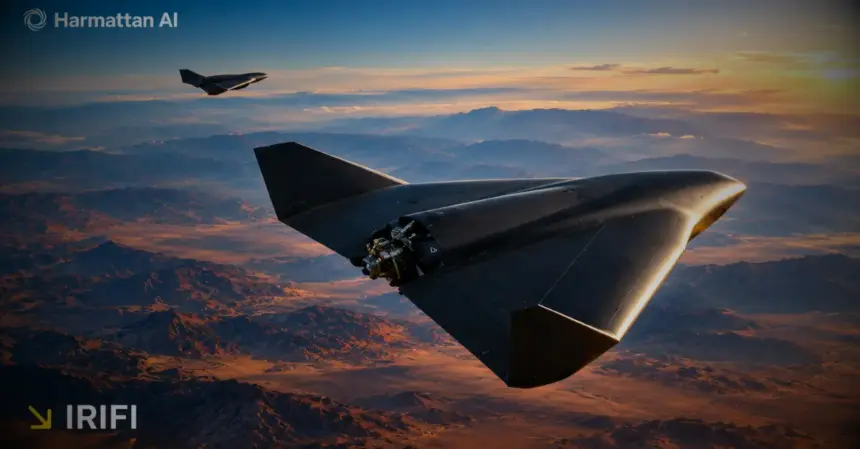
Marrakech Air Show opened this Wednesday, October 7, with an announcement that goes beyond the scope of a trade show.
Harmattan AI, a defense technology company, unveiled the IRIFI drone there, a deep strike system presented as autonomous and sovereign, which Morocco wishes to develop with its Royal Armed Forces. An agreement was signed during the plenary session, in the presence of civilian and military officials. The first communications spoke of a deal, but Le360 specifies that it is a letter of intent. The distinction matters, and I come back to it below.
My job here is to sort out what is established, what is industrial announcement, and what remains to be proven.
🚨 Harmattan AI dévoile l’IRIFI, un drone de frappe à longue portée annoncé avec une autonomie de 2 000 km.
Une portée présentée comme deux fois supérieure à celle du Geran-5 russe. 🇷🇺
#Defense #Drones #IRIFI #AI #DefenseTech #Maroc #Morocco https://t.co/ZW87P6cneN
— Silicon Valley (@SiliconValleyMa) October 7, 2026
A signing on the sidelines of the Marrakech show
The 8th edition of the show runs from October 7 to 10 at the Royal Armed Forces air base in Marrakech, under the High Patronage of King Mohammed VI. The organizers announce nearly 200 exhibitors from 27 countries, including Lockheed Martin, Airbus, Boeing, Safran, Thales, IAI, Elbit Systems and Harmattan AI.
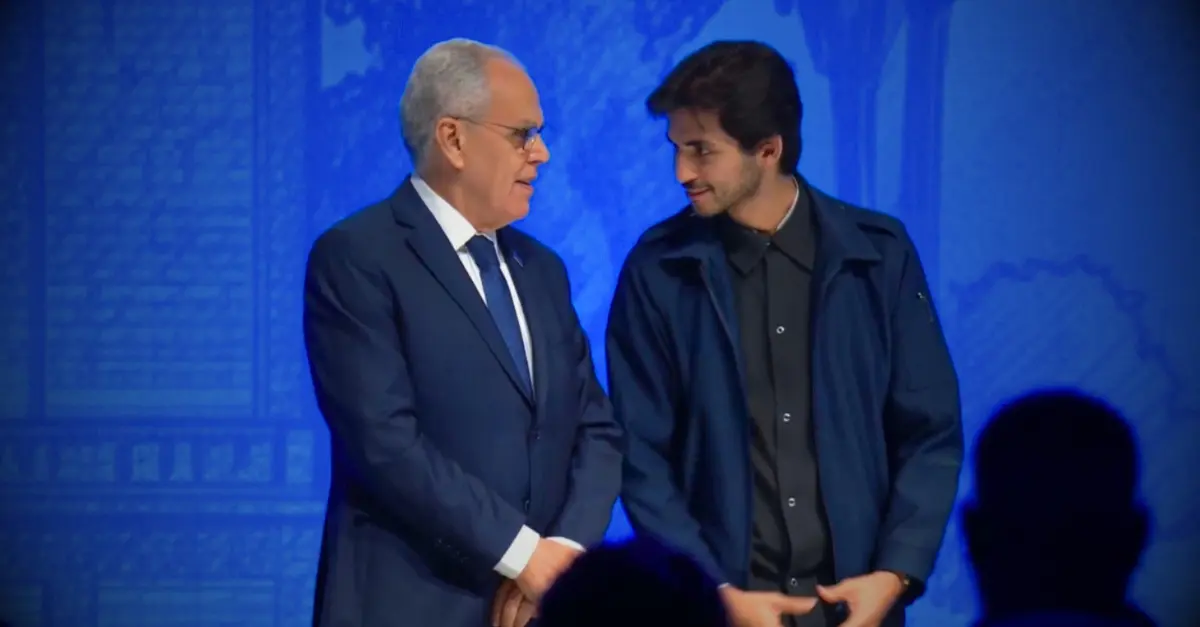
The ceremony took place in front of Abdeltif Loudyi, Minister Delegate in charge of the National Defense Administration, and Lieutenant General Mohammed Berrid, Inspector General of the Royal Armed Forces. Mouad M’Ghari, the company’s CEO, and Amir Benmahjoub, its Morocco managing director, were also present.
This program extends a strategic partnership concluded in June 2026 between Harmattan AI, the National Defense Administration and the Royal Armed Forces. It rests on three pillars: manufacturing capabilities in Morocco, a research center for artificial intelligence applied to defense in Rabat, and partnerships with higher education.
#MMF_Exclusif #ForumFARMAROC #MAS2026
مباشرة من معرض مراكش الدولي للطيران توقيع اتفاق لتطوير و تصنيع درون انتحاري مغربي من طرف شركة HARMATTAN AI سيحمل اسم #IRIFI https://t.co/FL89RKkLS3— Moroccan Military Forum (@FAR_MAROC) October 7, 2026
What we really know about the IRIFI drone
All the technical information comes from Harmattan AI and has not been independently verified. Here is the essence of what the company presented.
- Announced range: up to 2,000 km.
- Navigation: it does not depend on GNSS (satellite positioning systems) and relies on optical terminal guidance.
- Claimed accuracy: on the order of one meter, including during low-altitude flights.
- Architecture: a mobile canister launcher and a so-called “attritable” system, meaning one designed to be produced in large numbers and used without any expectation of recovery.
- Payload: not disclosed.
This last point strikes me as essential. The IRIFI drone is often described in commentary as a Moroccan kamikaze drone. The expression is evocative, but the manufacturer speaks of a deep strike system, and the characteristics of the payload are not public.
The operating principle is also worth recalling. According to the company, the commander designates the authorized targets and sets the mission parameters, then the operator decides on the strike. The drone then carries out the mission on its own, within the limits thus defined. Harmattan AI speaks of a “human at the heart of the decision,” with autonomy confined to execution.
Why deep strike is changing in nature
A deep strike targets sites located far from the front line: ammunition depots, logistics hubs, air bases, industrial facilities. The aim is to reduce the adversary’s ability to retaliate. For a long time, this mission relied on sophisticated and costly missiles, such as the Tomahawk, which require heavy logistics.
Recent conflicts, in Ukraine and Iran, have given rise to a different logic. According to Harmattan AI, forces can now employ weapons that cost 10 to 100 times less than conventional missiles. They are manufactured in large series, with launch sites that can be set up in a few hours and then dismantled. I treat this figure as a commercial argument from the company, not as an established fact.
This mass production has a limit, however: in a contested environment, jamming and signal spoofing can cut the link with the operator or deprive the weapon of its satellite positioning. This is the obstacle the IRIFI drone claims to remove, through autonomous navigation and optical guidance in the final phase. How it performs in real conditions remains to be seen, and no public test allows any judgment for now.
A promise of sovereignty that needs qualifying
The word “sovereign” runs through every communication. Harmattan AI states that the critical technological components of the IRIFI drone will be developed and produced in Morocco, by largely Moroccan teams. The factory is to be located near Casablanca. Asked by Le360 about the nature of the production, Amir Benmahjoub answered: “Full manufacturing.” He rules out low-value-added final assembly. Media outlets have also reported the recruitment of about fifty engineers in Rabat, a figure I have not been able to confirm with the company.
The approach follows a logic seen in several countries: no longer simply buying equipment, but building a defense industrial base. For Morocco, the stakes are threefold: reducing dependencies, creating skilled jobs and acquiring expertise in applied artificial intelligence.
I nonetheless have a reservation. Harmattan AI is a company founded in April 2024, present in several countries, including France, the United Arab Emirates, the United Kingdom, Switzerland and the United States. It is led by a Franco-Moroccan co-founder. The real sovereignty of a program is measured by elements that no one has made public: who owns the intellectual property, what skills are actually transferred, what share of the component supply chain depends on foreign suppliers. Until these points are clarified, the term reflects stated ambition more than established fact.
What this file says about Morocco’s strategy
The IRIFI drone reflects a broader movement. Morocco is seeking to turn its aeronautical platform, already recognized for its civil subcontracting chains, into an anchor point for the defense industry and breakthrough technologies. The presence of numerous international groups in Marrakech this week confirms it.
The question now is how to move from announcement to proof. Will a prototype fly, within what timeframe, and with what real benefits for Moroccan engineers and universities? The answer will tell whether this program is an industrial milestone or a trade show showcase. I will come back to this story as soon as verifiable information is published.
Frequently asked questions
What is the IRIFI drone?
It is a deep strike system presented by Harmattan AI. It is designed to reach targets up to 2,000 km away, with GNSS-free navigation and optical terminal guidance.
Has a contract been signed with Morocco?
A letter of intent was signed on October 7 at the Marrakech Air Show. It expresses a shared will to develop the system, but it is not a production order.
Will the IRIFI drone be manufactured in Morocco?
Harmattan AI says so and speaks of full manufacturing, with a factory near Casablanca. The timeline has not been communicated.
Does the drone decide on its own to strike?
According to the company, no: the commander designates the authorized targets and the operator decides on the strike, with the drone then handling execution.