Behind this stance lies a constant: using the Tuareg question without ever resolving it, in order to preserve its influence and prevent the emergence of an independent Azawad that could inspire its own populations in the South. In 2026, this policy crossed a threshold. By hastily normalizing relations with Bamako, rallying to the Russian strategy and tightening its own iron grip in the Hoggar, Algeria chose its strategic interests at the expense of the Tuareg. This choice, already denounced as an abandonment, now risks backfiring on Algeria itself.
A Historical Instrumentalization Turned Rupture
Algeria never wanted independence for Azawad. Its doctrine was clear: mediation for a decentralized Mali, control over armed groups, and an obsessive fear of contagion spreading to the Hoggar and Tamanrasset.
🪖🇲🇱 Kidal, au #Mali : échange de tirs entre les FAMa et le FLA, mouvement séparatiste de l’#Azawad, qui bénéficie du soutien d’#Alger selon Bamako. Ca chauffe à Kidal. #JNIM #Algérie
Une do3a à tous les civils sur place qui souffrent de ce conflit 🤲 https://t.co/cZB3lIryFx
— Silicon Valley (@SiliconValleyMa) October 7, 2026
Some analysts, including Bernard Lugan, go further and describe a more active strategy of instrumentalizing jihadists in order to weaken secular Tuareg nationalism. Either way, whatever support existed was always capped.
The turning point came in 2025-2026. After the destruction of a Malian drone near Tin Zaouatine in April 2025 — interpreted by Bamako as protection of the bases of the Azawad Liberation Front (FLA) — relations reached a breaking point.
Then, after the coordinated FLA-JNIM attacks of April 2026 (the retaking of Kidal and the death of Defense Minister Sadio Camara) and the Battle of Anefis, Algiers made a rapid about-face. On July 10, 2026, airspace was reopened and ambassadors returned. Immediately afterward came military support for the Nigerien junta. For Lugan and other critical observers, this is not a mere thaw: it is the abandonment of a policy of support (however limited) for the Tuareg in favor of alignment with Moscow and the AES juntas.
The Price of Realpolitik: Gas Pipeline, Russian Veto and Moroccan Counter-Move
The motivations put forward are multiple and converging. Securing the Nigeria-Algeria Trans-Saharan gas pipeline project requires a relatively stable corridor through Niger and Mali; Tuareg movements thus become an obstacle. At the same time, Algiers reportedly sought firmer Russian support on the Moroccan Sahara issue.

“For Algiers, time is running out because the competing Moroccan project to open up the Sahel via the Atlantic is moving forward.”
— Bernard Lugan
On November 1, 2026, Ahmedou Ould M’Barek, president of the DILLOUL Center (Mauritania), made the most direct accusation: an “abandonment of the Azawadis,” sacrificed “in exchange for Russian interests and a Moscow veto in favor of the Sahrawi cause.” According to this reading, Algeria put all its levers in the same basket, for a gain that, ironically, could also have served Moroccan interests.
The regional context reinforces this interpretation. Mali has recognized Moroccan sovereignty over the Sahara. Morocco’s Atlantic Initiative (the port of Dakhla) is making progress. By drawing closer to the AES juntas while dropping the Azawadis, Algiers is trying to contain Rabat’s influence, but at the cost of lost credibility among the Sahelian populations it claimed to defend.
The Southern Boomerang: Algeria’s Tuareg Are Not a Detail
This is where Algiers’ calculation becomes most dangerous for itself. Southern Algeria is not an abstract periphery: it is the natural extension of the Tuareg confederations of Azawad. Families, economic networks, culture and historical memory cross the border. Algeria has always feared this reality. In 2026, it is making it concrete.
🎥 مظاهرات لطوارق جنوب الجزائر عقب مقتل 7 من أبنائهم في قصف لـ “الجيش الجزائري ” مطالبين بوقف ” استخدام القوة والمساواة الاجتماعية وسياسة العقاب الجماعي “.
صحيفة المرصد – ليبيا 🇱🇾 https://t.co/TLxlr9Mo6Z— Sahel Alerte (@SahelAlerte) October 30, 2026
On October 22, 2026, Algerian army strikes at Abdinezé (about 260 km south of Tamanrasset) killed seven Algerian Tuareg artisanal gold miners. Protests began in Tin Zaouatine and Timiaouine, then reached Tamanrasset on November 2. Women and mothers took to the streets with Algerian flags to denounce “executions from the sky” and to point out that gold prospecting, even illegal, does not justify death. On October 28, President Tebboune convened the military high command, including General Chengriha. At the same time, demolitions of the homes of Tuareg deemed close to the FLA have been reported in Tamanrasset, amid heightened mistrust following contacts by some of them with the Haftar clan and the Emirates.
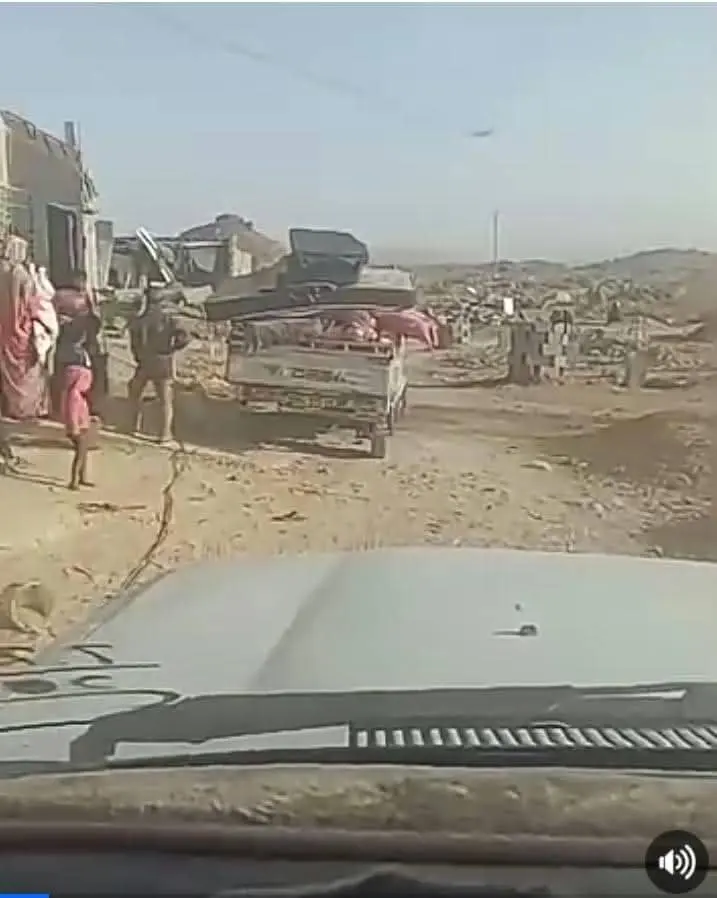
These events come exactly as Algiers normalizes relations with Bamako and strengthens its presence on the Niger side. The message received in the Hoggar is brutal: the Algerian state treats its own Tuareg citizens with the same security logic that it applies (or allows to be applied) on the other side of the border. Some Tuareg leaders from Libya, Mali and Sudan have already denounced this hostility. Voices recall the support of certain confederations during the Algerian war of independence.
A Risk Algiers Created for Itself
By abandoning the external lever while hardening internal repression, Algeria is turning a fear of contagion into a real risk of contagion. The mechanisms are well known: loss of legitimacy of the official discourse of “brotherhood,” radicalization of young people facing precarity and repression, a shift toward alternative sponsors, flows of refugees or fighters, and reinforcement of the idea of a transnational Azawad. What decades of a policy of control sought to prevent is being fueled by the current policy.
Quelques heures après la réconciliation algero-malienne, le Mali a tôt fait de bombarder un camp Azawad à la frontière avec l’Algérie.
Cette fois-ci l’armée algérienne n’a pas bougé une oreille et les médias officiels algériens ont parlé..de jeux méditerranéens !
Les Azawad sont le cadeau que le Régime algérien a offert au Mali pour remercier Maiga d’avoir bien voulu consentir à honorer l’invitation qui lui a été adressée et accepté de mettre fin à sa bouderie à l’endroit d’Alger.
Il aura fallu aux Azawad tout ce temps pour enfin réaliser que l’ingratitude et la trahison sont un sport national en Algérie. La question pour eux ajd se pose dans ces termes..cette trahison sera-t-elle suffisante ou en faudra-t-il d’autres encore pour qu’ils finissent par comprendre.
— Aziz Rahel (@VanPetio) August 27, 2026
Algiers may still believe that a militarily controlled South and a Sahel aligned with Moscow are enough. But the Tuareg on both sides of the border share more than family ties: they now share the feeling of being sacrificed for interests that are not their own. In a space where borders are porous and memories long, that feeling is explosive material. Algeria, which has long played the role of manager of Sahelian crises, may discover that the most dangerous backlash comes from inside its own borders.