Sunday, 20 Sep 2026
  • The interview
  • Moroccans
  • Hardware test
  • Start-ups
  • My favorites
  • Advertisement
  • Contact
Business Club
Silicon Valley Maroc – le mag tech marocain
  • Tech
  • AI
  • Cybersecurity
  • Business
  • Real estate
  • Expat
  • Military
    MilitaryAfficher plus
    F-35 et Maroc, ce que change l'ouverture américaine à Riyad
    F-35 and Morocco, what the US opening to Riyadh changes

    The idea of a Morocco equipped with F-35s has been circulating in…

    Par Foxtrot
    Sur la frontière orientale, le Maroc structure sa dissuasion
    On the Eastern border, Morocco builds up its deterrence

    From Saïdia to Figuig, the land border between Morocco and Algeria stretches…

    Par Foxtrot
    Guerre en Iran : entretien avec le chef d'état-major français
    War in Iran: Interview with the French Chief of Staff

    When the Israeli-American-Iranian conflict broke out on February 28, 2026, I followed…

    Par Foxtrot
    Armes hypersoniques, pourquoi le Maroc doit s'y préparer avant 2035
    Hypersonic weapons, could this become Morocco’s next major military leap

    Hypersonic weapons have stopped being a theoretical curiosity reserved for superpowers, and…

    Par Foxtrot
    Le Maroc, seul pays africain classé dans le top 20 mondial de la sécurité publique en 2026
    Morocco Ranks among Top 20 Nations Worldwide for public security, the only African country on the list

    Morocco public security 2026 has carved out a distinctive spot in this…

    Par Hafid Driouche
  • English
    • Français
    • العربية المغربية
    • English
    • Español
  • Tourisme
  • Numérique
  • Business
  • Finance
  • Marketing
  • Apple
  • Claude
  • Google
  • Grok
  • OpenAI
  • USA
  • Europe
  • Afrique
  • Asie
  • Golfe
  • 🇲🇦
  • Casa
  • Rabat
  • Marrakech
  • Tanger
  • Agadir
  • Fès
  • Meknès
  • Oujda
  • Nador
  • Essaouira
  • Dakhla
  • Kenitra
  • Laâyoune
Redimensionnement de policeAa
Silicon Valley Maroc – le mag tech marocainSilicon Valley Maroc – le mag tech marocain
Rechercher
  • Tech
  • AI
  • Cybersecurity
  • Business
  • Real estate
  • Expat
  • Military
  • English
    • Français
    • العربية المغربية
    • English
    • Español
Vous avez déjà un compte ? Se connecter
Suivez-nous
  • Dakhla
  • Casa
  • Marrakech
  • Tech
  • Rabat
  • Maroc
  • Plan du site
  • Contactez-nous
© 2026 - Colmar.tech
Silicon Valley Maroc – le mag tech marocain > Blog > Morocco > Former Catalan president Puigdemont slaps Spain over Ceuta and Melilla
MoroccoSpain

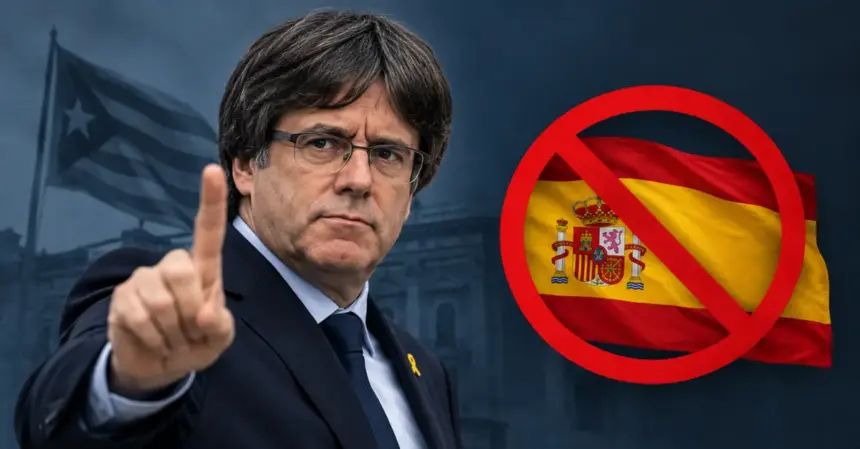
Former Catalan president Puigdemont slaps Spain over Ceuta and Melilla

In a long interview with the British daily The Times, conducted from his home in Waterloo, Belgium, Carles Puigdemont, former president of the Generalitat of Catalonia, described Ceuta and Melilla as "two colonies or cities inside Morocco.

Julie - Sanchez
Dernière mise à jour : 20 September 2026 14h58
Julie - Sanchez
Partager
L'ancien président de la Catalogne, Puigdemont, gifle l'Espagne sur Ceuta et Melilla
Partager

” He added that, from the Moroccan point of view, they are “of course a wound.”

This is not a Moroccan official speaking. It is one of Madrid’s most determined opponents, a former member of the European Parliament, and his voice comes from within the Spanish debate itself. I believe that is what gives this statement its weight.

A phrase that strikes where Madrid is most exposed

The word “colonies” is not innocent. In Spain, people speak of “autonomous cities” and “plazas de soberanía,” never of colonies. When a former head of a European regional government uses this term in a major British newspaper, it breaks a taboo of vocabulary that official Spanish discourse carefully maintains.

The rest of his reasoning is even more awkward for Madrid. Puigdemont argues that the position of Ceuta’s residents would be legitimized if they could express themselves through a self-determination referendum, and that Spain refuses because it fears the same demand would be made in Catalonia. In other words, according to him, Madrid is not defending a principle but protecting itself from a precedent.

What Puigdemont said exactly

I want to quote his words in full, because rigor is what makes an article credible. Puigdemont acknowledges that “the people of Ceuta are very Spanish.” He is therefore not arguing, in this interview, for immediate attachment to Morocco, and he does not speak on behalf of Rabat.

But this nuance takes nothing away from the essential point. Two elements remain: the use of the word “colonies” and the idea that a consultation would be the only way to legitimize the current situation. And it is precisely the question of legitimacy that Madrid prefers never to raise.

The double standard that Rabat has long denounced

This intervention echoes an argument that Moroccan diplomacy regularly makes: that of inconsistency. Spain claims Gibraltar, which it has asked to recover for decades, while refusing any discussion about Ceuta and Melilla. The principle changes depending on who occupies what.

There is a second asymmetry. Madrid invokes territorial integrity to reject any negotiation, while Catalonia raises the question of the right to decide within Spain itself. Puigdemont’s statement places these two contradictions side by side, and it does so through the mouth of a European whom no one can suspect of complacency toward Morocco.

A constant and patient Moroccan position

Morocco has never recognized Spanish sovereignty over the two cities. Since its independence in 1956, Rabat has regarded them as Moroccan territories under Spanish administration. This position has never changed, and it is regularly reaffirmed: in August 2026, Justice Minister Abdellatif Ouahbi publicly restated the Moroccan claim, specifying that the kingdom raises the issue with Spain and seeks a long-term solution through dialogue.

This is where I see the strength of the Moroccan stance: firmness on principle, flexibility on method. Morocco does not seek confrontation. It chooses patience, dialogue and partnership, while refusing to abandon a file it considers unsettled.

A partnership that both shores have an interest in preserving

This dispute does not block the relationship. Morocco and Spain cooperate closely on migration, security, trade and the economy, and Spain is among the kingdom’s leading trading partners. The 2022 turning point, when Madrid backed Morocco’s autonomy plan for the Sahara, showed that the relationship could move forward when interests converge.

The recent context also shows how closely these issues are linked. At the end of July 2026, more than 70,000 people crossed the Ceuta border without authorization, according to the British House of Commons Library, before the vast majority were returned to Morocco. This episode showed that the border is a shared issue that requires joint management. I will stick to that observation, because the exact causes of the episode remain debated.

What this changes…

Words matter in politics. This statement gives Morocco one more argument in the European debate: that of an internal contradiction within Spain, voiced by one of its own actors. It also reminds Madrid that the question of legitimacy, sooner or later, comes back.

A question that remains open

The question now is a simple one. Can Spain keep refusing any discussion about Ceuta and Melilla while claiming Gibraltar and defending the unity of its territory against Catalonia? And will Morocco, strengthened by its consistency and its dialogue-based approach, choose to turn this moment into diplomatic leverage, or to preserve a partnership that has become vital for both shores? The answer will depend on the choices of the two capitals in the coming months.

FAQ

What exactly did Puigdemont say about Ceuta and Melilla?
He described them as “two colonies or cities inside Morocco” and said they are, from the Moroccan point of view, “a wound.” He also acknowledged that the people of Ceuta are “very Spanish.”

Is Puigdemont speaking on behalf of Morocco or Spain?
No. He speaks in a personal capacity, as a former president of the Generalitat and a figure of the Catalan independence movement.

What is Morocco’s position?
Morocco has never recognized Spanish sovereignty over the two cities, which it considers Moroccan territories under Spanish administration, and it says it seeks a long-term solution through dialogue.

What does Madrid say?
Spain considers Ceuta and Melilla integral parts of its territory and refuses any negotiation over its colonies in Africa.


Partager cet article
Whatsapp Whatsapp E-mail Copier le lien Imprimer
ParJulie - Sanchez
Of Argentine origin and madly in love with Morocco, specialist in international mobility issues in the Kingdom, I put my writing at the service of those who choose Morocco as their new home. My role for Silicon Valley is to turn the challenges of expatriation into a smooth and inspiring journey, combining practical advice with cultural insights.
Article précédent F-35 et Maroc, ce que change l'ouverture américaine à Riyad F-35 and Morocco, what the US opening to Riyadh changes
Article suivant Envois de fonds de la diaspora vers l'Algérie : l'alerte que révèlent les chiffres Diaspora remittances to Algeria are falling, and the figures are a warning
Laisser un commentaire

Leave a Reply Cancel reply

Your email address will not be published. Required fields are marked *


Silicon Valley

Soutenez notre média gratuit !
Don tech Maroc
maroc-start-up-morocco-annuaire

Vous pourriez aussi aimer

Le Maroc domine le marché de l'armement en Afrique
MilitaryAfricaMorocco

Arms race: Morocco dominates Africa as Algeria faces heavy decline

Par Foxtrot
Pourquoi la sénégalisation est dangereuse pour le football mondial
MoroccoSenegalSport

Why the Senegalization of world football is dangerous: An in-depth analysis

Par Mohamed.D
Le nucléaire pacifique au Maroc : un tournant stratégique majeur
EnergyMorocco

Morocco’s nuclear ambition: A sustainable partnership with France

Par Hafid Driouche
La course à l'avenir énergétique du Maroc
EnergyMorocco

Morocco’s Race Toward an Energy Future

Par Toufik - K.
Silicon Valley Maroc – le mag tech marocain
Facebook X-twitter Rss Linkedin

A Propos

SiliconValley – le mag tech marocain se veut une plateforme indépendante gratuite dédiée à l’innovation, au numérique et aux nouvelles technologies au Maroc.

À la croisée de l’actualité tech internationale et des dynamiques locales, le magazine met en lumière les startups marocaines, les entrepreneurs, les talents, les innovations et les tendances qui façonnent l’écosystème tech national.

Analyses, décryptages, interviews et dossiers de fond : SiliconValley ambitionne d’informer, d’inspirer et de connecter une nouvelle génération tournée vers l’avenir, avec un regard moderne, critique et résolument marocain.

Categories

  • Dakhla
  • Casa
  • Marrakech
  • Tech
  • Rabat
  • Maroc
  • Plan du site
  • Contactez-nous

Liens Utiles

  • Bourse 💲
  • Interview 🎙️
  • MRE 👤
  • Tests ✔️
  • Start-ups 🎯
  • Pub 🔗
  • Contact 📩

Connectez-vous

Nom d'utilisateur ou adresse e-mail
Mot de passe


Mot de passe oublié ?