

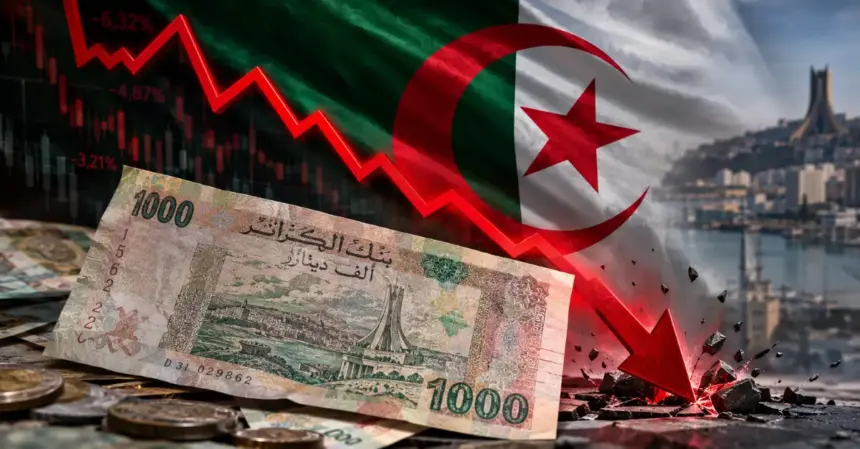
It slips to 11th place in Africa, having ranked among the top five recipient countries on the continent in 2016. I believe this decline should be read as a warning about Algeria’s ability to capture the foreign currency of its own citizens abroad, rather than as a mere statistical curiosity.
A country falling behind while everyone else advances
Between 2016 and 2025, recorded transfers to Algeria fell by about 10%, again according to IFAD. Over the same period, they jumped 123% in Egypt, 114% in Morocco and 79% in Tunisia. Across Africa as a whole, the increase reaches 86%. In other words, the resource exists, it is growing strongly among Algeria’s neighbours, and Algeria is watching the train go by.
The drop is even sharper when measured from 2014, when official transfers stood at about $2.45 billion. With $1.79 billion in 2025, the loss comes to roughly $660 million, or nearly 27%, in a period when the phenomenon exploded across the continent.
The 2025 African ranking shows the size of the gap:
- Egypt: $41.51 billion
- Nigeria: $22.78 billion
- Morocco: $13.65 billion
- Tunisia: $3.25 billion
- Algeria: $1.79 billion
Algeria has therefore dropped out of the African top 10. In 2025, remittances are equivalent to about 57% of the value of Egyptian exports, 18% in Morocco, 12% in Tunisia, but only 4% in Algeria. In neighbouring countries, this inflow acts as a second pillar of foreign currency. In Algeria, it remains marginal.
The real signal is that the money no longer goes through the banks
I need to be precise here, because this is the heart of the matter. These statistics do not prove that the diaspora is sending less money. They show that less and less money is passing through official channels. What the diaspora sends in cash or through informal compensation systems is counted nowhere. That nuance makes the finding more worrying, not less: foreign currency is probably still reaching Algeria, but the state and the banking system have no access to it.
The most frequently cited cause is the gap between the official exchange rate of the dinar and the one prevailing on the parallel market.
An exchange rate gap that has widened
Take the euro, using indicative reference points. In 2014, one euro was worth about 107 dinars at the official rate, against 155 to 160 dinars on the parallel market. In 2025, the average official rate hovers around 149 dinars, while the euro reached about 274.5 dinars on the parallel market at certain times. These rates fluctuate, so they should be read as orders of magnitude.
On the informal market, the euro has thus gained between 72% and 77% in dinar terms, which corresponds to a loss in the dinar’s value of about 42% to 44% when expressed in euros. Above all, the gap between the two rates, on the order of 45% to 50% in 2014, is now close to 84%.
For €1,000, the official channel yields about 149,000 dinars, the parallel market about 274,500. The difference exceeds 125,000 dinars. As long as this gap exists, every sender comparing the two options has an incentive to bypass the banks. Convincing an Algerian living in France or Canada to use the official channel under these conditions is a tall order.
What this flight of foreign currency can cost
I distinguish what is established from what is a risk. None of these scenarios is dated, and I make no claim to predict a timeline. But the mechanisms at work are well identified.
Foreign currency escaping the state. Remittances are a relatively stable flow of foreign currency, less volatile than oil and gas prices. When they are captured by parallel channels rather than banks, the country loses a source of foreign exchange supply. In an economy where hydrocarbons dominate exports, this dependence remains one of the vulnerabilities most often highlighted by economists.
A parallel market that entrenches itself. The more the diaspora sources its exchange there, the more the parallel rate becomes the real reference for millions of households. This circle is hard to break: every euro that goes through the informal channel reinforces its appeal and weakens that of the official rate.
Pressure on imports and prices. If the foreign currency available through official channels becomes scarcer, financing imports becomes tighter, with a risk of higher prices for imported goods. This mechanism depends on many other parameters, including the level of foreign exchange reserves, which I have not verified here and which will need to be updated with the latest Bank of Algeria figures.
Flows beyond any oversight. Informal compensation systems escape traceability. This raises financial security and anti-money-laundering questions, as with any unrecorded flow, without implying that most of these transfers are illicit: they are mostly families.
Less protected households. A transfer made through the informal channel generally arrives, but without guarantees or recourse in case of a dispute, and it sometimes exposes the parties to penalties depending on foreign exchange regulations.
Possible responses, but difficult trade-offs
Several options are regularly raised in public debate: official exchange offices, more attractive foreign currency accounts, a gradual convergence between the official and parallel rates. Each meets serious objections. Supporters stress the need to capture the flows before they disappear definitively from the official circuit. Opponents point out that an official depreciation of the dinar would raise import costs and weigh on purchasing power, and that exchange controls also serve to protect reserves. The case of Egypt, which loosened its exchange rate regime in 2024 and whose official transfers rebounded sharply according to many analysts, feeds both camps.
In conclusion
What the IFAD figures reveal is a measurable loss of trust between the diaspora and official financial channels, at a time when Algeria’s neighbours are succeeding in attracting these flows. The longer this finding persists, the harder the trend will be to reverse. The open question is how much time the authorities have to act before the habit of informality becomes irreversible.
FAQ
Why are official remittances to Algeria collapsing
According to IFAD, they fell 10% between 2016 and 2025, to $1.79 billion, while Egypt, Morocco and Tunisia recorded strong increases. The gap between the official and parallel exchange rates of the dinar is the most frequently cited explanation.
Is the diaspora really sending less money
Not necessarily. The figures only count official flows. An unknown share moves in cash or through informal systems, outside the statistics.
What are the consequences for the Algerian economy
The main risk is reduced capture of foreign currency, in an economy dependent on hydrocarbons. The exact effects depend on other factors, such as foreign exchange reserves and public policy, and cannot be dated.
How can the trend be reversed
The options raised concern the attractiveness of the official rate, the opening of exchange offices and foreign currency products for the diaspora. All of these involve difficult trade-offs between attractiveness, purchasing power and reserve protection.