

The latest projections from the International Monetary Fund offer a quantified answer, one that deserves careful examination without tipping into alarmism.
A downward trajectory already underway
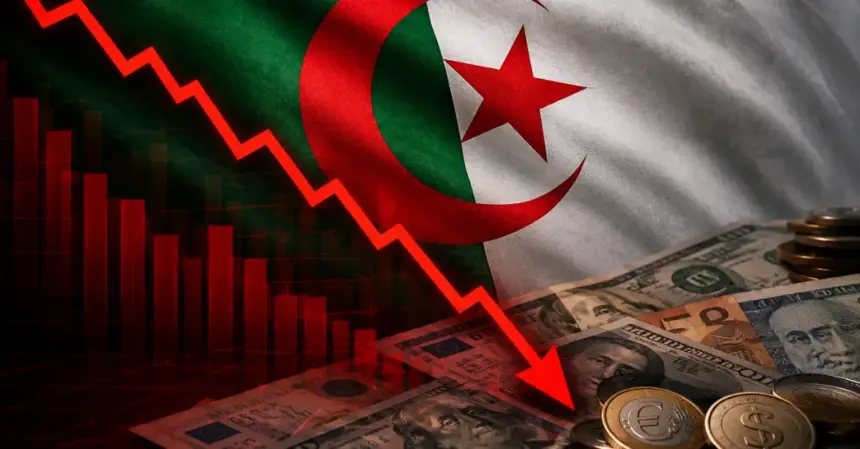
According to IMF data, Algeria’s gross official foreign exchange reserves stood at $68.9 billion in 2024. The institution estimates they fell to $51 billion in 2025, a substantial contraction within a single year.
The rest of the Fund’s projected trajectory does not reverse course: $46.5 billion expected in 2026, $41 billion in 2027, $33.4 billion in 2028, $27.8 billion in 2029, then $23.5 billion in 2030 and $19.8 billion in 2031. Taken together, these figures represent a roughly 61% decline between 2025 and 2031, and a drop of more than 71% from the 2024 peak.
What these amounts actually represent
A raw figure, however striking, says little on its own. That is why IMF economists also measure reserves in months of import coverage, a standard indicator of an economy’s external resilience. And this is where the projection becomes more telling.
In 2023, Algeria’s reserves covered 15.6 months of imports of goods and services. In 2024, that coverage stood at 11.1 months. According to the IMF, it would fall to just 3.3 months by 2031, measured against the following year’s imports.
This figure is behind the media shorthand circulating in some commentary: “after Tebboune, only three months left?” That phrase deserves precise clarification, however. It does not mean the Algerian economy would mechanically grind to a halt after three months. Rather, it conveys the idea that the country’s external financial cushion, comfortable throughout the previous decade, would become structurally narrow relative to the needs of an economy still dependent on strategic imports, whether food products, capital goods, or manufactured items.
Why 2029, then 2031, are dates that matter
The choice of a 2031 horizon in the IMF’s projections is not incidental to how some observers read it politically. Abdelmadjid Tebboune was re-elected in September 2024 for a second term, whose normal end falls in 2029. The year 2031 therefore corresponds to two years after that term’s theoretical conclusion, a period by which the fiscal margins inherited from previous years would have had time to narrow further if the projected trajectory holds.
It is worth stressing: the IMF’s analysis concerns a macroeconomic trajectory, not a political judgment. It falls within the standard multilateral surveillance exercise the institution conducts with its member states, based on assumptions about growth, hydrocarbon prices, and fiscal policy that can, by definition, change before then.
The mechanics behind the reserve drawdown
The IMF attributes this dynamic to a sharp widening of Algeria’s current account deficit in 2025. Imports continued to rise while hydrocarbon exports, the backbone of the country’s foreign currency inflows, contracted. This combination produced significant reserve losses, and the Fund anticipates persistent current account deficits across the projection period, rather than a one-off episode.
This erosion of reserves comes alongside another development, less frequently discussed but no less significant: that of public debt. The IMF projects gross public debt rising from about 48% of GDP in 2024 to 79% in 2031. The institution also points to the gradual depletion of fiscal buffers built up during periods of high hydrocarbon prices, growing state financing needs, and increased reliance on direct financing from the Bank of Algeria.
What the reserves actually contain
One question deserves to be asked carefully, as it is often overlooked in quick commentary on the subject: what exactly do these tens of billions of dollars consist of? A figure for official reserves does not necessarily correspond to immediately usable liquidity. A central bank’s reserves can include foreign currency deposits, liquid foreign securities, and other financial assets whose degree of availability varies.
Alongside these foreign exchange reserves, the Bank of Algeria separately holds monetary gold, estimated at approximately 173.56 tonnes according to the latest available data. On this point, a methodological nuance is warranted: the IMF’s metadata for Algeria indicate that gross reserves are presented excluding monetary gold, which is accounted for separately. But this methodological note, as currently accessible, has not been updated since 2011, and the Fund states that no detailed methodological notes exist beyond this document explaining how Algeria’s reserve statistics are compiled.
This methodological gap raises a legitimate question about the transparency of the Bank of Algeria’s exact reserve composition, and about what share of these assets would genuinely be mobilizable on short notice in the event of an external shock.
A few figures to situate the overall trajectory:
- 2024: $68.9 billion in reserves, equivalent to 11.1 months of imports
- 2025: $51 billion projected
- 2027: $41 billion projected
- 2029: $27.8 billion projected, the theoretical end of Tebboune’s second term
- 2031: $19.8 billion projected, equivalent to 3.3 months of imports
What is at stake going forward
Should this trajectory be confirmed, it would present Algeria with several structural challenges simultaneously: reduced fiscal room to absorb an external shock, persistent dependence on hydrocarbon revenues amid a global energy transition, and rapidly rising public debt that would narrow medium-term financing options. None of this points to an inevitable crisis, but it does outline a window of heightened vulnerability over the coming decade, one to which Algerian authorities would need to respond, whether through export diversification, import discipline, or reform of public financing mechanisms.
FAQ
Will Algeria’s foreign exchange reserves run out completely by 2031?
No. The IMF does not project total depletion, but a continuous decline to $19.8 billion by 2031, representing a markedly reduced level of import coverage compared to previous years.
What exactly does “3.3 months of imports” mean?
It indicates that the reserves projected for 2031 would cover 3.3 months of the following year’s expected imports of goods and services, compared with more than 15 months in 2023.
Is the gold Algeria holds included in these foreign exchange reserves?
Under IMF methodology, no: gross reserves are presented excluding monetary gold, which is accounted for separately. Algeria separately holds approximately 173.56 tonnes of monetary gold.