

Is Iran losing its main strategic lever in the war? After months of paralysis in the Strait of Hormuz, oil exports from the Middle East have rebounded sharply in recent weeks, despite Iranian threats and attacks. Behind this reversal lie complex maritime operations, bypass routes and US military support that are gradually shifting the balance of power in the region.
Key takeaways
- Middle East oil exports are approaching their pre-war level, according to Kpler.
- The Saudi pipeline to the Red Sea and shuttle tankers in the Gulf of Oman bypass the Strait of Hormuz.
- The United States protects these operations with short nighttime passage windows.
- This system adds about 30% to the cost per barrel, which keeps prices high.
- Iran is losing a negotiating lever and could step up its attacks.
A strait reopening without Tehran’s consent
For months, I watched, like many observers, the same scene play out: Gulf states appealing for Washington’s help, and Americans unable to lift the blockade themselves. A few missile strikes were enough for Tehran to dissuade shipowners from using the passage. That deterrence worked like a switch.
It works much less well today. According to the analysis I am drawing on, Iranian attacks on ships transiting Hormuz now have only a marginal effect on the Gulf states. For oil flows, the situation at times resembles the pre-war period. This is not a return to normal: the bypass routes are expensive and remain dangerous. But the finding is unexpected, and that is what makes the subject important: the strait was supposed to be the weak point of the entire region.
What the figures say
The data comes from Kpler, a company specializing in maritime traffic tracking. I report it as it was provided to me, with the usual caution until it has been cross-checked.
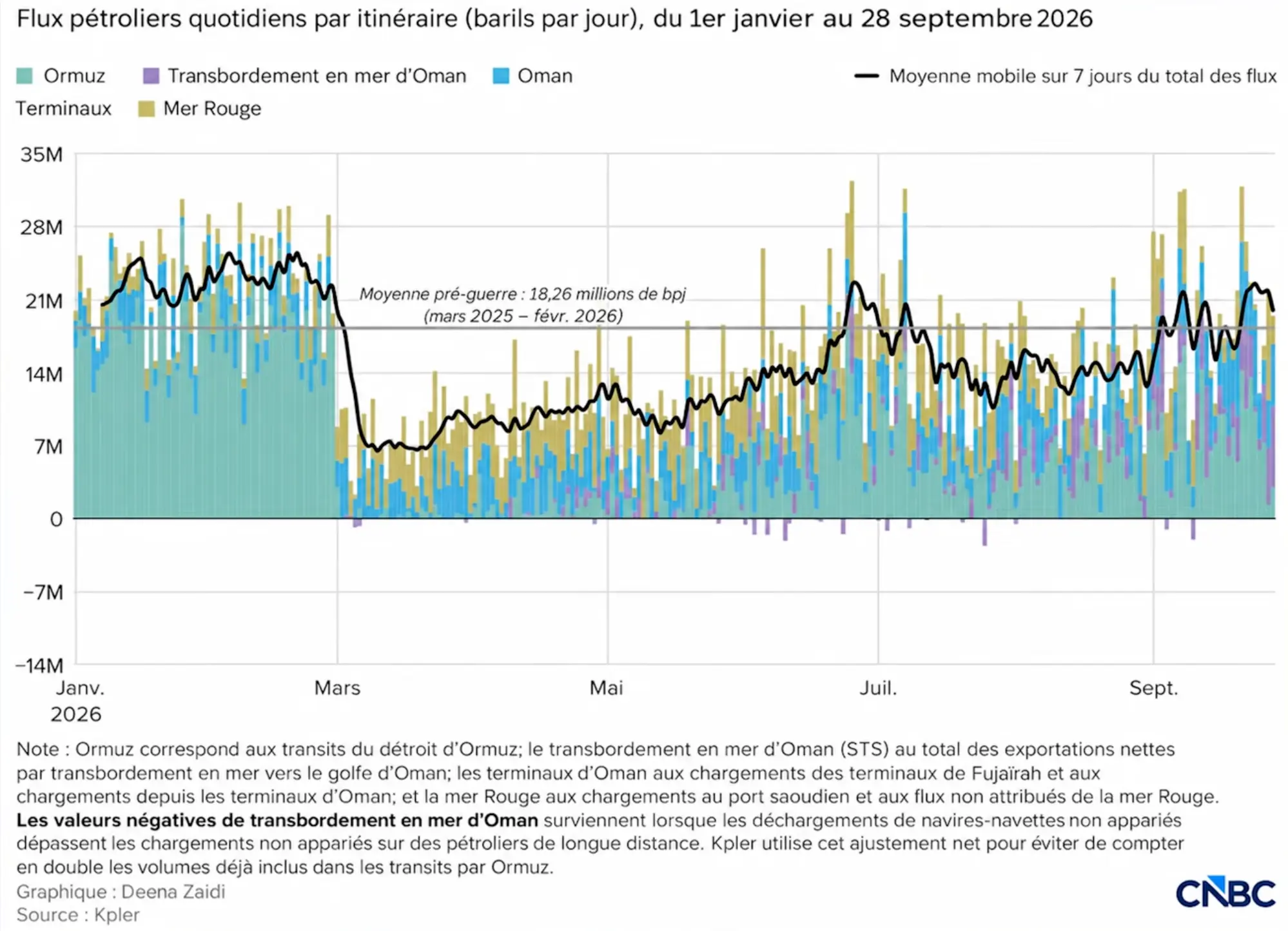
- In September, Middle East oil exports reached their highest level since February, that is, before the war began.
- Hormuz and the bypass routes combined account for nearly 80% of the pre-war level, excluding Iranian production, which cannot be exported.
- The September average stands at 13 million barrels per day, compared with 20 million before the conflict.
- Over the last week of September and the first days of October, volumes reportedly exceeded 20 million barrels per day.
This last observation calls for caution. Several vessels had been waiting to leave, and their departure probably inflates the figures temporarily. We will have to see whether this level holds.
The Saudi pipeline, a first safety valve
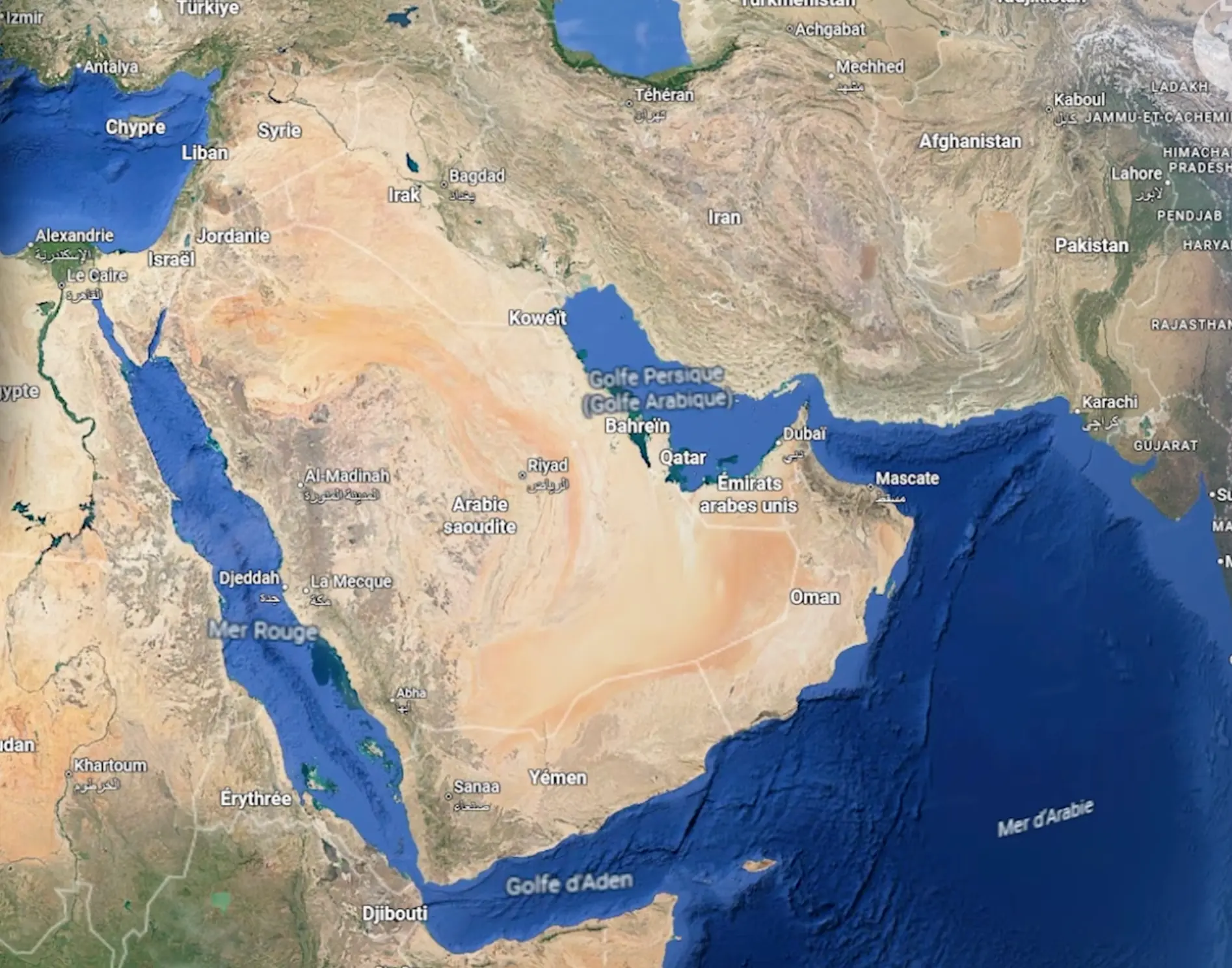
The first bypass route is the easiest to understand. Saudi Arabia normally exports most of its crude through the Persian Gulf. As soon as Hormuz was blocked, Riyadh turned to its east-west pipeline, which crosses the country to the Red Sea. It has allowed roughly 5 million barrels per day to be moved, out of a production of about 7 million, which is considerable.
Saudi exports through Hormuz, on the order of 7 to 8 million barrels per day, collapsed at the start of the conflict, while those through the Red Sea, via the Bab el-Mandeb strait, stabilized at around 5 million. The system looked convincing enough for Saudi Arabia to consider a second pipeline, which would raise capacity to 7 or 8 million barrels per day. That would be lasting insurance against any future blockage of the strait.
Iran understood this well. Drones from Iraq struck the pipeline and interrupted exports for several days. The episode was a national crisis for Riyadh. When exports stop, production continues until storage is full, after which wells must be shut down, a heavy technical operation whose effects can last for years. The subsequent resumption of flows through the Persian Gulf brought Saudi exports back close to their pre-war level.
Shuttle tankers to get around the blockade
The second route is more unusual. It originated in the United Arab Emirates, which, around May, realized the situation was going to last.
The problem was not only military, it was logistical. Commercial vessels refused to enter the Gulf to load cargo, because of insurance risk, crew safety and the danger of spills. The traditional international routes were also considered mined or too unsafe. There were also routes designated by Iran, subject to a toll, which the Gulf states did not intend to use.
Abu Dhabi therefore designated 11 state-owned tankers to serve as shuttles. They load in the Gulf, hug the Omani coast and meet, in the Gulf of Oman, the vessels of customers or international shipowners. The two ships line up on the open sea and the cargo is passed from one to the other through a pumping system. The technique is known in the military sphere, for refueling, and in the trade of Iranian crude to China, often transshipped near Malaysia. Here, it is used to get around the Hormuz trap.
The process makes the operation heavier: it is slow, costly and dangerous. It has nonetheless allowed the Emirates to export their own oil and to sell surplus capacity, notably to Iraq, in exchange for high fees. Other Gulf states copied the model, followed by Saudi Arabia. From around a dozen shuttles, the fleet is said to have grown to more than a hundred.
Why Iran does not attack these shuttles
The question comes naturally. The analysis offers two explanations. The first concerns capability: can Iran really strike moving targets, at night, consistently? The second is American involvement.
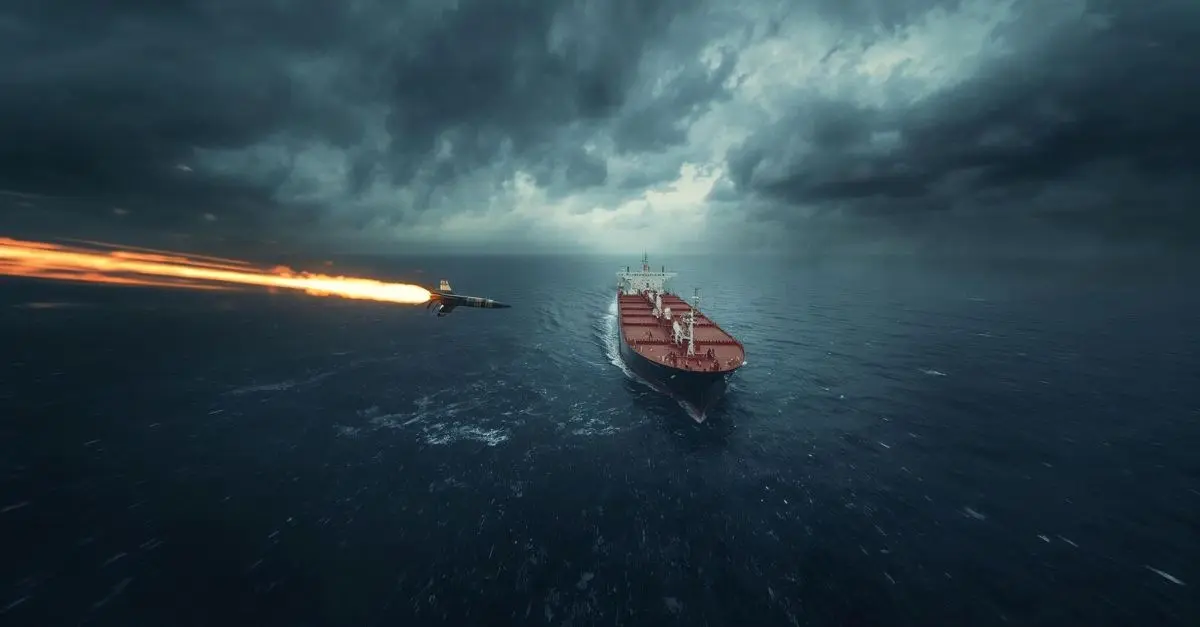
Washington is said to coordinate its actions with the countries of the region and to concentrate ships, aircraft and anti-missile assets over short periods. During a night of about seven or eight hours of darkness, three or four passage windows are opened, each assigned to a group of vessels. Instead of escorting each ship, an entire zone is protected, in the hope of intercepting incoming fire. The method is not foolproof: five or six ships were reportedly hit over the past ten days. But given the volumes, it works overall.
Why oil stays around 107 dollars a barrel
If oil is getting out, why isn’t the price of a barrel falling? According to the analysis, the current price, around 107 dollars, is consistent with what is being observed. If 20 million barrels per day had truly disappeared, it would be closer to 200 dollars. Several factors keep it at a high level:
- the cost of the system, estimated at about 30% more per barrel, due to the doubling of the vessels required, their constant mobilization and military protection;
- the Ukrainian campaign against Russian refineries, which weighs on the fuel market;
- the resumption of Chinese imports, which fell from 12 to 6 million barrels per day at the start of the war thanks to temporary measures that are now expiring;
- more general inflation in the global economy.
This last set of elements does not come from the analysis of the bypass routes. I therefore present it as a combination of factors, without claiming a precise hierarchy.
A negotiating lever that is eroding
For Tehran, Hormuz was much more than a military instrument. According to the analysis, Iran presented itself as the guardian of the strait after the war and negotiated toll mechanisms with countries of the region, with rates mentioned at 3, 4 or 7%. It was one of its main political gains, presented as such to public opinion.
Iran’s latest proposal appears to mark a shift. Iran would offer to reopen Hormuz in exchange for economic normalization: an end to the naval blockade, the lifting of sanctions and the return of confiscated assets. The nuclear issue would be explicitly excluded, postponed to a later date. The Americans refused. Lifting the blockade and sanctions without a nuclear counterpart would cost them all leverage, and above all they consider that the strait is already open in practice. A difficulty remains: after so many contradictory statements, Tehran no longer gives credit to American rhetoric, whatever the market figures show.
One can see in this a sign that Iran is aware of the erosion of its asset. The analysis adds that the Iranian economy is suffering: the American blockade reportedly targets all of the country’s ports, not just oil exports, which would fuel shortages of food, fertilizers and raw materials. Divisions are said to oppose, on one side, President Pezeshkian and Foreign Minister Abbas Araghchi, who favor concessions to stabilize the country, and on the other a harder line, close to the Revolutionary Guards. These are elements of analysis that I cannot verify here.
What to expect next
If Hormuz ceases to be a lever, Iran might seek to restore deterrence by other means. The analysis anticipates more frequent attacks on the shuttles and strikes genuinely targeting regional infrastructure, beyond symbolic gestures. Iran has also announced its intention to block the routes it deems illegal in the strait. Such a scenario would revive the risk of escalation, with consequences for prices.
Caution is warranted. The figures cited are recent and could be revised, and a system that relies on protected nighttime windows remains vulnerable to a single incident. The question remains open: is the resumption of flows durable, or a moment of adaptation before a new phase of tension? The answer will weigh as much on the negotiations as on the oil market.
FAQ
Have Gulf oil exports really returned to their pre-war level?
According to Kpler, they are approaching it: about 13 million barrels per day on average in September, compared with 20 million before the conflict, with peaks above 20 million in late September and early October. The volumes of recent days remain to be confirmed.
How does oil leave the Gulf despite the blockade?
Through two main routes: the Saudi east-west pipeline to the Red Sea, and shuttle tankers that hug the Omani coast to transfer their cargo at sea to customer vessels in the Gulf of Oman.
Why does the price of a barrel remain high?
The extra cost of the bypass routes, estimated at about 30% per barrel, adds to the war in Ukraine, the resumption of Chinese imports and general inflation.
What does Iran want in the negotiations?
According to the analysis, an end to the naval blockade, the lifting of sanctions and the return of assets, while setting aside the nuclear file. The United States has rejected this arrangement.