

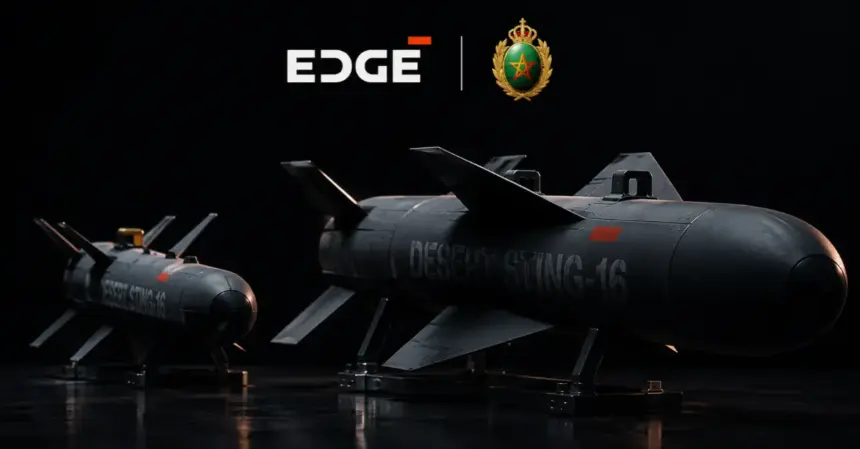
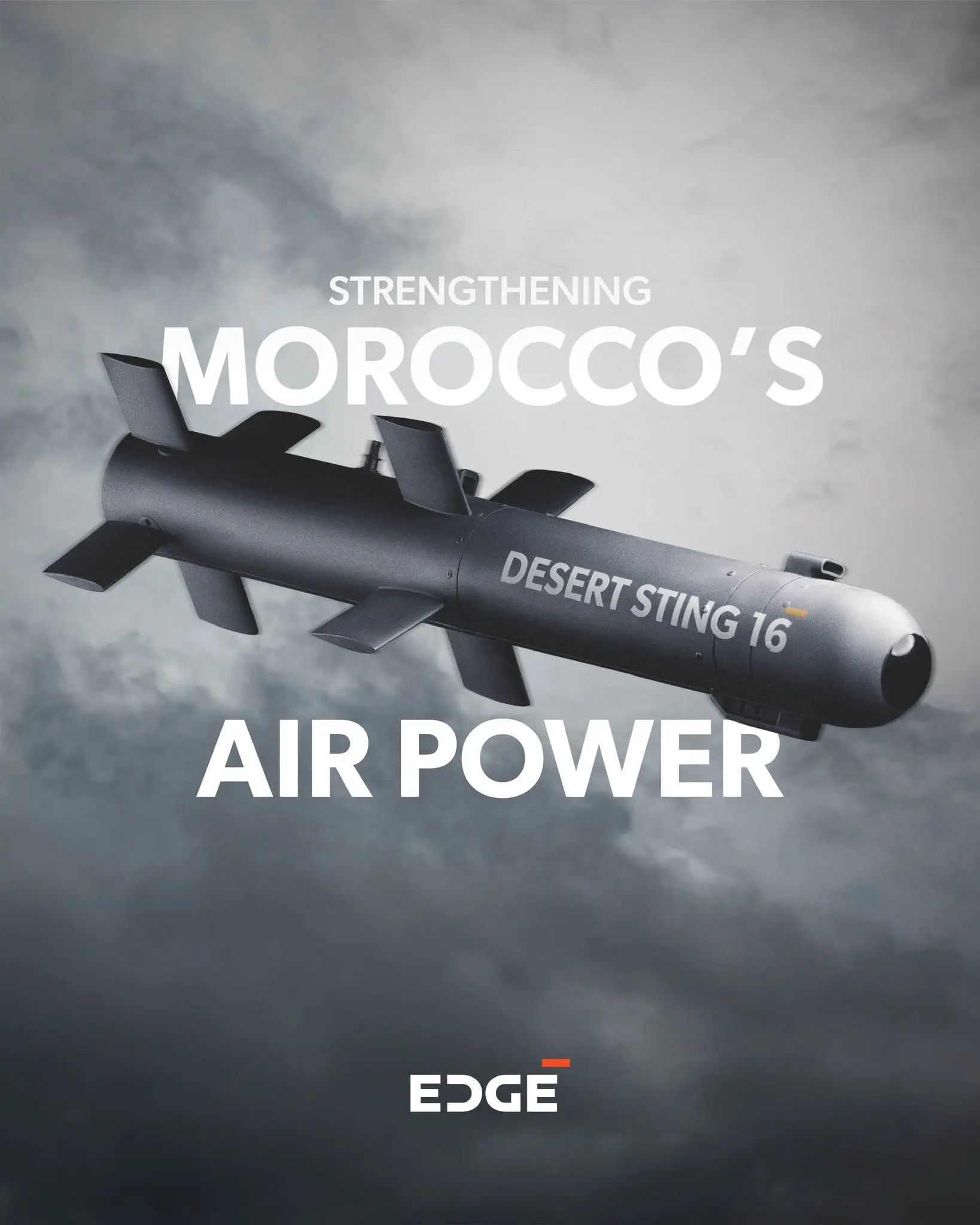
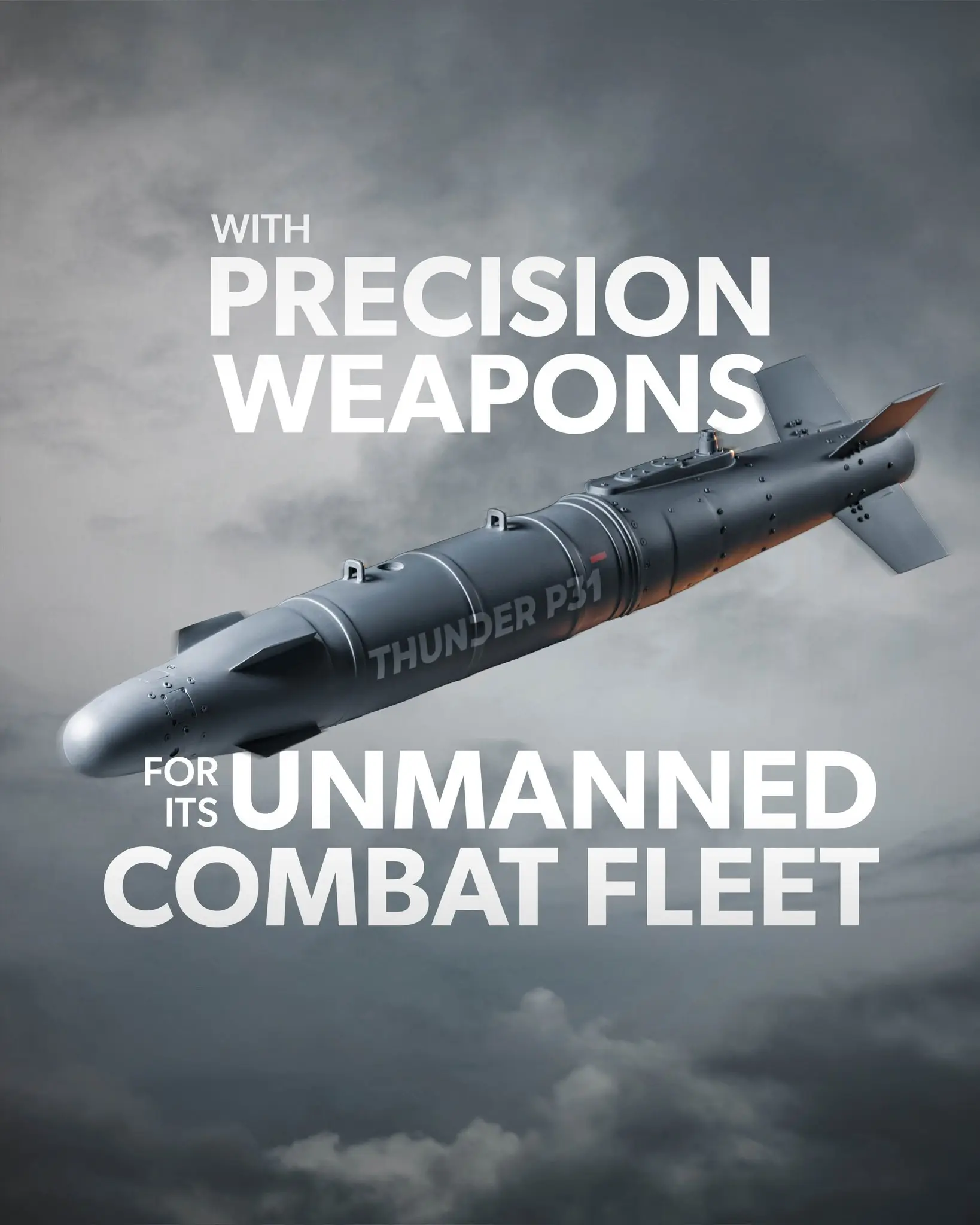
The Emirati defence group Edge has announced that it has signed a contract with Morocco’s Administration of National Defense. In a post on its official X account, it says it will supply the Royal Moroccan Air Force (RMAF) with the Desert Sting 16 guided glide weapon and the Thunder P-31 precision-guided munition.
Key takeaways
- Edge says it has signed a contract with Morocco’s Administration of National Defense.
- It will supply the Royal Moroccan Air Force with the Desert Sting 16 and the Thunder P-31.
- These guided weapons will be integrated into the combat drone fleet.
- They are manufactured in the UAE and tailored to Moroccan requirements.
- The value, quantities and delivery schedule have not been disclosed.
These weapons are to be integrated into the kingdom’s fleet of unmanned combat aircraft. The contract was signed during the Marrakech Air Show 2026, whose eighth edition runs from 7 to 10 October at the Royal Moroccan Air Force base, under the high patronage of King Mohammed VI.
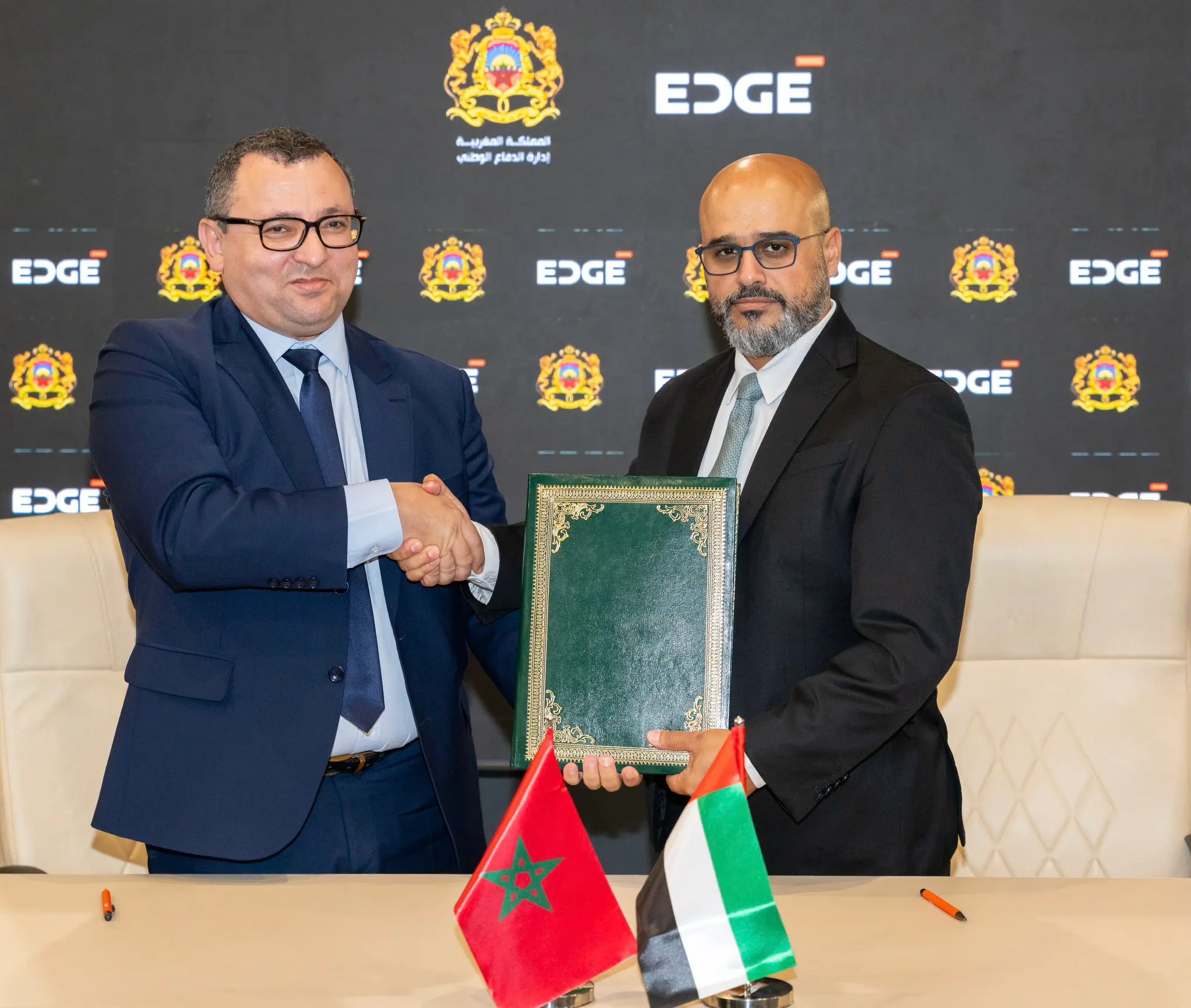
The post is accompanied by a photograph of the signing ceremony, taken in front of a backdrop bearing the kingdom’s coat of arms and the Edge logo. At first glance, this looks like one arms contract among many. I believe, however, that it sheds light on three underlying trends. Armed drones are becoming a pillar of Moroccan air power. Rabat is diversifying its suppliers. And the United Arab Emirates are establishing their defence industry on the African continent.
A contract signed where the defence industry puts itself on show
The Marrakech Air Show is held every two years. It brings together manufacturers, military staffs and political decision-makers, and serves as much as a trade fair as a venue for discreet meetings. Ahead of the 2026 edition, the specialist press had reported that Saudi Arabia and the Emirates would send sizeable military delegations. The Emirati national pavilion, backed by the Ministry of Defence and the Tawazun Council, brings together several groups, including Edge.
Edge is no newcomer to Morocco. The group made its debut there at the 2024 edition, where it already presented the Desert Sting family, the Thunder and Rash munitions, drones and an air defence system. Its chief executive described it at the time as a first step towards a long-term partnership with the kingdom. The 2026 contract turns that showcase into an order.
On the eve of the 2026 edition, Edge also stated that more than 80% of its products are manufactured in the UAE. It draws a security-of-supply argument from this. Its post on X follows the same line: the capabilities are manufactured in the UAE, designed to the operational requirements of the RMAF, with a guarantee of reliable supply chains and long-term sustainment.
What we know, and what we don’t
The available information comes from a single source: the manufacturer. It is worth separating what it asserts from what remains to be confirmed.
- Announced by Edge. A contract binds the group to Morocco’s Administration of National Defense.
- Announced by Edge. It covers the Desert Sting 16 and the Thunder P-31, intended for the Royal Moroccan Air Force.
- Announced by Edge. These weapons are to be integrated into the RMAF’s combat drone fleet.
- Announced by Edge. They are manufactured in the UAE and designed to Moroccan requirements, with a pledge of lasting support.
- Not disclosed in the post. The value, quantities, delivery schedule, any technology transfer and the carrier drone are not specified. I have not seen, at this stage, a separate communication from the Moroccan side.
Weapons designed for drones
Edge describes the Desert Sting family as guided glide weapons. These munitions are released from an aircraft and glide to their target under guidance. A drone can thus strike from a safe distance, without overflying the defended area. The appeal lies in tactical caution and cost. The Thunder follows a different logic: Edge classes it among cost-effective precision-guided munitions, designed to hit accurately with relatively light warheads.
This logic matches the patterns seen in recent years. The conflicts in Nagorno-Karabakh and Ukraine popularised the use of inexpensive armed drones capable of destroying far costlier equipment. Light, guided munitions are the natural complement to these platforms: they increase the number of targets engaged per sortie without resorting to heavier missiles.
Edge also presents, in general terms, guidance solutions designed to operate with or without satellite navigation. This matters against an adversary able to jam GPS signals. The group does not say whether it applies to the two weapons selected by Rabat.
🇦🇪🇲🇦|Le groupe émirati de défense Edge fournira ses armes aux Forces royales air marocaines
👉 En savoir plus : https://t.co/k05euDqooI#Edge fournira ses armes guidées Desert Sting 16 et Thunder P-31 aux #drones de combat des #FAR
#UAE #Morocco #Emiratsarabesunis #Militaire https://t.co/ATIizggsAY
— Silicon Valley (@SiliconValleyMa) October 9, 2026
Why Rabat is diversifying its suppliers
For several years, the Royal Moroccan Air Force has been building up its drone capabilities. It received its first Turkish Bayraktar TB2s in 2021. Several sources, which differ on the numbers, report the delivery of the first Akıncı, a heavier drone with longer endurance, capable of carrying a variety of weapons. A project for a drone production and maintenance plant in the province of Benslimane has also been presented as an industrial milestone.
This fleet sits alongside an air force whose equipment comes notably from the United States and France, and acquisitions from Israel. Rabat’s strategy appears consistent: avoid depending on a single supplier, or on a single export-licensing regime. A country that buys from several capitals reduces the risk of seeing a supply suspended for political reasons. The argument carries all the more weight because continuity of munitions supply has become a major issue in recent conflicts.
The relationship with the Emirates fits this logic. The two countries have a long-standing cooperation, and Abu Dhabi opened a consulate in Laayoune in 2020, which amounted to political support for Morocco’s position on the Sahara. The contract with Edge extends, on the industrial front, a long-standing diplomatic closeness.
The arguments on each side
Supporters of this rapprochement point to several advantages. According to Edge, the weapons are tailored to Morocco’s specifications, which limits reliance on “off-the-shelf” solutions. The Emirates do not attach to their sales the same political conditions as some Western suppliers. Long-term support, Edge’s central argument, answers a concrete concern of armed forces: having spare parts, training and updates available over several decades.
Sceptics raise other questions. Integrating one supplier’s weapons onto another’s drones is demanding engineering work. Weapon-carriage systems, fire-control software and certification all have to be adapted, which often requires the cooperation of both manufacturers. They also point to the usual opacity of such contracts, all the more so as the announcement here comes from a single party, making any independent assessment of cost-effectiveness difficult. Finally, some observers consider that the multiplication of armed-drone acquisitions in the region may feed an arms-race dynamic, notably between Morocco and Algeria, which is also modernising its forces. Rabat, for its part, presents these purchases as defensive, intended to protect its territory and counter security threats.
An industrial dimension adds to these debates. Edge is seeking to make the African continent a priority market, as its modernisation partnership with Angola shows. The kingdom, for its part, is seeking to develop a national defence industrial base. It remains to be seen whether this contract will include a local production or maintenance component, which would change its economic significance.
What to watch
I see three points to watch. The first is the nature of the integration: which drone will carry these weapons, and on what timetable. The second is the industrial dimension: will the contract be limited to a delivery, or open the way to a transfer of know-how? The third is the effect on the regional balance, which will depend less on the weapons’ technical specifications than on the volume of orders and how they are used.
In any case, this contract confirms that Morocco is building, step by step, an unmanned air capability that relies on several partners. The question in the coming years will be one of overall coherence: how will a fleet made up of platforms and weapons of different origins be maintained, funded and used? It is there, rather than in the signing itself, that the value of this choice will be decided.
FAQ
Who announced this contract?
Edge, on its official X account, with a photograph of the signing ceremony. The group says the contract was signed with Morocco’s Administration of National Defense during the Marrakech Air Show 2026.
What is Edge supplying to the Royal Moroccan Air Force?
The Desert Sting 16 guided glide weapon and the Thunder P-31 precision-guided munition. They are to be integrated into the RMAF’s combat drone fleet.
What is a guided glide weapon?
It is a weapon released from an aircraft that glides to its target under guidance. It allows strikes from a distance, without exposing the carrier aircraft to enemy defences.
Is the value of the contract known?
No. Edge’s post specifies neither the value, nor the quantities, nor the delivery schedule.