

This move, if confirmed, would be part of the groundwork for a possible acquisition of Lockheed Martin’s fifth-generation aircraft. At this stage, we have no official confirmation from Rabat or Washington. The sources specify neither the number of pilots involved nor the intended timetable.
Key takeaways
- Morocco has asked the United States to train pilots on the F-35A, according to Assahifa Arabic.
- The number of pilots and the timetable are not known.
- This type of training generally lasts five to eight months.
- Luke Air Force Base in Arizona is reportedly the most likely destination.
- No purchase agreement has been officially confirmed.
A training request that precedes the acquisition
The request has already been submitted to the US authorities, according to the information reported. Intensive training of this kind generally lasts between five and eight months, making it a heavy undertaking that is hard to improvise once the aircraft have been delivered.
This sequence is nothing unusual. American military cooperation agreements make it possible to plan training needs in advance, by aligning courses and their schedules with equipment deliveries. Discussions on pilot qualification can therefore begin during the preparatory phase. The actual start of the courses, however, requires an approved program, funding, and compliance with admission requirements and security procedures.
In other words, a training request is not an order. It signals preparation, not a decision that has been made. The sources consulted by Assahifa Arabic see it as a sign that preparations are moving forward and that an agreement could be announced soon. That reading remains, for now, an interpretation.
Why the F-35A
Morocco is reportedly interested in the F-35A variant in particular, because of its ability to operate from conventional land-based air bases and because of the needs of its air force. The F-35 comes in three versions:
- the F-35A, with conventional takeoff and landing, the one Rabat is interested in;
- the F-35B, designed for short takeoff and vertical landing;
- the F-35C, intended for aircraft carriers equipped with catapults and arresting wires.
The F-35A is a logical choice for a country that has no aircraft carrier. It is also the version flown by the two US Air Force aircraft that took part in an air demonstration at the opening of the eighth edition of the Marrakech International Air Show. According to the United States Africa Command (AFRICOM), these two fighters, from the 48th Fighter Wing based at RAF Lakenheath in the United Kingdom, flew over the Royal Moroccan Air Force base in Marrakech.
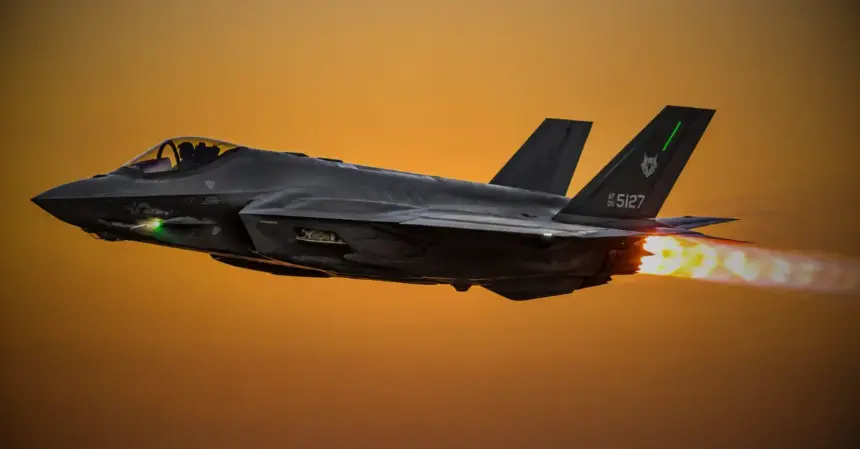
Technically, the F-35A combines stealth with integrated electronic and sensor systems. This data fusion improves the pilot’s situational awareness and allows the same aircraft to carry out several types of missions. Its low radar signature makes it harder to detect, track and target, and it is designed to support operations in complex air defense environments.
A likely training pathway
According to the same sources, if the acquisition goes ahead through the US Foreign Military Sales (FMS) program, Moroccan pilots could follow a training course provided for in the agreement between Rabat and Washington, or in a complementary government-to-government agreement. The relevant US authorities would then coordinate the program, together with military training units and Lockheed Martin. Previous F-35 sales to other countries also included pilot training and support under intergovernmental agreements.
Luke Air Force Base in Arizona would be the most likely destination. It is a major F-35 pilot training center for the US military, as well as for partner and customer countries. Military instructors there supervise flight training, while Lockheed Martin instructors handle theoretical courses and simulators.
Simulation plays a central role here, because the F-35 is a single-seat aircraft and there is no two-seat training version. An instructor therefore cannot sit behind the student. Pilots prepare for their first flight through theoretical courses, simulator sessions and assessments before taking the controls of the aircraft.
At the Marrakech air show, Lockheed Martin presented a prototype of the F-35 cockpit, faithfully reproducing the pilots’ training environment. The manufacturer also displayed scale models of the F-35A. The aircraft was widely used by the United States and Israel during the recent conflict with Iran, according to available information.
What such an aircraft would change for the Royal Air Force
According to sources cited by Assahifa Arabic, the entry into service of the F-35A would mark a qualitative shift for the Royal Moroccan Air Force and strengthen Morocco’s position in the regional balance of air power. These same sources claim it would make the kingdom the “master of the skies” in the region. That phrase is a forecast, not an observation, and deserves some qualification.
A stealth fighter does not, on its own, guarantee air superiority. That depends on the number of aircraft, maintenance, intelligence, logistics, available munitions, the continued training of crews, and their integration into a coherent command system. A small number of aircraft, however capable, does not produce the same effects as a full fleet backed by a solid support chain. The sources, incidentally, mention no quantities.
Cost is another factor. The F-35 is one of the most expensive weapons programs in the world, both to buy and to keep in operational condition. It also entails close dependence on the American logistics and software ecosystem, which weighs on any strategic decision.
A file that goes beyond air power alone
A potential agreement would fit into the already dense defense relationship between Rabat and Washington. In recent years, Morocco has stepped up its acquisitions from the United States and regularly hosts joint exercises. Its air force already relies in part on American aircraft, which facilitates interoperability and maintenance practices.
The American presence at the Marrakech air show, with flight demonstrations and equipment on display, illustrates this closeness. It says nothing, however, about the outcome of discussions on the F-35, which are part of a long process.
Selling the F-35 to a third country involves several steps. It requires political authorization from the US executive branch, followed by notification to Congress. It comes with an assessment of the risks of technology transfer and information security. Washington has already shown great caution on this point, as demonstrated in 2019 by Turkey’s removal from the program after it purchased Russian air defense systems. Guarantees on sensitive technologies and on the choice of suppliers would likely be required of any buyer.
Regional balances also come into play. The acquisition of a stealth fighter by a North African country would change perceptions of the balance of power across the region, where several states are modernizing their fleets, and would be likely to provoke reactions. At this stage, we have no official statement, American or Moroccan, that would allow us to gauge these effects. It would be premature to take them for granted.
What to watch
Several signals will show whether the move leads to a contract. An official notification to the US Congress would be the first formal indicator. The financing terms, the size of any order and the delivery schedule would then be the decisive elements. The actual start of courses at Luke, if it happens, would be an additional sign, though not a sufficient one.
It will also be worth watching how Rabat handles the industrial question. Modern defense agreements often include cooperation components, local maintenance or skills transfer. In recent years, Morocco has developed a dynamic civil aerospace sector, and the question of possible industrial spin-offs could arise.
A training request is a signal of intent, not a signature. It confirms that the F-35 file is advanced enough for concrete discussions to take place, but many steps remain before any agreement. We will continue to follow this story as official information becomes available.
FAQ
Has Morocco officially bought F-35s?
No. According to available information, it has requested pilot training, which falls under preparation. No order has been officially confirmed.
Why would Morocco be interested in the F-35A?
It is the conventional takeoff and landing version, suited to land bases. It matches the needs of the Royal Air Force, which has no aircraft carrier.
Where would Moroccan pilots be trained?
Luke Air Force Base in Arizona is cited as the most likely destination. It is a major F-35 pilot training center for US forces and partner countries.
How long does the training last?
This type of intensive training generally lasts between five and eight months, according to the sources. The number of pilots and the timetable have not been specified.