
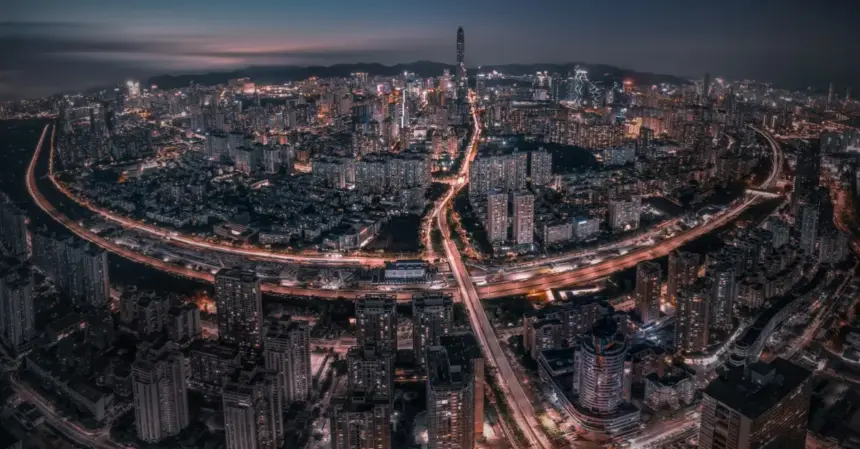
How did this shift happen? I believe the answer has less to do with a miracle than with methodical construction: a Chinese Silicon Valley. It is not a single place but an archipelago of technology hubs, from Beijing to Shenzhen and from Shanghai to Hangzhou, linked by capital, universities and an immense market.
A Chinese Silicon Valley as an archipelago, not a copy
The shortcut is tempting: China simply copied California. I think it misses the point. The American valley was born from the meeting of Stanford, defense contracts and venture capital. The Chinese model was built differently, in stages and in several places at once, with a far stronger role for the state.
Each major city developed its own specialty. Beijing draws on its universities and research centers, Shenzhen on hardware and production, Hangzhou on e-commerce and digital services, and Shanghai on finance and semiconductors. This division of labor, born partly of history and partly of public policy, explains the diversity of the ecosystem.
Zhongguancun, Beijing’s university cradle
For many, the story begins in Zhongguancun, in Beijing’s Haidian district in the northwest of the capital, next to Tsinghua University and Peking University. In the 1980s, one street there was nicknamed “electronics street,” where components and assembled computers were sold. In 1984, researchers from the Chinese Academy of Sciences founded the company that would become Lenovo. In 1988, the authorities created an experimental zone for new technology development, the ancestor of today’s innovation zones.
What I take from this is the mechanism: researchers were allowed to start companies, often attached to public institutions, within a perimeter where the rules were relaxed. Baidu, founded in 2000 by Robin Li, belongs to this lineage. Zhongguancun remains a major hub for artificial intelligence today, where large groups, laboratories and young startups rub shoulders.
Shenzhen, the factory that became a laboratory
Shenzhen’s case is more spectacular. In 1980, the city, then a modest town near Hong Kong, was designated a special economic zone. It now has more than 17 million inhabitants and is home to Huawei (founded in 1987), Tencent (1998), DJI (2006) and BYD (1995).
Its strength lies in the density of its industrial chain. Around the Huaqiangbei electronics market and the factories of the Pearl River Delta, an entrepreneur can find components, suppliers and prototyping workshops a few kilometers away, sometimes within days. Where a California startup depends on distant suppliers, a Shenzhen startup iterates physically, quickly and at lower cost. In my view, this is the least visible advantage and the hardest to replicate elsewhere.
Hangzhou and Shanghai, the other pillars
Hangzhou, long associated with tourism around West Lake, has become the capital of online commerce with Alibaba, founded in 1999 by Jack Ma, and its financial affiliate Ant Group. More recently, the city has seen a new generation of companies emerge, including DeepSeek in artificial intelligence and Unitree in robotics, which shows that the ecosystem is renewing itself beyond its historic giants.
Shanghai plays a different role. The Zhangjiang district concentrates semiconductor players, including SMIC, China’s largest foundry, founded in 2000. The creation in 2019 of the STAR Market, a stock exchange reserved for technology companies, gave young firms a way to raise funds and exit on Chinese soil.
The role of the state, between impetus and steering
I cannot tell this story without discussing the state. In 1986, the 863 Program set research priorities. In 1988, the Torch Program began supporting technology parks. In 2015, Made in China 2025 aimed to move industry up the value chain in sectors deemed strategic. In 2017, a national plan on artificial intelligence stated the ambition of making China a leader by 2030. The 2026-2030 five-year plan in turn places technological self-reliance among its priorities.
The money follows. The “Big Fund,” a public semiconductor fund launched in 2014, saw a third edition in May 2024 with about 344 billion yuan, or nearly 47 billion dollars, according to official data. The country also devotes about 2.7% of its GDP to research and development, according to the National Bureau of Statistics.
Opinions differ on how effective this system is. Its defenders see a capacity for long-term coordination that market democracies struggle to match. Its critics, including Chinese economists themselves, point to waste, overcapacity and price wars born of abundant subsidies. Washington and Brussels also accuse Beijing of unfair support practices, which the Chinese authorities dispute. I believe the reality lies somewhere between the two: the state created favorable conditions, but fierce competition among private companies did the rest.
A domestic market that serves as a springboard
The other engine is the size of the market. China has more than a billion internet users, according to CNNIC, the body in charge of the Chinese internet registry. A product can reach a scale there that most countries cannot offer before it is even exported.
Regulatory protection also played a part. Google’s departure from the mainland market in 2010 and web filtering left the field open to local players. Mobile payments, with Alipay and WeChat Pay, took hold when bank cards were still uncommon. One lesson seems clear to me: Chinese innovation was often built not through imitation but through adaptation to local uses, before becoming an exported model, as TikTok, Temu and Shein now show.
The Chinese champions, from BYD to Xiaomi
From this environment emerged a generation of global groups. Here are a few landmarks on their origins:
- Lenovo: 1984, spun out of the Chinese Academy of Sciences in Beijing
- Huawei: 1987, Shenzhen, telecom equipment first, then smartphones
- BYD: 1995, batteries first, then automobiles from 2003
- Tencent: 1998, messaging and video games, with WeChat as its flagship product
- Alibaba: 1999, online commerce in Hangzhou
- DJI: 2006, civilian drones, world leader in the sector
- Xiaomi: 2010, smartphones then connected devices, and electric cars since 2024
Two trajectories interest me in particular. BYD, initially a battery maker, overtook Tesla in fully electric car sales in the fourth quarter of 2023, then sold about 4.3 million electric and hybrid vehicles in 2024, according to its own figures. Xiaomi, for its part, launched its first car, the SU7, in March 2024, showing how a consumer electronics player can expand into the automotive industry.
Artificial intelligence, electric vehicles and robotics
These successes extend into several sectors. In January 2025, the release of the R1 model by the startup DeepSeek triggered a sharp stock market shock, with Nvidia losing nearly 600 billion dollars in market capitalization in a single session. The episode did not prove that China had caught up with the United States. It did show that Chinese teams could achieve comparable performance with more constrained resources.
In electric vehicles, the integration of batteries, software and production gives Chinese carmakers a real cost advantage. China also dominates global battery production. In robotics, according to the International Federation of Robotics, it now accounts for more than half of new industrial robot installations worldwide.
The limits, semiconductors and restrictions
The picture is not without flaws, and this is where the analysis becomes most interesting. The weak link remains the most advanced semiconductors. Since October 2022, the United States has tightened its export controls, joined by the Netherlands and Japan on certain lithography equipment. Huawei has been on the American blacklist since 2019.
Beijing has nonetheless found workarounds. In August 2023, Huawei’s Mate 60 Pro appeared with a 7-nanometer chip made by SMIC, according to teardown analyses carried out by specialist firms. Many saw this as proof that restrictions slow China down without stopping it. Others point out that these chips are produced at high costs and low yields, which limits their industrial reach.
Other weaknesses add to this. The regulatory crackdown of 2020-2021 on the big platforms, with the suspension of Ant Group’s IPO, cooled investors. An aging population, youth unemployment among graduates, and the tariffs imposed on Chinese electric vehicles by the United States and the European Union also weigh on the outlook.
What this Chinese Silicon Valley changes for the world
I take from this story a simple idea: China did not build a place but a system in which universities, public and private capital, industry and the market reinforce one another. This system is now mature enough to compete with the United States in several areas, while remaining dependent on foreign technology in others.
For countries like Morocco, the stakes are concrete. Several Chinese battery and automotive groups have announced or launched industrial projects there, drawn by its proximity to Europe. The open question is whether China will clear the last hurdle of advanced chips, and whether Western restrictions will, paradoxically, accelerate its self-reliance.
FAQ
What is the Chinese Silicon Valley?
There is not just one. Zhongguancun in Beijing is often presented as the historical equivalent, but Shenzhen, Hangzhou and Shanghai together form China’s technology ecosystem.
Why is Shenzhen so important for tech?
Because it brings together suppliers, factories and prototyping workshops in a small area, which makes it possible to go from idea to product very quickly.
Has China caught up with the United States in artificial intelligence?
Not overall. It is highly competitive in certain models and uses, but it remains behind on the most advanced chips, where American restrictions weigh heavily.
What is the main weakness of Chinese tech?
Cutting-edge semiconductors and the equipment needed to make them, where dependence on foreign technology remains strong.