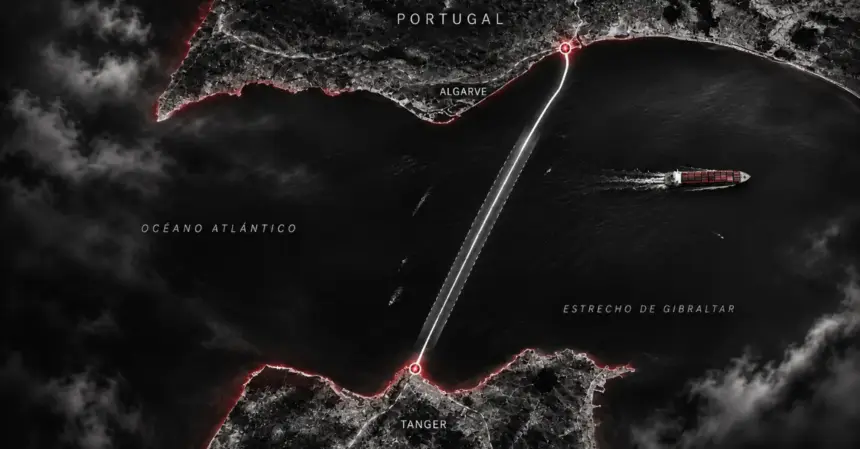
While Spanish port officials and media sound repeated alarms over Morocco’s logistics expansion, Portugal has convinced the European Commission to adopt its proposal to involve Morocco, Egypt and Tunisia in concrete pilot projects on multimodal corridors and digital freight tracking.
The Iberian contrast in the face of Morocco’s rise
Morocco has transformed its logistics positioning in a decade. Tanger Med handled 11.1 million TEU in 2025, according to its port authority, far exceeding the combined volume of Valencia and Algeciras. Expansions are under way, notably a third phase of Tanger Med (an announced investment of around 730 million euros for an additional capacity of 4.5 million TEU) and the development of Nador West Med.
These advances are prompting concerned reactions on the Spanish side. Presidents of Andalusian port authorities have called for joint strategies to counter Moroccan competition. Articles and statements highlight the risk of losing transshipment traffic, the effects of the ETS (Emissions Trading System), which makes calls at European ports more expensive than at non-EU ports, and the physical expansion constraints at Algeciras. Voices in the Canary Islands and elsewhere also express concern about Dakhla or possible Moroccan investments in Spanish terminals. These positions are documented in the specialized and regional press; they reflect a legitimate competitive reading, but they remain largely defensive.

Portugal, for its part, is taking an operational approach. Its proposal, retained in the European action plan as a related bilateral and regional action under the “Sustainable transport for a better-connected region” initiative, covers trials of sea-rail integration, digital cargo tracking and capacity building for transport administrations, together with Morocco, Egypt and Tunisia. Lisbon also adds exchanges of best practice on urban mobility.
What the Portuguese offer actually contains
These pilots are not heavy infrastructure. They aim to test shared tools for flow visibility (location, cargo status, documentation) and better coordination between ships and trains. The goal is to reduce friction at borders, speed up freight forwarders and prepare administrations to manage shared data. Morocco already has a foundation with platforms such as PortNet and multimodal strategies built around its ports and logistics zones. Adapting these tools to different chains (bilateral or regional) avoids a one-size-fits-all approach that would be too rigid.
This initiative comes in a favorable trade context. Goods trade between Morocco and Portugal reached nearly 1.2 billion euros over the first eight months of 2026, according to AICEP, up more than 20% year on year. Regular shipping lines already connect Portuguese ports to Casablanca, Agadir and Tanger Med. Portugal is also pursuing its PORTOS 5+ strategy, which emphasizes digitalization, intermodality and Atlantic connectivity.
The broader regional action, funded with 3.5 million euros through the GET-Med programme (NDICI-Global Europe), focuses mainly on renewable or low-carbon fuels for maritime and aviation. Two deliverables are planned for the fourth quarter of 2026: the signing of ETAP II with the European Union Aviation Safety Agency (a partial follow-up to the 2020-2026 programme, which received 3 million euros) and a feasibility study on an EU-Mediterranean-Gulf partnership for these fuels. The Portuguese pilots are attached to it as related actions.
Strategic stakes and limits of the scheme
This difference in approach is not trivial. Portugal, smaller and less involved in direct territorial rivalries in the Strait, can position itself as a pragmatic partner. It is also exploring electricity interconnection projects with Morocco and benefits from shipping lines that already link the two markets. For Morocco, these trials offer an additional way to improve the efficiency of its exports to Europe without relying solely on the land corridor through Spain, while making the most of its investments in hubs and digitalization.
The stakes are both economic and geopolitical. Better digital visibility of cargo strengthens supply chain resilience against shocks (geopolitical, climate-related or regulatory). It can also facilitate a modal shift to rail and sea, in line with decarbonization goals. On skills, it echoes other actions of the Pact, notably the Talent Partnerships, which target transport professions in Morocco, Egypt and Tunisia.
The limits remain real. The 3.5 million euro envelope covers the regional action as a whole; the pilots make up only part of it. The investment needed for smooth corridors is far higher (the European document also mentions substantial amounts for rail or motorway resilience projects in Morocco). Interoperability of digital systems, sharing of sensitive data and the involvement of private operators (shipping lines, rail operators, freight forwarders) will determine whether these trials remain technical exercises or produce measurable effects. Competition between hubs does not disappear: Tanger Med continues to grow rapidly, which can both attract partnerships and heighten tensions with the most exposed European ports.
Key figures of the scheme and its context
- 3.5 million euros through GET-Med (NDICI) for the regional action on sustainable transport
- Signing of ETAP II with EASA expected before the end of 2026
- Feasibility study on sustainable fuels for the EU-Mediterranean-Gulf partnership expected in the fourth quarter of 2026
- Partners of the Portuguese pilots: Morocco, Egypt, Tunisia
- Tanger Med: 11.1 million TEU in 2025; Algeciras: around 4.7 million
Open prospects
Portugal is moving forward here with concrete proposals validated by Brussels, whereas part of the Spanish discourse remains centered on defending existing positions against Morocco’s rise. This reading does not erase the legitimate interests of Spanish ports or the depth of Spain-Morocco trade ties, which remain considerable. It does, however, underline that a purely defensive stance risks leaving the field open to more operational cooperation led by others.
These digital tracking and sea-rail integration pilots remain modest. Their value lies in the ability to turn experiments into shared tools, aligned with the partners’ national strategies and with the involvement of the private sector. In an environment where flow visibility and corridor fluidity are becoming competitive advantages, the Portugal-Morocco relationship offers a more pragmatic testing ground than repeated alarms. It remains to be seen whether these trials will scale up or remain isolated technical initiatives.
FAQ
Why is Portugal associated with these pilots with Morocco?
Because it proposed these multimodal corridor and digital freight tracking projects; the Commission retained them in the action plan of 10 November 2026 as related actions to the sustainable transport initiative.
What is the Spanish position on Morocco’s logistics rise?
Spanish port authorities and media express concern about competition from Tanger Med and Nador West Med, particularly because of volumes, expansions and the effects of European regulations (ETS) on the competitiveness of EU ports.
Does the 3.5 million euro funding cover only the Portugal-Morocco pilots?
No. This envelope funds the broader regional action on sustainable transport (low-emission fuels, the follow-up to ETAP, etc.). The Portuguese pilots are attached to it as related bilateral and regional actions.
What is the potential impact for logistics operators?
Better digital visibility of cargo and smoother sea-rail integration can reduce delays and administrative friction, provided the trials are put into operation with the private sector.