
Key takeaways
- No official diplomatic relations exist between Algeria and Israel, yet commercial flows appear in international databases ($32.3 million in Israeli-declared imports in 2024, according to OEC/UN Comtrade)
- Since September 2024, Algeria has paid $60,000 per month ($720,000 per year) to Washington lobbying firm BGR Government Affairs, a contract renewed in September 2025
- BGR has documented ties to Israel, notably through its role in the 2020 Abraham Accords
- No new FARA filing has appeared for 2026-2027 as of this writing
According to UN/UN Comtrade data compiled by the Observatory of Economic Complexity (OEC), Israel declared approximately $32.3 million in imports from Algeria in 2024, involving notably inorganic chemicals, precious metal compounds, and certain isotopes.
Source: https://oec.world/es/profile/bilateral-country/dza/partner/isr
These figures should be read with caution: customs statistics record flows as declared by countries, without necessarily establishing direct bilateral trade between Algerian and Israeli companies. Triangular trade mechanisms, involving third-country intermediaries, may explain part of this data — a 2024 clarification already flagged this possibility for earlier exchanges.
A contract signed quietly during the diplomatic season
The amount, the identity of the firm, and the nature of its ties to Israel are documented in the filings BGR is required to submit to the US Department of Justice under the Foreign Agents Registration Act (FARA), a 1938 law requiring transparency on activities carried out in the United States on behalf of a foreign government.
The contract was signed in early September 2024 by Sabri Boukadoum, Algeria’s ambassador to Washington and former Minister of Foreign Affairs. It covers government affairs and public relations services concerning Algeria-US bilateral relations. The agreed terms:
- $60,000 per month, or $720,000 over a full year
- Contract renewed in September 2025 for an additional 12 months, under the same terms
- Total Algerian commitment: $1.44 million over two contract years
This type of arrangement is not exceptional in itself: Bahrain, for example, paid BGR $730,000 in 2023 for comparable services. What sets the Algerian case apart is the specific choice of contractor.
Who is BGR Government Affairs
Founded in 1991, BGR Group is one of Washington’s most influential lobbying and communications firms, with nearly two hundred clients in the US and abroad. The Algerian account is led by Scott Eisner, former president of the US-Africa Business Center at the US Chamber of Commerce, who also manages the firm’s Tanzania mandate.
It is another aspect of BGR’s profile that fuels controversy: its documented ties to Israel. The firm was involved in the negotiations that led to the normalization of relations between Israel and Bahrain under the 2020 Abraham Accords. One of its associates, David Barak, maintains ties to Israeli institutions. On the very day the Algerian contract took effect, in September 2024, Magen David Adom — Israel’s equivalent of the Red Cross — announced the appointment of Gilad Erdan, a former minister in the Netanyahu government, as its international president. This timing coincidence does not, on its own, prove any particular Algerian intent, but it has been enough to fuel, in trade press coverage, the notion of a structural proximity between the firm chosen by Algiers and Israel’s political ecosystem.
What the declared payments show
BGR’s semiannual filings make it possible to trace the actual financial flows:
- $180,000 paid for the first months of the contract in 2024
- $360,000 paid between December 2024 and May 2025 (the equivalent of six monthly payments at the agreed rate)
These amounts are consistent with the monthly pace set out in the original contract. They confirm that Algeria’s financial commitment translated into regular payments, not merely an agreement in principle left without budgetary follow-through.
Outreach to Congress and the executive branch
The FARA filings describe classic institutional lobbying work: outreach to and meetings with staff from several key US congressional committees, notably the House Foreign Affairs Committee and the Senate Foreign Relations Committee, as well as contacts at the State Department and the White House National Security Council.
The stated objectives span a wide range — defense cooperation, trade relations, regional security, counterterrorism — and, in some correspondence, the Western Sahara issue, a topic on which Washington took a position favoring Morocco’s autonomy plan under the Trump administration. This explains Algeria’s interest in maintaining a channel of influence in Washington on this specific issue.
A media push around the ambassador
Beyond institutional outreach, BGR also worked on Algeria’s public image in the United States. In mid-February 2025, the firm pitched an interview with the Algerian ambassador to a wide range of American newsrooms — including Reuters, CNN, Bloomberg, Associated Press, the New York Times, the Washington Post, Politico, NPR, and Foreign Policy.
Communications materials were also registered with FARA on Algeria’s behalf, including one highlighting the relationship between President Abdelmadjid Tebboune and Pope Leo XIV — a relationship that materialized in a Vatican audience in July 2025, amid reports of a papal visit to Algeria planned for 2026.
The real debate: activity versus results
These elements establish, unambiguously, that BGR has been active: congressional outreach, media pitching, distribution of communications materials. The real question raised by these documents is therefore not whether the work happened, but whether it worked. FARA filings document the effort deployed — the meetings requested, the contacts made, the journalists pitched — but they do not, on their own, establish that any major US decision, significant economic agreement, or tangible diplomatic breakthrough on a specific issue, such as Western Sahara, resulted directly from this work.
Another gray area has emerged more recently. The contract renewed in September 2025 was set to expire in September 2026. Yet in the FARA registry as of late September 2026, no new Algerian agreement for the 2026-2027 period has publicly appeared — without it being possible, at this stage, to say whether this reflects a simple administrative filing delay or an Algerian reassessment of the spending’s value.
A hard-to-ignore contradiction
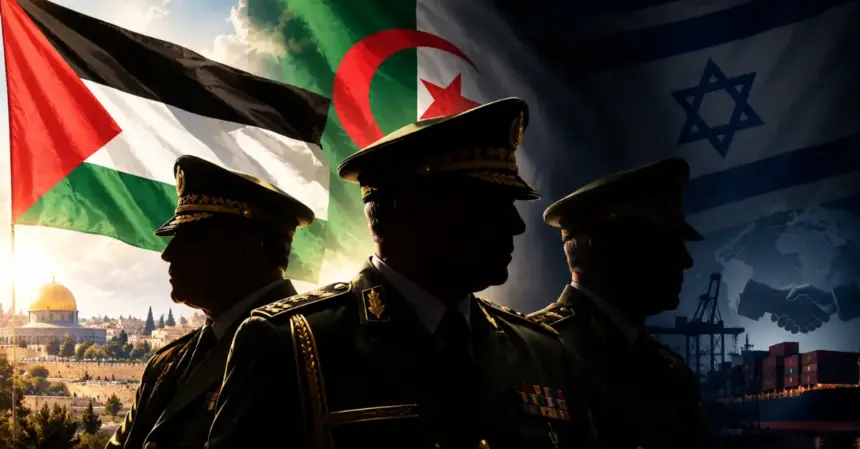
In its official diplomatic discourse, Algeria projects constant, firm support for the Palestinian cause, routinely reaffirmed in presidential speeches and at the United Nations. At the same time, the Algerian state funds, through an ordinary commercial contract, a firm whose figures and long-standing clients are directly associated with Israeli-Arab normalization and with Israeli interests in Washington.
This situation is not necessarily a sign of deliberate inconsistency: economic and security diplomacy often follows a logic distinct from public political discourse, and many Arab states — including ones that have not normalized relations with Israel — use similar firms out of sheer Washington pragmatism, for lack of an equally well-connected alternative. Still, the gap between Algeria’s declared diplomatic line and its choice of contractor legitimately fuels debate over the coherence of Algerian foreign policy — a debate that only greater transparency from Algiers about its objectives could help settle.
What this investigation cannot settle
One thing is established: Algeria pays, BGR works, and the traces of that work are public. What remains open is the return on this diplomatic investment. Without a clearly identifiable outcome indicator — a congressional vote, a dated trade agreement, a measurable shift in the US position on Western Sahara — the $720,000 annual figure remains exactly what it is: the documented cost of an influence effort whose effectiveness, for now, remains a matter of judgment rather than proof.
FAQ
Is the contract between Algeria and BGR illegal?
No. It is registered in compliance with the Foreign Agents Registration Act, which requires transparency on this type of agreement rather than banning it.
Do other countries in the region use the same type of firm?
Yes. Bahrain, Somalia, and Tanzania are among BGR’s African and Middle Eastern clients, at monthly rates that vary with the scope of the mandate.
Was the contract renewed for 2026-2027?
No new filing publicly appeared in the FARA registry as of late September 2026, though this does not allow for a definitive conclusion that it was not renewed.
Why does the choice of BGR raise questions?
Because some of the firm’s figures and long-standing clients are associated with normalizing relations with Israel, which contrasts with Algiers’ consistently pro-Palestinian diplomatic discourse.