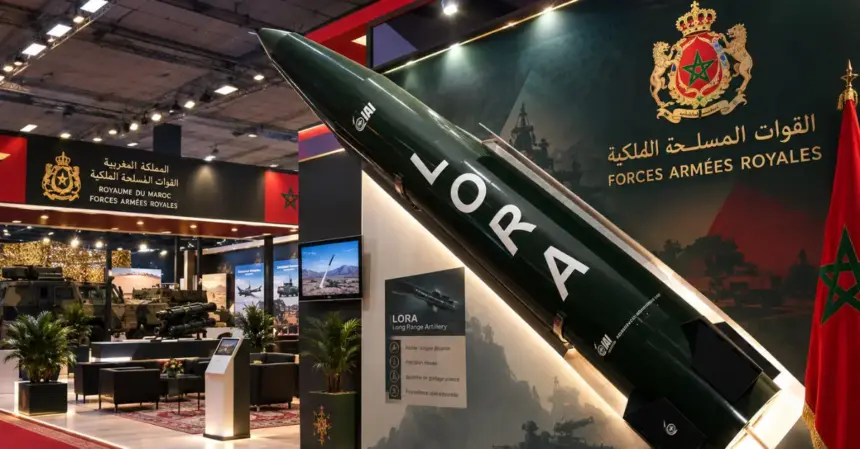
On the grand chessboard of the Western Mediterranean, a simple four-letter acronym is now enough to send shudders through the general staffs and newsrooms of the Iberian Peninsula: LORA (Long Range Artillery). The announcement of decisive progress in negotiations between the Kingdom of Morocco and state-owned manufacturer Israel Aerospace Industries (IAI) for the acquisition of this high-precision quasi-ballistic missile system has triggered a genuine shockwave in Spain.
- Mapping the Concern: Madrid Draws Range Circles
- From Drone to Ballistic Missile: The Metamorphosis of Moroccan Military Doctrine
- The Israeli Factor: An Uninhibited Industrial and Military Alliance
- Political Repercussions in Madrid: Pressure Mounts on La Moncloa
- A New Geopolitical Reality in the Western Mediterranean
From national dailies to specialized defense reviews and continuous television news channels, the observation is made with undisguised nervousness: Morocco is no longer simply seeking to modernize its armed forces to maintain a balance against its Algerian neighbor; it is acquiring a deep, surgical strike capability capable of completely redefining the regional balance of power.
For Spanish analysts, the problem lies not only in the technical characteristics of the missile, but in what it symbolizes: the spectacular qualitative leap in the military alliance between Rabat and Tel Aviv, sealed in the wake of the Abraham Accords. While Madrid watched the rise of the Moroccan drone fleet with relative detachment, the entry onto the scene of a strategic-range ballistic vector is shaking a decades-old dogma: that of Spain’s undisputed military superiority on its southern flank.
Mapping the Concern: Madrid Draws Range Circles
One only needs to open the pages of major Spanish newspapers, such as El Español, El Mundo, or La Razón, to gauge the extent of the unease. Article after article features multiplying infographics, overlaying concentric circles of ballistic trajectory onto a map of Spain originating from northern Morocco.
The LORA system is not conventional artillery. It is an ultra-modern surface-to-surface quasi-ballistic missile system with an official range of approximately 430 kilometers (potentially exceeding 500 km in certain configurations) and guided by a GPS/INS system combined with electro-optical imaging for its terminal phase. Its Circular Error Probable (CEP) is less than 10 meters, making it a formidable tool for surgical strikes against critical infrastructure: air bases, command centers, ammunition depots, or port facilities.
     [ LORA SYSTEM (Israel Aerospace Industries) ]
                     │
    ┌────────────────┴────────────────┐
    ▼                                 ▼
Range: ~430-500 km               Precision: < 10 m (CEP)
Trajectory: Quasi-ballistic      Speed: Hypersonic (Terminal phase)
By tracing these action radii from the military bases in the Kingdom’s north (notably in the Nador or Tetouan regions), Spanish military experts have drawn up an operational assessment that immediately chilled commentators:
Enclaves and Sovereign Territories: Ceuta, Melilla, as well as the Plazas de Soberanía (notably the Alhucemas and Chafarinas islands archipelago), find themselves under the direct and instant threat of a saturating strike, with no possible reaction time for local garrisons.
Andalusia and the South of the Peninsula: Major Spanish strategic bases, such as the Rota naval base (which hosts the NATO ballistic missile defense shield and US destroyers) and the Morón de la Frontera air base, fall directly within LORA’s potential impact zone.
The Heart of Spanish Territory: Even more concerning for the Iberian press, the missile’s maximum action radius makes it possible to reach cities located far beyond the Mediterranean coast, striking Murcia, Seville, Ciudad Real, and approaching the outskirts of the Community of Madrid.
The Canary Islands Archipelago: Deployed from Morocco’s southwestern coast, LORA can cover the entirety of the Canary Islands territory, neutralizing any insular advantage in the event of naval or aerial tension.
What panics the Spanish press is also the very nature of LORA’s trajectory. Unlike conventional ballistic missiles that follow a predictable parabola, LORA performs evasive maneuvers during its flight phase and dives onto its target at hypersonic speeds. This capability makes it extremely difficult to intercept by air defense systems currently deployed by Spain, such as the Patriot (PAC-2) or NASAMS systems.
From Drone to Ballistic Missile: The Metamorphosis of Moroccan Military Doctrine
To understand the panic of the Spanish media, one must analyze the speed with which Morocco’s Royal Armed Forces (FAR) have undergone their doctrinal shift. For a long time, the Spanish perception of Moroccan military potential was based on an asymmetric vision: Morocco was viewed as a regional power focused on counter-insurgency doctrine and defending its territorial integrity in the Southern Provinces.
However, the normalization of diplomatic relations between Morocco and Israel in December 2020, followed by the signing of the historic security cooperation framework agreement in November 2021 between Rabat and Tel Aviv, irreversibly changed the equation.
In just a few years, Morocco has moved from an equipment logic based on acquiring second-hand or opportunistic material to a state-of-the-art technological integration strategy:
Supremacy in Drones: Morocco quickly built one of the most diversified and efficient drone fleets in the region (Turkish Bayraktar TB2s, Harop and Hero-30 kamikaze drones, Hermes 900 and Wing Loong II reconnaissance and strike drones). This initial phase aimed at mastering tactical space and border surveillance.
Multi-Layer Air Defense: With the acquisition of the Israeli BARAK MX system and the Chinese FD-2000B system, Morocco has sanitized its own airspace, depriving its neighbors of the possibility of easy air superiority.
The Leap to Deep Strategic Strike: The arrival of the LORA missile marks the crossing of a major doctrinal milestone. This is no longer about field tactics or surveillance, but about real strategic deterrence capability. Morocco is acquiring the ability to destroy high-value infrastructure on an adversary’s territory with extremely high precision, without having to commit its fighter aircraft against enemy defenses.
                 EVOLUTION OF THE FAR'S STRATEGIC POTENTIAL
                 ─────────────────────────────────────────

  Phase 1 : Tactics & Surveillance    ──►  Drones (TB2, Harop, Hermes 900)
  Phase 2 : Sanctuarization           ──►  Air Defense (BARAK MX, FD-2000B)
  Phase 3 : Deep Deterrence           ──►  Ballistic Vectors (LORA)
It is this dazzling transition toward high-intensity warfare and long-range striking that is destabilizing analysts in Madrid. Spain has grown accustomed over three decades to assessing its security through the lens of the absolute technological superiority of its Air Force (Ejército del Aire) and Navy (Armada). The appearance of high-precision ballistic missiles on the southern shore radically transforms this equation, as it proves that technology can compensate for numbers and neutralize traditional naval or aerial superiority.
The Israeli Factor: An Uninhibited Industrial and Military Alliance
Another central element feeding the anxiety of the Spanish press and security establishment lies in the nature of the partnership between Morocco and Israel. Unlike traditional military procurement from Washington or Paris, often accompanied by strict geopolitical restrictions or very lengthy parliamentary approval procedures, the Moroccan-Israeli partnership is characterized by unprecedented flexibility and technology transfer.
For the Spanish media, the agreement with Israel Aerospace Industries is not a simple “off-the-shelf” commercial transaction. Reports indicating the establishment of drone and missile component manufacturing and assembly units directly on Moroccan soil reinforce the sense of a growing Moroccan strategic autonomy.
By partnering with the Israeli defense industry—renowned for designing weapons tested in real combat conditions (combat-proven)—Morocco ensures privileged access to cutting-edge technologies:
Latest-generation electronic warfare and jamming systems.
Very high-resolution observation satellites (such as the contract for the Ofek-13 / Ofek Series satellite intended to replace the Mohammed VI constellation).
Smart artillery systems and precision ballistic missiles.
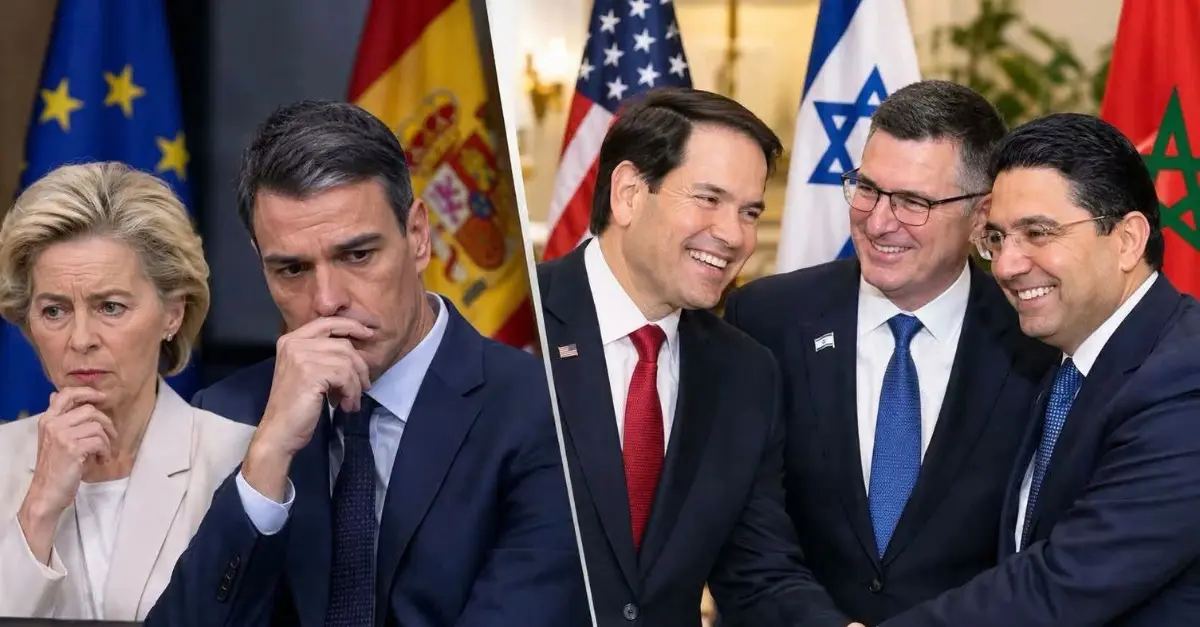
Spanish editorialists often bitterly highlight the irony of the situation: while Spain and part of the European Union maintain a diplomatic stance that is sometimes critical or cautious toward Tel Aviv, Morocco has successfully locked in a highly strategic military-industrial axis that allows it to accelerate its rearmament without depending on European political blockages.
Political Repercussions in Madrid: Pressure Mounts on La Moncloa
The media panic surrounding the LORA missile has not remained confined to newspaper columns; it quickly spilled over into internal Spanish political debate, becoming a subject of sharp confrontation in the Congress of Deputies.
The Vulnerability of Ceuta and Melilla under Debate
The geopolitical status of Ceuta and Melilla remains the neuralgic point of this concern. NATO does not explicitly ensure automatic coverage of these two enclaves located on the African continent under Article 5 of its Charter, an ambiguity regularly recalled by the Spanish opposition (notably the Partido Popular and VOX). Morocco’s acquisition of missiles capable of striking these cities’ strategic infrastructure in seconds accentuates the sense of defensive isolation of these territories.
Questioning the Defense Budget
The conservative and specialized press uses the case of the LORA missile to denounce Spain’s lag in modernizing its own armed forces. Despite recent commitments to increase military spending to reach the 2% of GDP demanded by NATO, Spain suffers from chronic delays in several key programs:
Missile Defense: Spain lacks an upper-tier ballistic interception system equivalent to David’s Sling or Arrow 3. Its existing Patriot batteries require costly modernizations to counter threats in LORA’s class.
Heavy Artillery and Deep Strike: The Spanish Army (Ejército de Tierra) has long lacked long-range artillery systems similar to HIMARS or LORA, although catch-up projects (such as the SILAM program) have been launched.
Spanish Diplomacy on a Tightrope
The Spanish government, led by Pedro Sánchez, finds itself caught between a rock and a hard place. On one hand, Madrid seeks to preserve at all costs the “new stage” of its diplomatic relationship with Morocco—initiated after Spanish support for the Moroccan autonomy plan for the Sahara in 2022—which is essential for cooperation in counter-terrorism and migration management. On the other hand, media and political pressure forces it to reassure a public anxious to see its southern neighbor develop unprecedented deterrent capabilities.
A New Geopolitical Reality in the Western Mediterranean
The Spanish media frenzy surrounding Morocco’s acquisition of the LORA missile reveals a historic paradigm shift. What the Iberian press describes as “panic” is actually the belated realization of an irreversible mutation: Morocco is no longer merely a secondary security partner on the southern shore of the Strait of Gibraltar, but an emerging and autonomous military power, capable of imposing its own rules of deterrence.
By integrating the LORA missile into its arsenal, Rabat is not necessarily seeking to provoke a conflict with its northern neighbor. The Kingdom’s objective fits into a global strategic vision: to sanctuary its territory, establish indisputable military superiority over its direct regional rivals, and command respect as a key player in the Mediterranean and Atlantic basin.
Faced with this dynamic, Spain finds itself confronted with its own paradoxes. It must relearn how to dialogue with a Moroccan neighbor now equipped with high-precision ballistic artillery capabilities, while urgently reassessing its own choices regarding national defense. One thing is certain: the era when the military balance of the Western Mediterranean was written solely from European capitals has definitively come to an end.