

A site still under construction, a first commercial operation
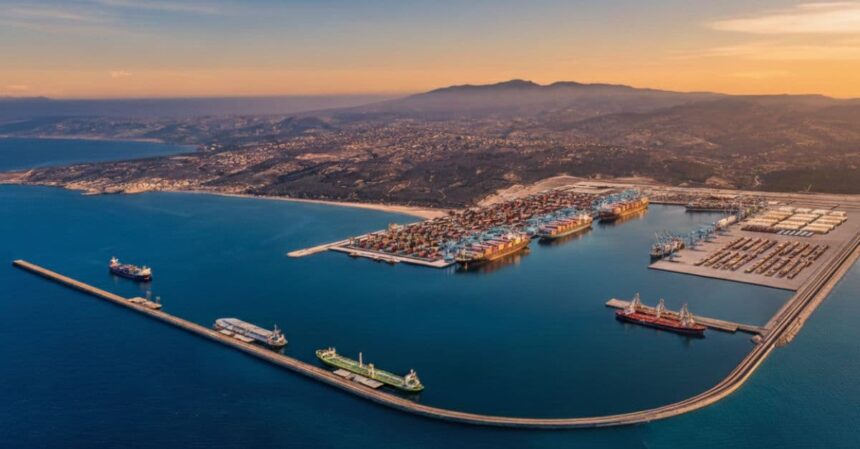
The Nador West Med port, located on Morocco’s Mediterranean coast, is a project whose full completion is announced for the end of the decade. It aims, eventually, to become a major logistics and energy hub in the western Mediterranean basin, complementing Tanger Med, which has been operational since 2007.
The cargo observed consisted of wind turbine blades manufactured in Morocco by a company that has formed an industrial partnership with a Chinese group. This type of joint venture fits into a broader trend: several international manufacturers of renewable energy equipment have set up production units in Morocco in recent years, drawn by production costs, geographic proximity to the European market, and existing free trade agreements. Exporting via Nador, rather than through an already congested port like Tanger Med, would illustrate the Moroccan authorities’ intent to spread logistics flows across several pieces of infrastructure.
Tanger Med, a regional benchmark
The comparison with Tanger Med comes up often in Moroccan public debate, given how this port has become, in less than two decades, one of the most active transshipment platforms on the African continent, ranking among the top African ports by container volume handled. This success has regularly been highlighted by Rabat as an argument in its economic and diplomatic rivalry with Algiers.
From this perspective, Algeria’s deep-water port project at El Hamdania, in the Tipaza province, offers a contrast often pointed out by Moroccan observers. Announced in 2015 as part of a partnership with Chinese operators, the project went through several delays before Algerian authorities announced, in the course of 2025, a thorough review of the file. The precise reasons behind this stall — financing, technical choices, strategic reorientation — have not been the subject of a detailed official statement, leaving room for diverging interpretations on either side of the border.
Ceuta, Melilla, and the question of trade flows
The development of the Nador port is also being closely watched in Spain, given its proximity to Melilla, a city under Spanish administration that Morocco claims as part of its own territory — a sovereignty dispute that remains, to this day, unresolved between Rabat and Madrid, and distinct from the purely economic issues discussed here.
Some Moroccan commentators claim that the rise of the Tangier and Nador ports has gradually diverted trade flows that previously passed through Ceuta and Melilla, and that several international shipping companies have reorganized their regional presence as a result. These claims, circulated without verifiable institutional sourcing at this stage, need to be confirmed by official customs or port data before being presented as established fact; for now, they reflect more of a Moroccan-side perception than a measured finding.
A three-facade port strategy
Morocco is simultaneously running several major port projects: besides Tanger Med and Nador West Med, the country is developing the Dakhla Atlantic port, presented as a gateway to West Africa and, in the longer term, to the Americas. This multi-facade strategy — Mediterranean, North Atlantic, and South Atlantic — is part of a broader industrial policy aimed at locally developing high-value-added sectors: automotive, aerospace, and now renewable energy, along with, according to government announcements that remain sparsely documented publicly, a nascent defense-industrial base.
On this last point, statements about Moroccan production of drones, anti-drone systems, or other military equipment should be treated with caution: Morocco has indeed entered industrial partnerships in the defense sector, notably with Turkey for drone assembly, but the exact scale of this emerging sector remains difficult to establish in the absence of detailed official data.
Key points
- Nador West Med: Moroccan Mediterranean port under construction, completion expected around 2029-2030
- First commercial export: wind turbine blades manufactured in Morocco in partnership with a Chinese group
- Regional comparison: Tanger Med, operational since 2007, remains Morocco’s benchmark port; Algeria’s El Hamdania project (announced in 2015) was called into question in 2025
- Parallel diplomatic stake: Nador’s proximity to Melilla, whose status remains disputed between Rabat and Madrid
Outlook
Morocco’s rising port capacity fits into a broader regional economic competition, in which logistics infrastructure is becoming a tool of influence as much as one of development. It remains to be seen whether this dynamic will translate, in the coming years, into a measurable shift in Mediterranean trade flows, or whether it remains for now more a communication argument than an established statistical reality.
FAQ
Is the Nador West Med port already operational?
The site is not yet complete; full completion is announced for the end of the decade, but occasional commercial operations, such as this wind turbine export, are already taking place there.
Has Algeria’s El Hamdania port project been abandoned?
Algerian authorities announced in 2025 a thorough review of the file, without a detailed official statement on either a definitive abandonment or a relaunch.
Does Morocco actually produce wind turbines for export?
Yes, through industrial units set up with foreign partners, including Chinese groups, taking advantage of the kingdom’s trade agreements with the European Union.