

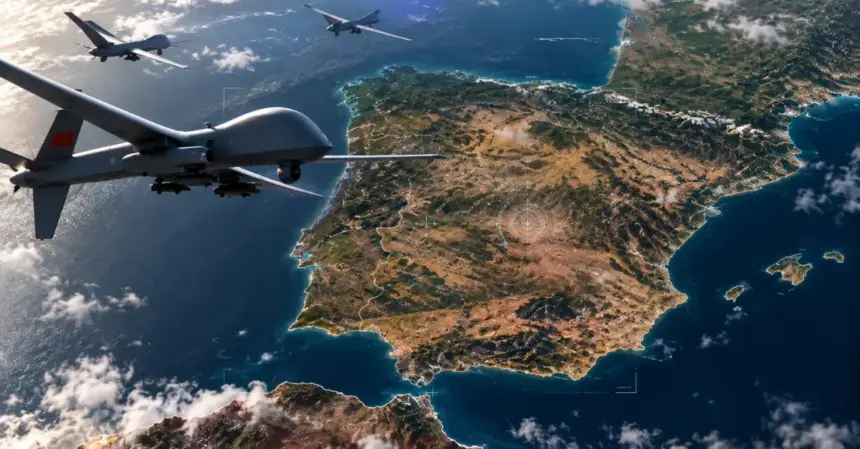
In this context, Spain would lose what its membership in NATO and the European Union normally provides: available partners.
My working hypothesis is simple. European capitals, absorbed by the Eastern front, would have neither the means nor the willingness to open a second theatre in the south. Morocco, meanwhile, would maintain the support of its American and Israeli allies. Under these conditions, and in a short or medium-duration conflict, I believe Morocco would prevail in the drone warfare and inflict considerable damage across Spanish territory.
What Spain is already doing for Ukraine
It should be remembered that Spain is not a bystander in the war in Ukraine. Since 2022, it has participated in the European military effort in several ways:
- deliveries of equipment, including anti-tank systems, ammunition, military vehicles, night-vision equipment, defense systems, and logistical support
- training in Spain of 7,000 to 8,000 Ukrainian soldiers, as part of European missions
- military financial aid of around €1 billion per year in 2024–2025, with new packages including air defense and anti-drone systems
- a recent focus on anti-drone defense, with funding for systems and radar and European industrial cooperation to produce them
This commitment is a credit to Madrid, but it has a strategic downside. In an open war between Russia and Europe, these contributions would not stop—they would intensify. Stocks already reduced by deliveries, training capacities mobilized, budgets directed eastward, and especially anti-drone systems produced at the European level and sent to the front—all of this would reduce what Spain would have available to defend itself at home. It would be caught between alliance commitments and national needs.
A Europe absorbed by the Eastern front
Facing Russia, Europe would again become an alliance of priorities. Ammunition, air defenses, drones, and intelligence would first go to countries near the front line. Spain, far from this line, would take a back seat in resource allocation, and its requests would clash with already saturated production chains.
There is also a political reality. Morocco is a major partner of the European Union in trade, energy, industrial investment, and migration cooperation. No capital would want to add a rupture with Rabat to a war against Russia. The instinct would be to push for de-escalation. Finally, Ceuta and Melilla are not covered by NATO’s collective defense guarantee, leaving little legal basis for allied intervention.
Morocco and its alliances
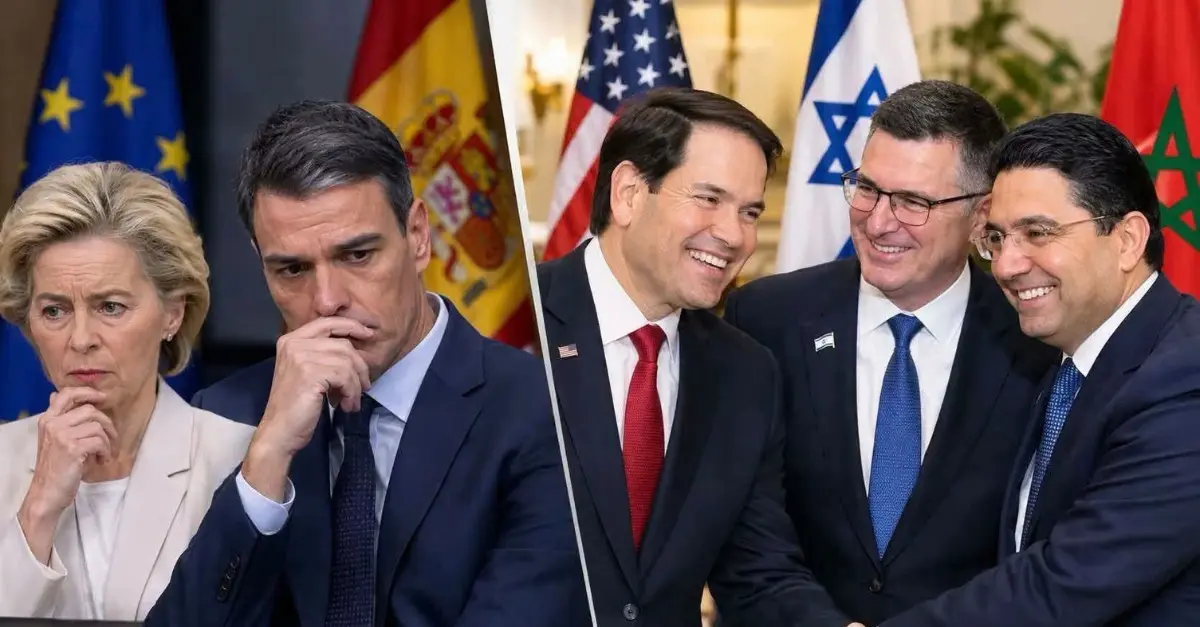
This is the central contrast of the scenario. While Spain would find itself relatively alone, Morocco would rely on a network of established partners. The United States has long considered it a major non-NATO ally and conducts large-scale exercises with it. Israel, since normalization in 2020, has developed deep military and industrial cooperation, especially in drones and electronic warfare. Turkey has supplied combat drones. In this scenario, these supports translate into satellite intelligence, ammunition, training, and maintenance.
This depth of alliances is not only quantitative. It gives Rabat access to combat-proven technologies, while Spain would depend on national stocks and emergency procurement.
A Morocco that produces its own drones
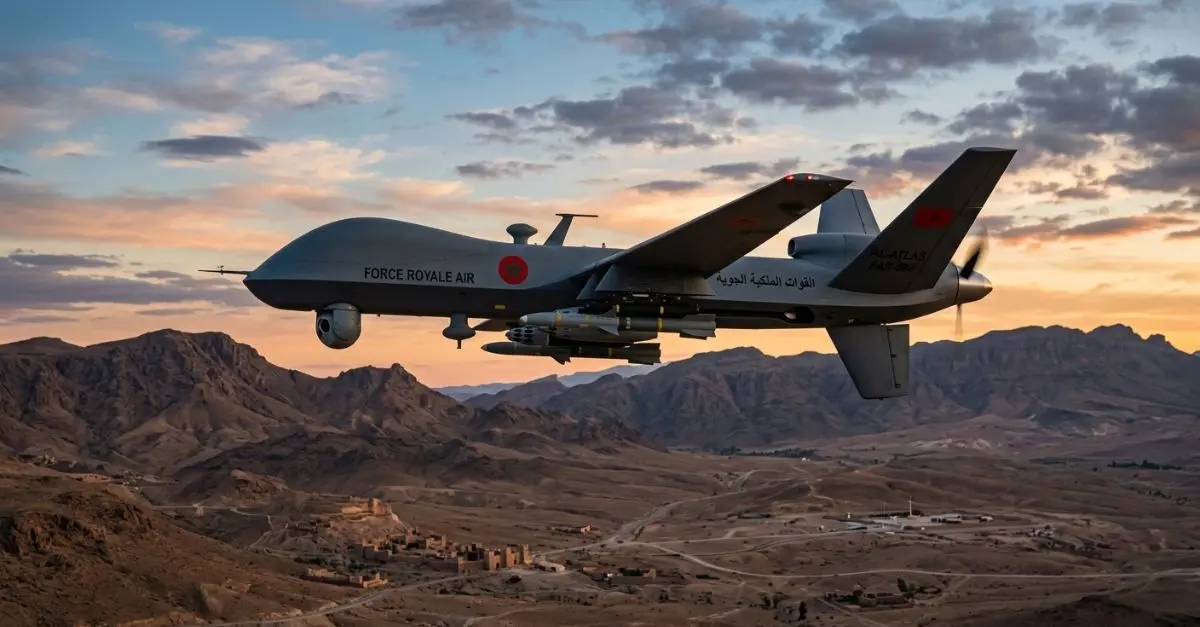
One parameter significantly changes the equation: Morocco is no longer just buying drones, it is starting to produce them. In recent years, the kingdom has launched a domestic industrial push, with drone manufacturing units already in place and increasing production of drones and anti-drone systems. Turkish-origin drones are among those now being produced on Moroccan soil, and cooperation with Israel has also opened the way to local production.
This capability is based on a solid industrial foundation. Morocco is now one of the most industrialized countries in Africa, with established sectors in automotive, aerospace, and electronics, well-equipped industrial zones, and a major port such as Tanger Med. For a country already experienced in high-level subcontracting, creating drone factories is not an obstacle but a logical extension of existing capabilities.
In a war of attrition, the consequence is significant. While Spain would depend on European programs absorbed by the Eastern front and on external supplies, Morocco could replenish its losses and adapt production locally, without relying solely on supply convoys from allies. This local production adds depth and duration to its capabilities rather than replacing allied support.
A nuance remains important. Some sensitive components, such as advanced electronics, engines, or satellite links, may still depend on imports, meaning Morocco’s industrial autonomy remains partial. But this dependency is far smaller than Spain’s gap in external support.
Drone warfare: why Morocco would win
A drone war is decided by four elements: seeing, jamming, endurance, and mass strikes. In each of these, the advantage appears to favor Rabat.
Seeing. With US satellite imagery and Israeli analysis, Morocco would have a precise picture of Spanish deployments, both at sea and on land. Spain, deprived of European intelligence sharing focused on Russia, would see less and have to protect everything at once.
Jamming. Electronic warfare is where Israel’s advantage is strongest. Jamming, deception, passive detection, and swarm coordination allow control of low-altitude airspace. Spain invests in radar and anti-drone systems, but its development is recent and dependent on European programs.
Endurance. Attrition determines the outcome. Intercepting dozens of small drones with expensive missiles is a losing exchange, and Spain would have no European reserves to fall back on. Morocco, supplied by its allies, would turn losses into a manageable operational cost.
Mass strikes. Swarm saturation overwhelms defenses before interceptors are exhausted. Quantity, local production, and ammunition flow would give Rabat a decisive advantage.
Damage across Spain
What distinguishes this scenario is the scale of its consequences. I do not see a conflict limited to the Strait or the enclaves. An actor that dominates low-altitude airspace and surveillance can affect an entire territory, from the mainland to the Balearic Islands, the Canary Islands, and southern Atlantic waters.
Militarily, pressure on bases, naval assets, and air defenses would force Madrid to disperse its forces. Economically, disruptions to ports, Strait traffic, energy, and telecommunications would quickly be felt in a country whose tourism and trade depend on smooth flows. Politically, the inability to protect the entire territory would fuel a crisis of confidence. Ceuta and Melilla, surrounded by Moroccan territory and difficult to supply, would be the first to be weakened.
Spain would partially compensate with its territorial size and trained armed forces, but defending a large, discontinuous area without external reinforcement is far more costly than attacking it.
What tempers this conclusion
It would be dishonest not to highlight the limitations of the scenario. A Russia–Europe war coinciding with a Spain–Morocco conflict is highly unlikely. Washington, engaged with NATO against Russia, would have little incentive to arm a country against an alliance partner hosting US bases. A drone-only war is also an abstraction, as escalation into other weapons would be difficult to avoid. Finally, over the medium term, the growth of European industry, including anti-drone capabilities, could rebalance the balance of power.
In a world where Europe is absorbed by Russia, Spain would be militarily weakened: committed alongside Ukraine, it would see its stocks, budgets, and anti-drone systems drawn toward the Eastern front, without being able to rely on European support to defend itself in the south. Facing it, a Morocco supported by its alliances would, in my view, prevail in drone warfare, at the cost of significant damage across Spanish territory.
FAQ
Why would Spain be weakened in this scenario?
Because Europe, absorbed by Russia, could not supply enough ammunition, anti-drone defenses, or intelligence, while Spain’s own resources are already mobilized for Ukraine.
What is Spain doing for Ukraine?
It supplies equipment, trains several thousand Ukrainian soldiers, and spends around €1 billion per year in military aid, with a recent focus on anti-drone defense.
What is Morocco’s advantage based on?
On its alliances with the United States and Israel, providing intelligence, electronic warfare, and ammunition, and on its ability to sustain attrition.
Is this scenario realistic?
No, it is a hypothetical exercise. It assumes a two-front conflict and US support for Morocco against a NATO ally, which is highly unlikely.