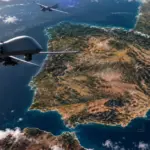


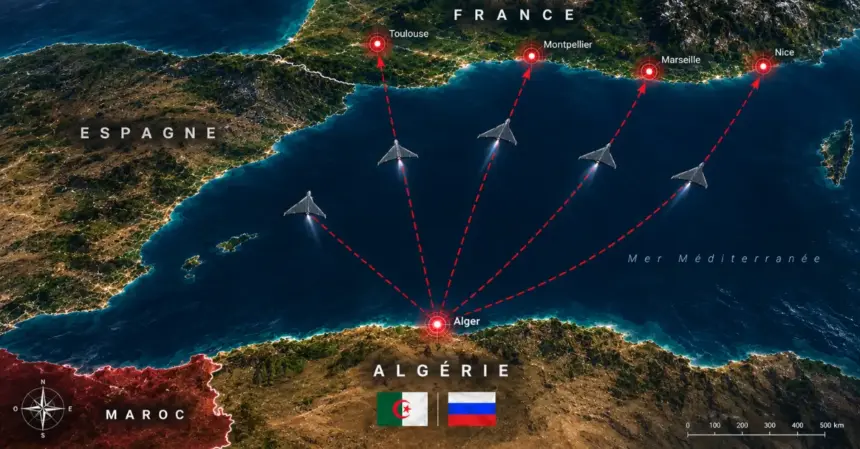
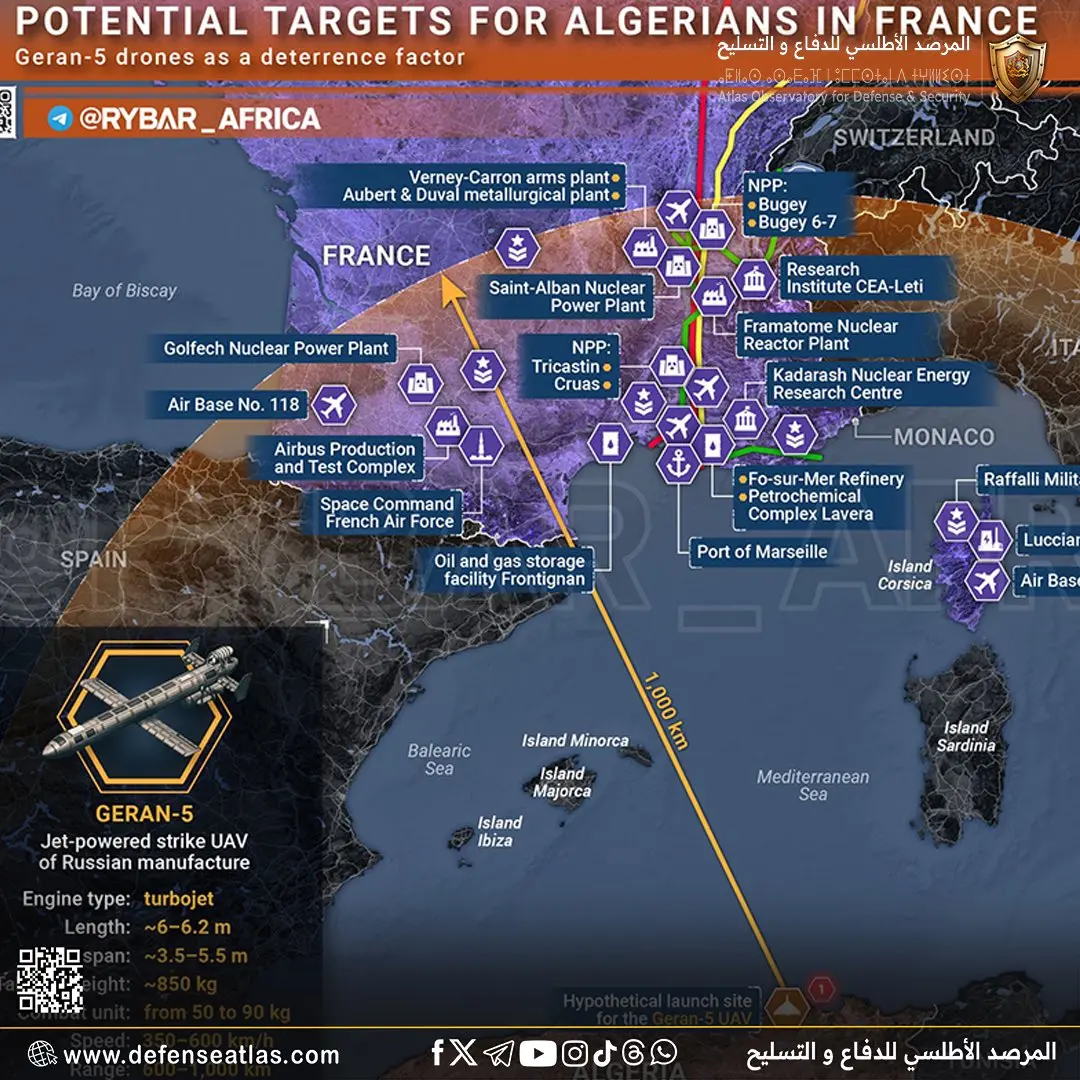
The message refers to critical infrastructure and strategic sites in France and its European partners, identifying the Geran-5 drone as the delivery system, potentially launched from Algeria. At this stage, there is no official confirmation of such a threat from Moscow, Algiers, or Paris. The topic nevertheless deserves a careful and measured analysis, without alarmism.
What Rybar says and what the channel represents
Rybar is a pro-Russian military analysis channel and one of the most widely followed actors in the “war blogger” ecosystem. Some media outlets describe it as close to Russia’s military apparatus, and it is sometimes even linked—without verified public evidence—to foreign intelligence structures.
This distinction matters: influence channels are not official government spokespeople. Their content may reflect internal narratives, test reactions, or amplify strategic messaging without direct Kremlin endorsement.
According to circulating information, Russian and Algerian sources are said to have mentioned a potential Geran-5 production line in Algeria. Claims about strikes on Europe from Algerian territory remain unverified, and no satellite imagery or independent evidence has confirmed such facilities.
The Geran-5: a jet-powered evolution of loitering munitions
Under the “Geran” designation, Russia has been producing since 2022 localized versions of Iran’s Shahed-136 drones—low-cost, long-range kamikaze drones designed to overwhelm air defenses through saturation attacks.
The Geran-5 represents a further evolution. According to Ukraine’s military intelligence (GUR), it is jet-powered, making it significantly faster and harder to intercept than propeller-driven versions. Its first reported use dates back to early 2026.
Reported specifications (unverified independently):
- Explosive payload: ~90 kg (GUR estimate)
- Range: ~1,000 km (GUR estimate)
- Production rate: up to 3,000 Geran-4 and Geran-5 drones per month, mainly in Alabuga (Tatarstan)
- Interception rate: around 60% in August, according to EUobserver battlefield reporting
These figures illustrate a key strategic issue: low-cost drones force defenders to use expensive interceptors, creating a long-term economic imbalance in warfare.
Drone production in Algeria: what is known and unknown
Russia and Algeria have maintained a long-standing defense partnership, with Algeria being one of Russia’s largest arms customers (fighter jets, air defense systems, submarines).
A potential expansion into drone manufacturing would not be unprecedented in this context. However, critical uncertainties remain:
- No confirmed evidence of a Geran production chain in Algeria
- No verified scale or operational control
- No indication that Algerian territory is being used for external strike operations
Producing military equipment under license is one issue; allowing its use against third countries is a completely different legal and political matter.
Algeria traditionally follows a non-alignment doctrine and opposes foreign military bases on its territory. The country has not officially responded to these allegations.
A geography that works on paper, but is complex in reality
In theory, southern Europe falls within a possible operational radius:
- Algiers to Marseille: ~750 km
- Algiers to Paris: ~1,350 km
If the reported range of the Geran-5 is accurate, parts of southern France, Corsica, Sardinia, and the Balearic Islands could be within reach.
However, operational reality is far more complex:
- Launch sites would be detectable by satellite
- Mediterranean air and naval surveillance coverage is dense
- Large-scale coordinated drone waves would likely generate early warning signals
The primary effect of such a threat may therefore be psychological and strategic rather than operational: increasing perceived vulnerability in Europe’s southern flank.
Why would such messaging emerge now?
Three non-exclusive interpretations exist:
1. Strategic pressure
Expanding the perceived threat zone forces European states to reconsider security priorities beyond Eastern Europe.
2. Franco-Algerian tensions
Relations between Paris and Algiers remain strained. Any suggestion of military use of Algerian territory would intensify diplomatic pressure and regional uncertainty.
3. Narrative escalation
The claim may also reflect informational escalation from non-official channels, without corresponding operational reality. Russia’s drone production is heavily committed to Ukraine, and Algeria would face significant geopolitical risks if directly involved.
What can France and Europe do?
Europe has already begun accelerating anti-drone defense systems following drone incursions on its eastern flank.
A southern Mediterranean scenario would require:
- Expanded radar coverage
- Stronger electronic warfare capabilities
- Low-cost interception systems (guns, jammers, short-range interceptors)
- Better integration of air and naval surveillance in the Mediterranean basin
The key challenge remains economic: using missiles worth hundreds of thousands of euros to intercept drones worth a fraction of that cost is not sustainable long-term.
Conclusion
At this stage, there is no verified evidence confirming the claims of drone deployment from Algeria against France. The scenario remains hypothetical and based on unconfirmed reports.
However, it highlights a broader strategic shift: the extension of drone warfare beyond Ukraine and into wider geopolitical narratives involving Europe, North Africa, and the Mediterranean.
The central question remains open: how far can drone warfare expand beyond its original battlefield?