


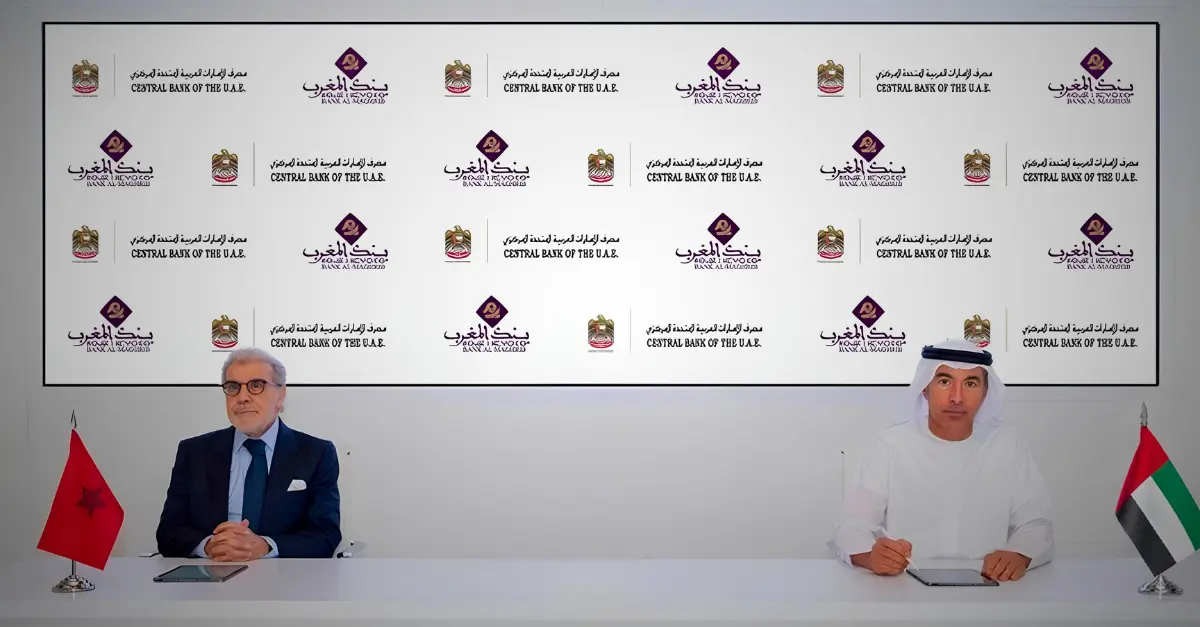
This Saturday in Abu Dhabi, the Bank of Morocco, better known as Bank Al-Maghrib, and the Central Bank of the United Arab Emirates signed two memorandums of understanding. The first covers banking supervision and Islamic finance, the second the interconnection of payment systems and financial messaging. The texts were initialled by the wali (governor) of Bank Al-Maghrib, Abdellatif Jouahri, and by the governor of the Emirati central bank, Khaled Mohamed Balama.
Key takeaways
- Bank Al-Maghrib and the UAE Central Bank signed two memorandums in Abu Dhabi this Saturday.
- The first covers banking supervision and Islamic finance.
- The second aims to interconnect payment systems and financial messaging.
- Both banks intend to explore instant payments and central bank digital currencies.
- These are agreements in principle: their implementation remains to be defined.
A memorandum of understanding is not a treaty, still less a contract. Yet it says something about how two monetary institutions intend to organise their relationship. We set out to understand what these two texts cover, what they make possible and what they leave open.
What the two memorandums say
According to the information released about the signing, the two agreements pursue distinct but complementary objectives.
- Banking supervision: exchange of expertise between the two supervisory authorities.
- Islamic finance: development of joint or coordinated solutions in this segment.
- Payments: exploration of the interconnection of instant payment platforms.
- Central bank digital currencies: study of their use in cross-border transactions.
- Financial messaging: interconnection of the channels through which banks exchange their payment instructions.
The verb that recurs in the wording of these objectives is “explore”. The aim, then, is not to announce an operational system but to open a project. The two institutions say they want to improve the efficiency of financial transactions and broaden banking and commercial cooperation between the two countries. At this stage, we are aware of neither a timetable nor a budget, and the full content of the texts has not been made public.
Why supervision is the most concrete area
Of the two agreements, the first is probably the one that will produce the fastest effects, and the least visible to the general public. In practice, cooperation between supervisors means sharing risk-analysis methods, lessons learned from inspections and regulatory approaches. It does not change customers’ daily lives, but it matters for institutions operating in both countries.
Bank Al-Maghrib has long experience in this field. Created in 1959, it has seen its independence strengthened by successive statutory reforms, and it supervises a banking sector in which several players are established in Africa. Its wali himself noted, in a speech in Lisbon, that Moroccan banks were present in 25 countries on the continent. For a supervisor, this regional dimension makes it necessary to multiply agreements with foreign counterparts. A country that hosts or sends out banking groups must be able to exchange information with the authorities of the jurisdictions concerned.
On the Emirati side, the central bank oversees a highly internationalised financial centre, where local banks, foreign subsidiaries and financial free zones with their own regulators coexist. Closer ties with an African partner whose expertise is recognised on the continent may clearly be of interest. We offer this reading as analysis: the statements do not detail each party’s motivations.
Islamic finance, a sensitive and still young sector in Morocco
The second strand of banking cooperation concerns Islamic finance. Morocco long kept this sector at arm’s length before opening the way to so-called “participative” banks (to be verified: banking law was adapted and the first institutions opened from 2017). These banks operate under the oversight of a religious body responsible for validating the compliance of their products with sharia principles. Their development remains, to our knowledge, gradual and still limited compared with conventional banks, but we do not have up-to-date figures here that we could attribute to a source.
The Emirates offer a useful contrast. Their financial system has long combined Islamic and conventional institutions, and Islamic finance is an established segment there. For a central bank seeking to structure a more recent market, access to proven experience is an asset. For Abu Dhabi, a partnership with Morocco may open the door to a sizeable market at the crossroads of Europe and Africa.
A fundamental question remains that the texts, as they have been presented to us, do not settle. Islamic finance rests on standards and interpretations that may vary from one country to another. Developing joint “solutions” therefore also means engaging with the religious compliance bodies on each side. This is long-term work.
Instant payments and digital currencies, the most ambitious strand
The second memorandum is the one drawing the most attention, because it touches the very infrastructure of exchange. Let us first recall what is at stake.
A conventional cross-border payment often passes through a chain of intermediary banks. Each charges fees and adds delay, and the customer does not always know when the money will arrive. Interconnecting two instant payment platforms aims to shorten this chain: a transfer sent in one country could be received almost immediately in the other, through linked systems rather than successive correspondent banks.
Financial messaging systems, for their part, are the standardised channels through which banks exchange their orders. Making them compatible is a technical prerequisite for any interconnection, a bit like two rail networks that must agree on track gauge before running trains from one country to the other.
As for central bank digital currencies, these are digital versions of official money, issued and guaranteed by the monetary institution itself, not to be confused with private cryptocurrencies. Several central banks around the world are experimenting with their use for international payments, but most are still at pilot stages. The memorandum, moreover, is limited to an “exploration”. The two institutions commit to studying, not to deploying.
What may change, and what remains uncertain
The potential beneficiaries are numerous, provided the project succeeds: companies trading between the two countries, Emirati investors present in Morocco, households sending money home. Lower fees and shorter delays are the argument most often put forward by promoters of this kind of project. The real gains will nonetheless depend on technical and pricing choices that are not yet known.
Several points remain open, and we prefer to name them rather than gloss over them.
The timetable. No deadline has been announced. Payment interconnection projects generally require study phases, testing, regulatory adjustments and IT investment.
The legal framework. A memorandum sets out an intention. For a payment to actually flow from one system to the other, operational agreements will be needed, along with compliance with anti-money laundering and counter-terrorist financing rules, and clear liability rules in the event of an incident.
Monetary sovereignty. In Lisbon, Jouahri argued for “win-win” cooperation between African countries, while stressing that monetary sovereignty has several dimensions and must reckon with regional and international developments. Interconnection with a Gulf partner fits into this broader reflection: it diversifies payment channels, which can be seen as a strategic asset, but it also requires managing the new technical dependencies it creates.
The use of digital currencies. Opinions differ on their usefulness. Supporters see them as a way to simplify international settlements. Critics point to risks for privacy, banking stability and cybersecurity. The fact that the text speaks of exploration leaves each central bank free to conclude that deployment is not desirable.
A signal within an already dense economic relationship
This signing comes against the backdrop of economic relations between Morocco and the Emirates that are commonly described as close, notably in terms of investment (to be verified and quantified with an official source before publication). It adds an institutional layer to this link: that of central banks, which oversee flows rather than generate them.
It also illustrates a more general trend. Central banks in emerging economies are multiplying bilateral agreements to reduce their dependence on traditional payment channels, which are slower and more costly. Morocco, through its geographical position and the presence of its banks in Africa, can act as a gateway. The Emirates, for their part, are seeking to strengthen their status as a financial hub between Asia, the Middle East and Africa. The interests converge, but they do not coincide.
An open conclusion
We will refrain from drawing hasty conclusions. Two memorandums of understanding open up avenues without guaranteeing they will materialise. The true measure of this signing will come in the months and years ahead: through the announcement of a timetable, the setting up of working groups, payment tests between the two systems or, conversely, a prolonged silence.
What is established, however, is that two monetary institutions with different profiles have chosen to put structuring subjects on the table: supervision, Islamic finance and payment infrastructure. For industry professionals and the companies concerned alike, the matter deserves close attention.
FAQ
What exactly did Bank Al-Maghrib and the UAE Central Bank sign?
Two memorandums of understanding, signed in Abu Dhabi. One covers banking supervision and Islamic finance, the other the interconnection of payment systems and financial messaging.
Is a memorandum of understanding legally binding?
As a general rule, no. It expresses an intention to cooperate and sets a working framework. Its implementation requires more precise agreements, which have not been announced at this stage.
Will payments between Morocco and the UAE soon be instant?
No date has been given. The two institutions speak of exploring the interconnection of instant payment platforms, which corresponds to a study phase.
Will central bank digital currencies be used?
Their use in cross-border transactions is among the avenues to be explored. Nothing indicates, at this stage, that deployment has been decided.