
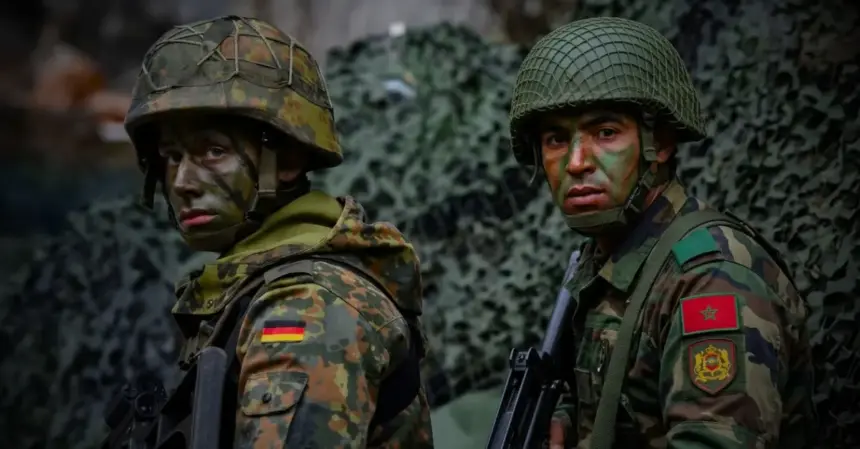
In 2025, Germany approved military equipment exports to Morocco worth 19.27 million euros, mainly surveillance and target detection technologies. The figures appear in the annual report on arms exports, submitted to the Bundestag in August and recently picked up by specialised international media. The amount is modest. The political trajectory it is part of is less so, and that is what I propose to examine here.
- On April 30, 2026, Berlin and Rabat expressed their intention to strengthen their military cooperation.
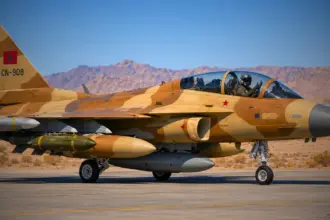
- In 2025, Germany approved 19.27 million euros of military exports to Morocco.
- More than half of this concerns surveillance and target detection (55.2%).
- This remains marginal compared with Germany’s 13.3 billion euros in defence exports.
- Germany is not among Morocco’s top three arms suppliers.
A political commitment announced in April 2026
On April 30, 2026, Moroccan Foreign Minister Nasser Bourita received his German counterpart, Johann Wadephul, in Rabat for the second session of the Morocco-Germany Multidimensional Strategic Dialogue. At the end of the talks, according to the joint statement, the two ministers expressed their intention to further strengthen military cooperation as well as cooperation in armaments and defence, based on mutual trust and respect.
The text states that a declaration of intent on military cooperation will be an important step towards continued, ambitious and mutually beneficial military cooperation. The two sides also welcomed the progress made in negotiating a bilateral security agreement and in establishing a security dialogue.
I would stress one important nuance. These wordings express an intention and describe ongoing negotiations. They do not announce a concluded agreement. At this stage, the documents cited detail neither the content nor the timetable of these future commitments.
What the German report says about exports
In Germany, any export of military equipment requires a licence from the federal government, which reports each year to Parliament on the authorisations granted, by country and by category. For 2025, Morocco obtained 26 individual export licences. Berlin also issued nine collective licences, which, under German regulations, authorise a large number of exports to several specifically identified recipients.
Key figures for the Moroccan case:
- 19.27 million euros in licences approved in 2025
- 26 individual licences and 9 collective licences
- 55.2% of the value for target location, detection and identification devices, as well as parts for surveillance and tracking systems
- 30.9% for armoured vehicle components
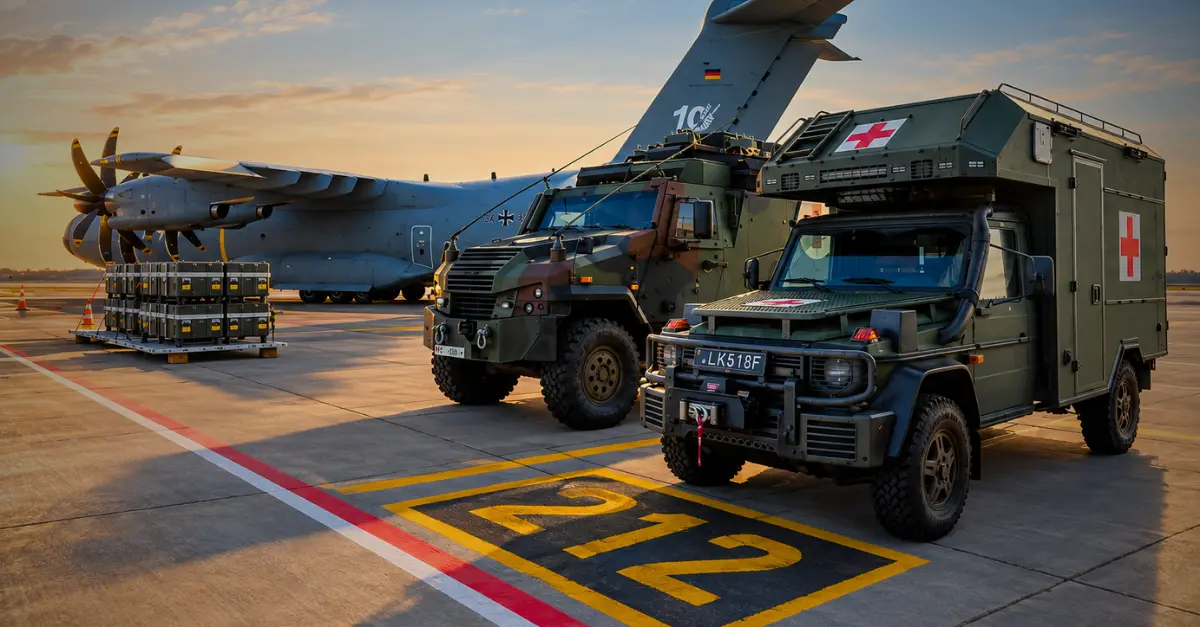
- The remainder for aircraft-related items, military electronic equipment, software and technologies
A methodological point is in order. The report describes categories and approved values, not actual deliveries, and it specifies neither the exact equipment nor its end use. I stick to what the document establishes.
An acceleration in the second half of 2025
Most of the amount was approved in the second half of the year. The interim report covering January to June 2025 listed 14 licences worth about 8.47 million euros. By difference, the remaining 12 licences, worth about 10.8 million euros, were granted between July and December. More than half of the value therefore came in the second half, without the report explaining why.
A marginal share of German sales
These figures need to be put into perspective. According to the Bundestag press service, which summarised the report on August 25, German defence exports reached 13.3 billion euros in 2025, compared with 13.4 billion in 2024. EU and NATO member states, as well as comparable countries such as Australia, Japan and Switzerland, received approvals worth 8.7 billion euros. Licences for third countries, including Ukraine, amounted to about 4.6 billion, of which 2.27 billion went to Ukraine alone, which topped this group.
Morocco, which is neither an EU nor a NATO member, falls into the category of third countries. By my own calculation from the published figures, its 19.27 million euros represent slightly more than 0.1% of the German total. The issue is therefore not the volume, but the nature of the equipment, centred on surveillance, and the direction the relationship is taking.
The framework for German licences
The German Foreign Ministry states that Berlin decides on its arms exports according to the government’s political principles on the matter, in which respect for human rights in the recipient country plays an important role. This is the official criterion. The report does not say how it was applied licence by licence, and I do not seek to fill this silence with conjecture. For a third country, these authorisations remain by nature political decisions as much as commercial ones.
Moroccan Sahara and migration, two linked issues
The joint statement of April addresses two sensitive subjects. On the Moroccan Sahara, Berlin reaffirmed that it considers Morocco’s autonomy initiative a serious and credible basis for negotiations. This position is not new: Germany had already set it out in a joint statement published in Rabat in August 2022, which described the 2007 plan as a serious and credible effort and a good basis for reaching an agreement.
On migration, the two ministers welcomed a strategic and reliable partnership. They reaffirmed their commitment to continue strengthening return and readmission processes, as well as to improve labour mobility and legal migration. This cluster of issues, defence, the Moroccan Sahara, migration, shows that the relationship is not limited to equipment sales. The link between these areas is explicit in the official texts, and everyone can draw their own reading from it.
Strong economic ties
According to the German Foreign Ministry, Germany imported more than 3.4 billion euros of Moroccan goods in 2025 and exported slightly less than 3.9 billion euros to the kingdom. About 300 German companies are present in Morocco, 30 of which have production sites or service subsidiaries, and they have created about 35,000 jobs in the country. These exchanges form the foundation on which the political and security rapprochement rests.
A still secondary supplier in the arms market
In the arms market, Germany is not currently one of Morocco’s main suppliers. According to the Stockholm International Peace Research Institute (SIPRI), the United States accounted for 60% of the kingdom’s major arms imports between 2021 and 2025, ahead of Israel (24%) and France (10%). SIPRI ranks Morocco 28th among the world’s arms importers over this period. Germany is therefore not among the top three. This does not rule out a rise in its role, but the available data do not allow us to say so.
What is at stake going forward
Several questions remain open. The first concerns the pace: will the rise in licences in the second half of 2025 be confirmed in upcoming reports? The second concerns the nature of the cooperation, since the declaration of intent and the security agreement mentioned in April could extend the framework beyond one-off licences. The third falls within German political debate, where respect for human rights remains an official criterion that parliamentarians can question when these reports are reviewed.
Meanwhile, 2026 marks 70 years of diplomatic relations between the two countries, which both capitals described in their April statement as seven decades of historic partnership. This symbol offers a convenient setting for new announcements. It remains to be seen whether they will translate into concrete commitments, and whether Morocco will further diversify its sources of equipment beyond its current suppliers.
FAQ
What is the nature of the military strengthening between Morocco and Germany?
On April 30, 2026, the two foreign ministers expressed their intention to strengthen military, armaments and defence cooperation. A declaration of intent and a bilateral security agreement are under discussion.
How much military export approval did Germany grant to Morocco in 2025?
The German government’s annual report cites 19.27 million euros, spread across 26 individual licences. Nine collective licences were also issued.
What types of equipment are involved?
Target location, detection and identification devices, as well as parts for surveillance and tracking systems, account for 55.2% of the value. Armoured vehicle components account for 30.9%.
Is Germany a major arms supplier to Morocco?
No, according to SIPRI. Between 2021 and 2025, the United States (60%), Israel (24%) and France (10%) dominate Morocco’s major arms imports.