

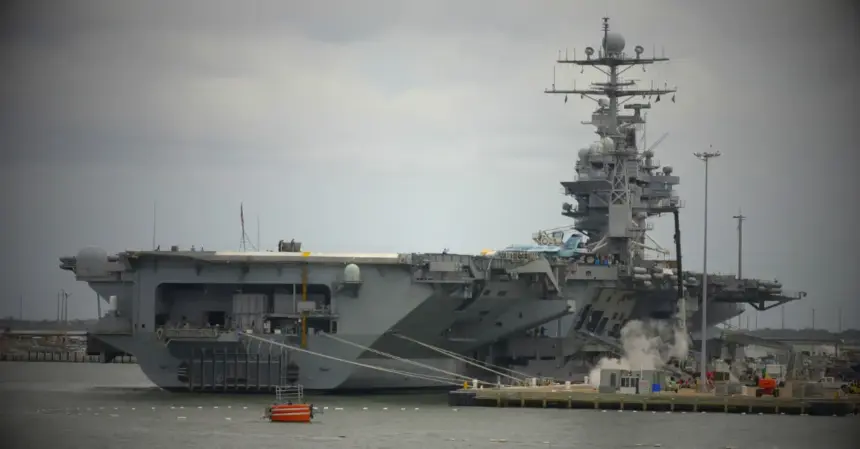
Merchant ships are waiting for a military escort in the Red Sea because no frigates are available. France is sending additional assets to Saudi Arabia after the attacks on the Yanbu oil facilities. The Strait of Hormuz remains under severe tension. For several weeks now, navies have been called on everywhere at once. I want to understand what this means for their size, their equipment and their place in defence strategies.
- Navies are in demand everywhere at once: the Red Sea, Hormuz, Saudi Arabia.
- According to Admiral Merveilleux du Vignaux, fleets have shrunk over several decades and need to be rebuilt.
- Drones multiply capabilities, but they do not replace ships.
- Survivability, electronic warfare and availability are becoming priorities.
- Euronaval reports around 40% more exhibitors this year.
A sea that is becoming contested again
The question in the title is worth asking, because large combat fleets have long been seen as a legacy. Recent conflicts seemed to be fought on land, in the air or in cyberspace. The sea appeared settled, a space for transit rather than confrontation.
Current events contradict that impression. When a strait closes or a maritime route becomes dangerous, it is navies that are called on, because only they can escort, monitor and deter over the long term.
On this point, Rear Admiral Guillaume Merveilleux du Vignaux, general commissioner of the Euronaval exhibition, is explicit. I draw here on the interview he gave to a programme devoted to aerospace and defence. He reminds us that the sea is not just a backdrop. It involves natural resources and climate routes, and above all international trade. According to him, around 80% by value and 90% by volume of the goods traded worldwide travel by sea. These orders of magnitude are put forward by the admiral and should be cross-checked against an institutional source before publication.
Fleet sizes that have become insufficient
The reasoning that follows is simple. Protecting these flows requires assets in both quantity and quality. Yet, as the admiral points out, navies have seen a fairly marked reduction in their size over recent decades.
One of the journalists present pointed out that the war in Ukraine had revealed a lack of mass in land forces, with too few tanks and too little artillery. He wondered whether the naval domain faced the same problem. The admiral did not dispute the parallel. He judged that the number of vessels remained insufficient in the current context, including for a navy like the French one, whose fleet of first-rank frigates numbers around fifteen, a figure mentioned during the interview.
This notion of mass deserves an explanation. A warship can only be in one place at a time. It needs maintenance periods and crew rotations, and it cannot be replaced overnight. When several theatres flare up simultaneously, such as the Red Sea, the Persian Gulf and the Mediterranean, the number of available vessels quickly becomes the limiting factor.
The shift to high-intensity warfare
The second change lies in the nature of the threat. The admiral explains that Western navies have long operated in permissive environments. They now face a quicker resort to violence and a more abrupt escalation. This is what military planners call high intensity: a confrontation in which losses are expected and forces must keep fighting regardless.
In practical terms, this shifts priorities towards what he calls the survivability of platforms. A ship must be able to absorb attacks, make repairs at sea and operate in degraded mode. The discussions at Euronaval will therefore focus heavily on several areas:
- electronic warfare, to jam enemy sensors and protect one’s own communications;
- artificial intelligence, to process the mass of data collected;
- radars and anti-air defences, to counter saturation by missiles and drones;
- cybersecurity, to protect increasingly interconnected systems.
Drones, a force multiplier rather than a substitute
Navies have long seemed behind on drones. The admiral hopes that Euronaval 2026 will mark a move to operational use, while noting that this decision rests with the authorities that buy the equipment.
Above all, he stresses a nuance that I find sound. The issue is no longer just the drone itself, but its integration into an existing fleet, which will continue to carry men and women, with a suitable command system, communications and logistics. He gives a very concrete example: how do you embark, launch and recover a surface drone of around fifteen metres from a frigate in rough seas? It is these engineering details that will determine the real usefulness of such systems.
Asked whether drones risk being used to mask capability gaps, the admiral replies that they are not there to hide anything but to multiply. They make it possible to operate in areas or volumes where vessels cannot be sent, for lack of enough of them. They remain a complement rather than a replacement: the presence of a ship and its crew has a value that an autonomous machine cannot replace.
The long term, a major constraint for navies
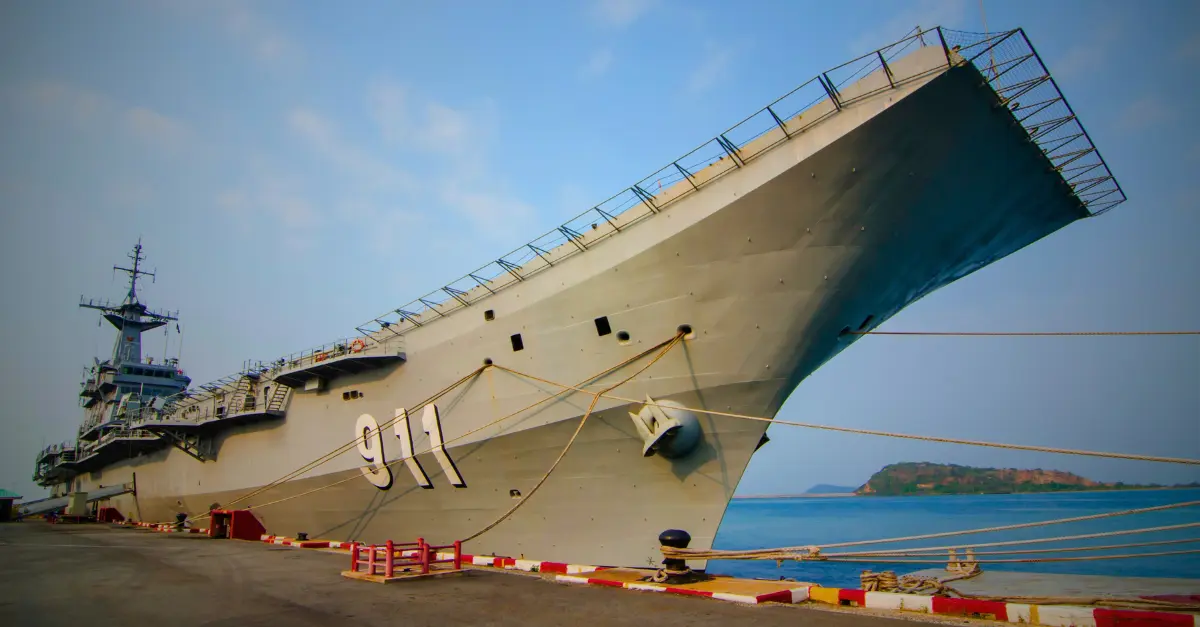
This is the most recurrent theme of the interview. A navy is built over decades. The decision to decommission a vessel can be taken in a few minutes, whereas rebuilding the corresponding capability takes several years at a minimum, and even several decades if the know-how has been lost.
In this connection, the admiral cites a saying attributed to Richelieu, according to which sovereigns have often neglected the sea, to the detriment of their interests. He adds a nuance, however: in his view the French Navy has never been neglected, but it has not always held the priority rank it could have had. He considers that the military programming law and its update, with rising budget steps, represent a significant catch-up effort, made in a difficult economic context.
This increase comes as the French Navy celebrates its 400th anniversary. The admiral sees it as proof that the maritime dimension holds a central place in states’ geopolitics.
On the industrial side, he says he is confident about France, which, in his view, has a defence technological and industrial base among the world’s leading ones. He nevertheless highlights two challenges:
- maintaining rare skills, such as the design and maintenance of nuclear ballistic missile submarines or nuclear aircraft carriers;
- recruiting and training despite demographic constraints and the pace of technological change.
It is in this spirit that Euronaval has scheduled, on the last day of the exhibition, a day devoted to attractiveness, intended to bring together students, jobseekers, people retraining and recruiters from the naval industry.
Availability, the sinews of war
A fleet figure says nothing about how many ships can actually put to sea. The maritime environment is, as the admiral reminds us, extremely abrasive: salt, heat, cold, heavy seas. The most sophisticated systems are only worth something if they work over time. The ability to endure, to repair and to operate in degraded conditions is therefore among the themes to be addressed. In the same programme, maintenance in operational condition (MCO) was also described as a fundamental issue.
The exhibition, a reflection of global rearmament
Euronaval presents itself as the world’s leading naval defence exhibition. Its general commissioner reports growth of around 40% in the number of exhibitors this year, which he describes as unprecedented. He sees it as a reflection of a global rearmament movement and of the industry’s readiness, particularly the French one.
Visitors will come from Europe, the Americas, Asia, Oceania and the Middle East, notably the United Arab Emirates and Saudi Arabia. The admiral also notes the growing presence of Eastern European manufacturers, in particular from the Baltic states.
One question remains open: that of Israeli exhibitors. The admiral says that the French government has, to date, imposed no restriction, whereas Israeli exhibitors were excluded, at least in part, from another exhibition last summer. He specifies that the decision rests with government authorities and will be applied if it is taken.
China, the unknown behind the numbers
It is impossible to discuss this subject without mentioning China. The admiral recalls that it is by far the world’s leading producer of merchant ships, with more than 90% of output according to him. He sees this as the result of a long-term industrial strategy that consolidates the entire value chain, from the supply of raw materials to the operation of the vessels.
He notes that the Chinese navy has grown considerably in size. The unknown concerns its level of combat experience and the operational capability of its sailors, who have not yet been put to the test. He adds that he hopes this will never happen. The argument is a cautious one: the number of hulls does not tell the whole story, and it is also training, doctrine and experience that determine the value of a fleet.
Warships: useful or not?
My answer is nuanced but clear. Current tensions show that warships remain indispensable as long as trade and energy travel by sea. Their usefulness lies not only in the ability to fight, but also in the ability to deter, escort and reassure.
The real debate is about the form this presence should take. Do we need more vessels, more drones, better availability, new skills? Probably all of these at once, within a constrained budget and with timelines measured in years. In that respect, Euronaval will be a good barometer of the choices that states and manufacturers actually make.
FAQ
Why are navies in such high demand again?
Because several sensitive maritime areas, such as the Red Sea and the Strait of Hormuz, are facing tensions at the same time, and trade routes there are exposed.
Can drones replace frigates?
No, according to Admiral Merveilleux du Vignaux. They act as force multipliers and make it possible to operate where vessels cannot be sent, but they fit into a fleet that continues to carry crews.
What is meant by high intensity?
It is a combat context in which violence escalates quickly and forces must withstand massive attacks, for example by missiles and drones, while remaining operational.
Why is ship availability so important?
Because a vessel that is unavailable protects nothing. The marine environment wears out equipment quickly, and the ability to repair and endure is as decisive as the technology on board.