

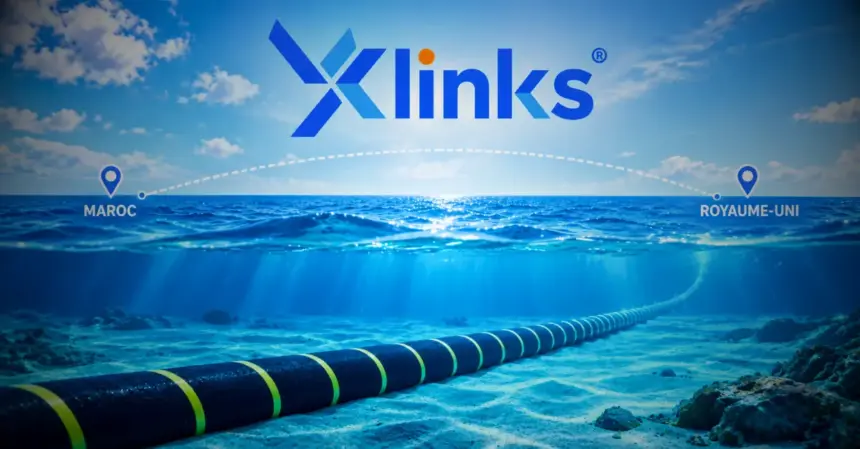
In late June 2025, the British government announced that it would not back the Xlinks Morocco–UK Power Project with a contract for difference (CfD). This mechanism guarantees a long-term purchase price to an electricity producer. Without it, a project of this scale struggles to find financiers. Fifteen months later, the question in our title deserves a precise answer: the cable planned between southern Morocco and Devon is not about to be laid, but the idea behind it has not disappeared. It has changed destination, and then changed nature.
Key takeaways
- London refused in June 2025 to back Xlinks’ Morocco–UK cable.
- It was meant to deliver 3.6 GW to the United Kingdom through 4,000 km of subsea cable.
- Xlinks is now targeting Germany with Sila Atlantik, with no final financing announced.
- The British site would host a 1.5 GW AI data campus, contested locally.
- For Morocco, the challenge is to secure real local benefits.
What the project involved
Xlinks, a British company founded in 2018, proposed to generate solar and wind electricity in the province of Tan-Tan, in southern Morocco, and to carry it to the United Kingdom through a high-voltage direct current (HVDC) subsea cable, over roughly 4,000 kilometres. This technology limits losses over very long distances. The main figures, as presented by the developer:
- 11.5 GW of renewable generation capacity in Morocco;
- 22.5 GWh of battery storage;
- 3.6 GW delivered to the British grid, or about 8% of the country’s current electricity consumption according to Xlinks, enough to supply seven million homes;
- a grid connection point at Alverdiscott, in North Devon;
- a cost estimated at around £20 billion, according to the most frequently cited estimates.
The central argument rested on complementarity: Moroccan weather is not correlated with that of Northern Europe. When the wind drops and the sun is missing across the Channel, an episode the Germans call a Dunkelflaute, Moroccan electricity would keep flowing. Heavyweight investors had joined the venture, including TotalEnergies, which took a stake in November 2023, and, according to the trade press, TAQA and Octopus Energy.
Why London said no
According to information reported by the energy press, the UK Department for Energy Security and Net Zero (DESNZ) pointed to the project’s execution complexity and to the security exposure of an infrastructure so long and so concentrated. Both reservations deserve to be taken seriously. No subsea cable of this length and capacity has yet been built. Very high-capacity HVDC cables are made by a limited number of manufacturers, whose order books are already full. A single 3.6 GW cable would also create a dependency whose vulnerability, in a context of threats to undersea infrastructure, cannot be ignored.
Xlinks and its supporters, among them industry figures such as Greg Jackson (Octopus Energy) and Michael Liebreich, according to the company’s communications, have argued the opposite. In their view, diversifying supply sources strengthens energy security rather than weakening it. The debate comes down to a fundamental question: should one bet on a single, highly capital-intensive project, or on a multitude of smaller capacities that are quicker to deploy? There is no purely technical answer, because it involves budgetary and political trade-offs.
Is the British project really dead?
In its original form, yes, at least as long as no public support is restored. Xlinks says on its website that it has taken note of the British decision and is exploring alternatives, and it ended the consultation planned in France on the cable’s route, for lack of a CfD. We have found no sign of a reversal from London.
What the group has done with its assets is more interesting. It did not simply close the file: it recycled what could be recycled, namely its technical expertise, its grid connection agreements and its land. This is where the story leaves pure energy and enters tech.
Sila Atlantik, the same idea turned towards Germany
From autumn 2025, the Moroccan and international press reported on a new project, Sila Atlantik, made official by Xlinks in early 2026. It would link Morocco to Germany through two HVDC cables of about 4,800 kilometres. According to TelQuel, citing a source close to the matter, the scheme would rely on up to 15 GW of solar and wind generation and about 10 GWh of storage, for a delivered capacity of around 3.6 GW. The German utilities E.ON and Uniper are cited as backers, according to Morocco World News. In early 2026, the German government and a major German industrial group also expressed their interest in a letter addressed to the Moroccan authorities, as reported by the press.
These elements are encouraging for the developer, but they remain expressions of interest, not financial commitments. The timeline mentioned, around 2030, looks ambitious given the British setback and the industrial constraints discussed above. And the precedent of Desertec, a large European project for Saharan solar electricity abandoned in the 2010s, is a reminder that political enthusiasm is not enough.
From cable to data centre
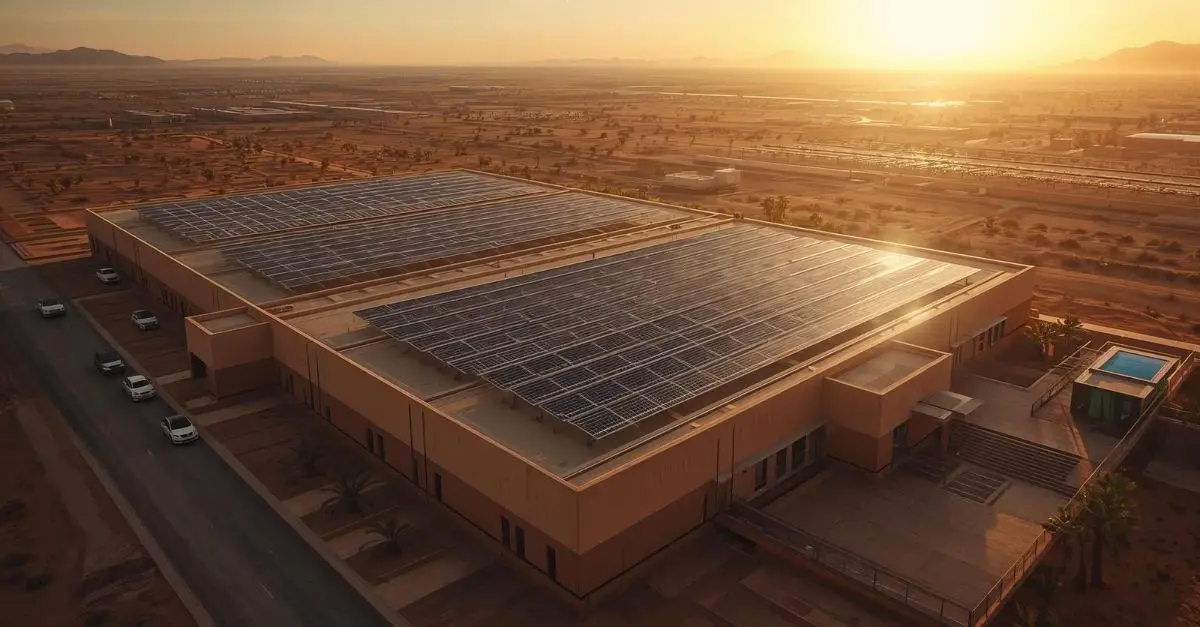
The other rebound, more unexpected, is digital. In June 2026, Xlinks unveiled a plan for a data campus at Alverdiscott, the site originally intended to receive Moroccan electricity. Named Valeon, it would provide up to 1.5 GW of computing capacity dedicated to artificial intelligence, backed by a 1.8 GW battery storage facility. The announced investment exceeds £12 billion. Xlinks justifies the choice of location in part by the available capacity at the local substation, which was to host the Moroccan cable.
The logic is coherent: AI consumes enormous amounts of electricity, and grid connections have become a scarce asset. But the project is facing local opposition. According to Silicon UK, around 200 people demonstrated on 21 September outside Torridge District Council in Bideford, against the conversion of about 850 acres of farmland. An online petition had passed 2,250 signatures in early July. Xlinks, which has not yet submitted its planning applications, says it intends to do so early next year, after consultation.
This second episode sheds light on the first. Xlinks is turning an infrastructure for imported energy into an infrastructure for energy consumed on site, which changes the nature of the bet: it is no longer a matter of selling Morocco’s electricity, but of making the most of a British grid connection point.
What Morocco can take from it
For the Kingdom of Morocco, the stakes go beyond a single customer. Its strategy aims to make it an exporter of green energy to Europe, and the generation proposed at Tan-Tan fitted into that ambition. TelQuel noted in October 2025 that the British episode left a lesson: despite preparatory investments, the country had not secured solid guarantees on local benefits. At this stage, we have found no detailed official Moroccan reaction to Sila Atlantik.
The question is therefore not only who will buy the electricity, but what the territory will get out of it: jobs, industrialisation, possible local manufacturing of components, and a share of the electricity reserved for domestic consumption. Morocco World News also mentions the idea of cable production in Morocco. These are all conditions Rabat can set before committing, especially as the country now has two competing projects to compare, one abandoned, the other still taking shape.
An open conclusion
The Morocco–UK cable, as originally designed, no longer has a credible roadmap without a new decision from London. But the Xlinks file remains revealing. It shows that the difficulty for major interconnectors is no longer the resource, which is abundant in Morocco, but financing, cable manufacturing, infrastructure security and local acceptance. Will Germany do what London refused to do? Will residents of Devon allow an AI campus to rise on land planned for energy? And will Morocco, this time, obtain clear counterparts? The coming months will bring some answers, but none is guaranteed today.
Frequently asked questions
Has the Xlinks Morocco–UK project been officially abandoned?
The British government refused in June 2025 to grant it a CfD. Xlinks says it is exploring alternatives, but no new British public support has been announced to date.
What is Sila Atlantik?
It is a project to interconnect Morocco and Germany through two HVDC subsea cables, led by Xlinks. It is at the development stage, with no final financing announced.
What is happening to the Alverdiscott site?
Xlinks is now proposing an AI data campus (1.5 GW) with battery storage (1.8 GW) there. Planning applications have not yet been submitted and the project faces local opposition.
Why link Morocco to Europe by cable?
Morocco enjoys strong sunshine and steady winds, and its output is not synchronised with that of Northern Europe. The aim is to supply low-carbon electricity when Europe’s own local generation is weak.