

Taken in isolation, the figure is striking: 26 individual licences for military equipment exports granted by Berlin to German manufacturers for Morocco in 2025, worth around 19.27 million euros in total. It appears in the German federal government’s report to the Bundestag, relayed by the Moroccan outlet Hespress. Set against the 13.3 billion euros of licences Germany issued last year, it weighs very little. But we would be wrong to see it as a mere accounting line: what these licences contain says more than their value.
Discreet equipment at the heart of modern systems
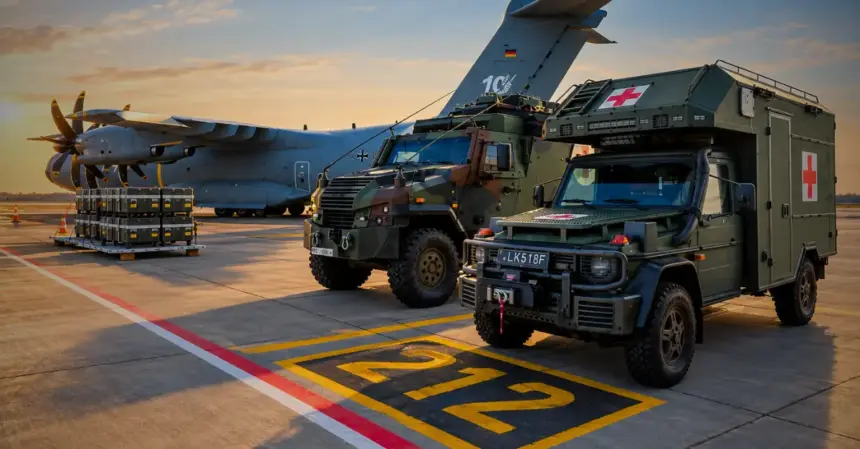
According to the report, the individual licences cover military tracking, communication and positioning equipment, spare parts for surveillance and target-tracking systems, and components for armoured vehicles.
No tanks, ships or aircraft are listed. This is the electronic and logistical layer of contemporary armies: what allows them to see, communicate, locate themselves and keep in service platforms often acquired elsewhere. These building blocks are less spectacular than a delivery of armoured vehicles, but they determine how effective the hardware really is.
The report also mentions 9 additional authorisations issued under Germany’s collective export licence scheme, known as SAG. This mechanism allows German manufacturers to supply components and spare parts, and to provide maintenance and upgrades, over several years without applying for a new authorisation for each transaction. According to the document, it operates within cooperation programmes with European partners.
Reading the figures carefully
A few precautions are in order.
A licence is not a delivery. The amounts reported correspond to authorisations granted, not to equipment actually shipped or payments made. A gap can exist between what Berlin authorises and what is ultimately exported.
The average amount remains modest. Dividing 19.27 million euros by 26 licences gives roughly 740,000 euros per authorisation. That is the order of magnitude of parts, modules and subsystems, not of major armament programmes. This average is my own calculation, based on the report’s figures.
SAG licences escape the usual accounting. They appear here without a value, and their cumulative effect over several years is hard to measure. I prefer to flag this rather than draw quantified conclusions the report does not support.
Morocco within German arms exports
To place Morocco, one has to look at the whole picture. According to the same data, Germany issued military export licences worth around 13.3 billion euros in 2025. The figure is best read in stages:
- Ukraine tops the list of recipients, with about 2.27 billion euros, nearly 17% of the total;
- European Union and NATO member states account for about 65% of licences, more than 8.7 billion euros;
- third countries outside these two blocs represent about 4.6 billion euros;
- military vehicles and armoured vehicles dominate the exported categories, with more than 5.39 billion euros, ahead of military aircraft and related technologies, then ammunition.
Morocco falls into the third-country category, where German policy is traditionally the most restrictive. Its 19.27 million euros represent about 0.15% of total licences, making it a marginal partner in value terms. That takes nothing away from its qualitative interest, but it argues against over-interpreting the volume.
Why this matters
A relationship that has known turbulence
We know that relations between Rabat and Berlin went through a period of tension in 2021, with the recall of the Moroccan ambassador, before a gradual normalisation from 2022. On the Sahara issue, Berlin has since adopted a more favourable tone toward Morocco’s autonomy plan, describing it as a serious basis for a solution. These elements of context should be checked for exact wording before publication. That licences continue to be granted, including for sensitive equipment such as tracking systems, fits within this normalisation without proving it.
A Moroccan strategy of diversification
The Kingdom has for years pursued a multi-supplier procurement policy, mixing American, European, Israeli and, more recently, Turkish sources. In this landscape, Germany does not play the role of a major platform supplier but that of a provider of precision technologies and components, a niche where German industry has real expertise. Collective licences, which ease long-term maintenance, match the needs of an army that operates a heterogeneous fleet.
A German balancing act under scrutiny
On Berlin’s side, every licence to a third country is reviewed against German political principles on arms exports, which take into account, among other things, the human rights situation and regional stability. This framework explains why reports like this one are closely examined by parliamentarians and by organisations that monitor the arms trade. Critics may see a questionable consistency with the stated requirements, while advocates of a pragmatic approach see recognition of Morocco’s role as a security partner in North Africa and the western Mediterranean. Both readings deserve a hearing.
What these licences do not say
The report tells us neither the identity of the manufacturers involved, nor the specific systems targeted, nor the end users within the Moroccan forces. Nor does it say whether the components intended for armoured vehicles equip platforms of German origin or from other countries. As for the SAG licences, it links them to cooperation programmes with European partners, which suggests that some German components may be integrated into systems assembled elsewhere in Europe. This is an interpretive hypothesis, not a fact established by the document.
Outlook
Three elements deserve monitoring in coming years: the trend in individual licence amounts, the growing place of collective authorisations in the relationship, and the possible appearance of heavier equipment categories. A shift in German export policy, already under debate in Berlin amid European rearmament, could also change the situation for third countries.
At this stage, the figures describe a real, technical, low-intensity cooperation rather than a strategic turning point. The open question is whether it will stay confined to components and maintenance, or pave the way for more ambitious industrial partnerships.
FAQ
What do 19.27 million euros represent in German military exports?
About 0.15% of the roughly 13.3 billion euros of licences issued in 2025. Morocco therefore remains a minor customer in value terms.
What types of equipment are involved?
Tracking, communication and positioning equipment, parts for surveillance and target-tracking systems, and components for armoured vehicles.
What is a collective export licence (SAG)?
A scheme that allows manufacturers to supply components, spare parts and maintenance services over several years without a new application each time, within cooperation programmes with European partners.
Does a licence mean the equipment has been delivered?
No. It authorises export, but actual deliveries may differ in volume and timing.