

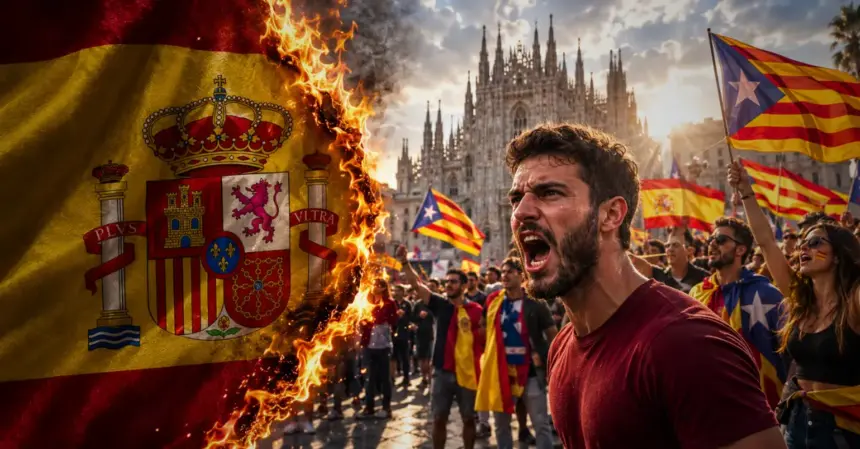
I believe this uproar is not innocent. Meanwhile, the streets are rumbling: for several days now, mass housing protests, driven largely by young people, have been spreading across several cities. All around, a government hemmed in by scandals, peripheries that are radicalising, a far right lying in wait and growing isolation from Washington to Brussels. Ceuta is the tree. Almost no one wants to look at the forest.
Key takeaways
- The Ceuta crisis dominates the debate, but social anger is rising.
- Mass housing protests, driven by many young people, are spreading across several cities.
- People close to Pedro Sánchez are targeted by corruption cases.
- In Catalonia, Aliança Catalana, a far-right separatist party, has reached 16.7% of voting intentions.
- Vox is rising and Trump is harshly criticising Madrid, which has been excluded from the G20 preparatory meetings.
A convenient media storm
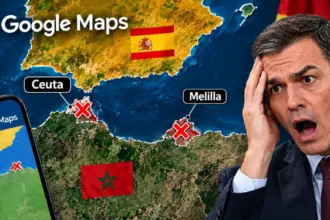
The facts are serious, and I do not dispute them. The mass arrivals of 30 and 31 July caused deaths, and on 5 October the El Trampolín camp, home to about 3,000 people, had to be cleared with 350 police officers backed by soldiers, according to AFP. King Felipe VI is due to visit Ceuta and then Melilla on 13 October, a trip the press describes as diplomatically very risky.
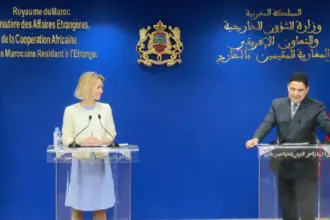
But look at the mechanics. From the first hours, part of the Spanish press pointed the finger at Rabat, as in 2021: Morocco supposedly opened the floodgates to punish Madrid’s rapprochement with Algiers. The accusation was picked up, amplified, then turned into a judicial matter: the National Court is investigating, relying on a 55-page report from the National Centre for Immigration and Borders (CENIF) pointing to a role played by members of the Moroccan security forces. Yet the leadership of the National Police states that no report attributes the planning of the mass entry to Morocco, and Pedro Sánchez says no partner intelligence service has flagged any Rabat involvement. Morocco, for its part, speaks of disinformation and says it has opened an investigation, without having produced evidence.
What no one disputes, however, is that Spain’s services saw nothing coming. Sánchez himself acknowledged it, and according to the press, the investigation could even reach the Interior Minister, Fernando Grande-Marlaska.
My reading is therefore the following. As long as suspicion against Morocco occupies the space, it spares Madrid the uncomfortable questions: why did the border give way in a single night? And that is so much time during which people talk less about the social anger rising in the streets.
Young people take to the streets
This is the strongest signal of recent days. On 2 October, lawmakers rejected two government texts aimed at better protecting tenants. The very next day, gigantic demonstrations gathered tens of thousands of people in Madrid and other cities, according to AFP, behind a banner calling to march “towards a general strike”. In Madrid, a camp has occupied the Puerta del Sol since 26 September. Mobilisations also took place in San Sebastián and Vitoria, called by the LAB union and the Tenants’ Union, and media outlets report tensions in Valencia and the postponement of a march in Barcelona. The movement gained momentum after the eviction of an octogenarian woman whose rent had risen by 275%.
Among the demonstrators are many young people and precarious thirty-somethings. “We live in very precarious conditions, crushed by a system that does not offer us decent conditions,” Javier, 31, a solar panel installer, told AFP. Spaniards are among the young Europeans who leave the parental home the latest, and over ten years the average rental price per square metre has almost doubled, according to an RTVE analysis relayed by franceinfo.
The government, for its part, could call early elections to get out of the crisis, according to AFP. That says a great deal about how much the street weighs on Madrid.
A government hemmed in by scandals
The so-called “Koldo” trial took place before the Supreme Court in the spring. Former Transport Minister José Luis Ábalos, long Sánchez’s right-hand man, and his former adviser Koldo García are being tried over kickbacks linked to medical equipment contracts during Covid. Prosecutors are seeking 24 years in prison for the former and 19 for the latter. Another defendant, businessman Víctor de Aldama, accused Sánchez of having been the leader of the “organised gang”, which Sánchez denies. Sánchez himself faces no criminal charge.
Santos Cerdán, the former number three of the PSOE, was placed in pre-trial detention in 2025 for criminal organisation, corruption and influence peddling; he is awaiting trial, and his office was searched in May 2026. Two other cases target the prime minister’s inner circle: the investigation into his wife, Begoña Gómez, and the one into his brother David Sánchez, who is due to stand trial. The opposition sees systemic corruption. For a man who came to power promising to fight it, the loss of credibility is heavy.
A Spain at risk of fracturing soon!
The territorial question is not dying out: it is hardening. Nearly one Catalan in two, 45%, supports independence, according to the regional government’s survey published in July. Above all, Aliança Catalana, a far-right separatist party, has risen from 3.8% to 16.7% of voting intentions according to an El Mundo poll, ahead of the ERC, the historic party of the independence left. The traditional separatist parties rule out any cooperation with it: a camp tearing itself apart, and an identity-driven radicalisation that no government has managed to defuse.
There is something more embarrassing still for Madrid: dependence. It was by negotiating with the Catalan separatist parties that Sánchez formed his government at the end of 2023, and, according to Sigma Dos, Junts’ rejection of the housing decrees weighed on public opinion. A minority executive, hanging on the moods of partners who challenge the country’s unity: a fragile equation.
A hard right that is settling in
According to a Sigma Dos poll published in recent days, Vox would reach 18.3% of the vote and 63 seats, up from 33 in the 2023 general election, its fifth consecutive poll on the rise. Added together, the PP and Vox would reach 203 seats, 27 more than the absolute majority of 176. A poll is not an election, but the trend is clear. When a party of this nature prospers at this pace, it is because the ground is fertile: immigration, perceived insecurity, distrust of elites, housing. Not to mention the numerous demonstrations where Spaniards could be seen making Nazi and racist gestures…
Unemployment, poverty, precariousness
In the second quarter of 2026, the national statistics institute (INE) put unemployment at 9.87%, its lowest level since 2008. The figure deserves to be read in full, however: about 2.5 million people remain jobless, and the USO trade union observes that much of the growth rests on the summer season rather than on a transformation of the production model. For young people, the picture is harsher: unstable jobs, relatively low salaries, and a mismatch between training and available jobs, according to the OECD.
In 2025, 25.7% of the population was at risk of poverty or social exclusion according to the INE, that is, one Spaniard in four. Families with children, precarious workers, some immigrant populations and low earners in big cities are the hardest hit.
An ageing country, emptying countryside
The OECD estimates, in its baseline scenario, that Spain’s working-age population could fall by more than 30% by 2060. Pensions, healthcare, long-term care, funding of public services: everything rests on a balance that demographics threaten. At the same time, some rural areas are losing their young people: closed schools, fewer medical services, failing transport, vanishing shops, isolated elderly people.
Immigration, tourism, climate
Immigration expands the labour force and fills labour shortages, but it fuels debates about integration, access to housing, employment and the distribution of migrants between regions. It would be wrong to make it the sole cause of Spain’s ills: the housing shortage, tourism and construction constraints weigh heavily. In Ceuta, a court ruling limiting the return of swimmers and the regularisation championed by Sánchez were cited among the factors of the crisis, according to Euronews. Andrej Babiš, the Czech prime minister, called the situation “absolutely scandalous” and did not rule out a temporary closure of Schengen to Spain.
Mass tourism feeds the same anger: in the Canary Islands, thousands of people have demonstrated over housing costs, traffic and pressure on public services. Finally, according to La República, the July Ávila fire burned 50,000 hectares, the largest in the country’s history, against a backdrop of droughts and heatwaves.
A bad pupil on the international stage
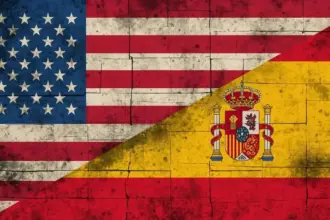
Donald Trump accuses Spain of refusing the NATO defence spending target of 5% of GDP and of having closed its airspace and bases, including Rota and Morón, to the war against Iran. In Ankara on 8 July, he called it a “wasted cause” and asked that all trade with it be “cut off”. He had already suggested in October 2025 expelling it from the Alliance, and Reuters reported in April that Washington was considering suspending it from positions of responsibility. The 1949 treaty provides for neither suspension nor expulsion, but the threat speaks to the distrust. Same scenario for the G20: Spain has been excluded from the preparatory meetings for the Miami summit on 14 and 15 December, and will attend only as a guest country.
The word that keeps coming back
In a country that lived through 1936, talking about civil war is never trivial. The phrase keeps coming back to describe a society where each camp challenges the legitimacy of the other: a government hemmed in by scandals, a youth camping on the squares, regions defying Madrid, a far right on the rise. Nothing allows us to predict an armed confrontation, but everything points to breaking points that are multiplying.
A question without an answer
Spain does not lack warnings. It lacks the courage to look at them. As long as Ceuta serves as a screen, the forest will keep growing, and the question is no longer whether these fault lines will converge, but what, when the day comes, will still hold the country together.
Key figures
- 2 October: lawmakers reject two texts on tenant protection.
- 3 October: mass housing protests in Madrid and other cities (AFP).
- Average rental price per m² almost doubled in ten years (RTVE).
- 9.87% unemployment, or about 2.5 million people (INE).
- 25.7% of the population at risk of poverty or exclusion in 2025 (INE).
- 16.7% of voting intentions for Aliança Catalana (El Mundo).
- 18.3% and 63 seats for Vox, 203 seats for PP plus Vox (Sigma Dos).
FAQ
Why are young people protesting in Spain?
They are denouncing the cost of housing and precariousness. The protests followed the rejection, on 2 October, of two texts protecting tenants.
Is Morocco responsible for the Ceuta crisis?
Nothing establishes it to date. A CENIF report points to a role played by members of the Moroccan forces, while the National Police and Pedro Sánchez say they have no evidence to that effect.
Is Pedro Sánchez being prosecuted for corruption?
No, he faces no criminal charge. But former associates, his wife and his brother are targeted by proceedings.
Can Spain be expelled from NATO?
The treaty provides for neither suspension nor expulsion, but Donald Trump has repeatedly made threats.