Saturday, 31 Oct 2026
  • The interview
  • Moroccans
  • Hardware test
  • Start-ups
  • My favorites
  • Advertisement
  • Contact
Business Club
Silicon Valley Maroc – le mag tech marocain
  • Tech
  • AI
  • Cybersecurity
  • Business
  • Real estate
  • Expat
  • Military
    MilitaryAfficher plus
    La Marine royale marocaine organise un séminaire régional sur l’hydrographie
    The Royal Moroccan Navy organizes a regional seminar on hydrography

    Between presentations on converting S-57 data to S-101, demonstrations of high-resolution bathymetric…

    Par Reda S.
    L’École des langues des FAR lance la première session CPOC-26
    The FAR language school launches the first CPOC-26 session

    From October 26 to 30, 2026, the Language School of the Royal…

    Par Hafid D.
    Haftar, une armée de 4x4 ? La réalité de son arsenal aérien
    Haftar: an army of 4x4s? A look at his air arsenal

    Haftar’s Air Force: A power-projection force serving territorial control.

    Par Foxtrot
    Pourquoi le Maroc doit créer une grande école d’ingénieurs de défense
    Why Morocco needs to establish a major Defense engineering school

    One idea keeps striking me every time. Morocco now has the legal…

    Par Hafid D.
    Pourquoi la maintenance des F-16 pourrait devenir un atout stratégique majeur pour le Maroc
    Why F-16 maintenance could become a major strategic asset for Morocco

    For a long time, we have viewed Africa’s militaries through a single…

    Par Hafid D.
  • English
    • Français
    • العربية المغربية
    • English
    • Español
    • 中文 (中国)
  • Tourisme
  • Numérique
  • Business
  • Finance
  • Marketing
  • Apple
  • Claude
  • Google
  • Grok
  • OpenAI
  • USA
  • Europe
  • Afrique
  • Asie
  • Golfe
  • 🇲🇦
  • Casa
  • Rabat
  • Marrakech
  • Tanger
  • Agadir
  • Fès
  • Meknès
  • Oujda
  • Nador
  • Essaouira
  • Dakhla
  • Kenitra
  • Laâyoune
Redimensionnement de policeAa
Silicon Valley Maroc – le mag tech marocainSilicon Valley Maroc – le mag tech marocain
Rechercher
  • Tech
  • AI
  • Cybersecurity
  • Business
  • Real estate
  • Expat
  • Military
  • English
    • Français
    • العربية المغربية
    • English
    • Español
    • 中文 (中国)
Vous avez déjà un compte ? Se connecter
Suivez-nous
  • Dakhla
  • Casa
  • Marrakech
  • Tech
  • Rabat
  • Maroc
  • Plan du site
  • Contactez-nous
© 2026 - Colmar.tech
Silicon Valley Maroc – le mag tech marocain > Blog > Economy > Toward a NATO-Iran war? What the red sea escalation reveals
EconomyIranMilitaryUSA

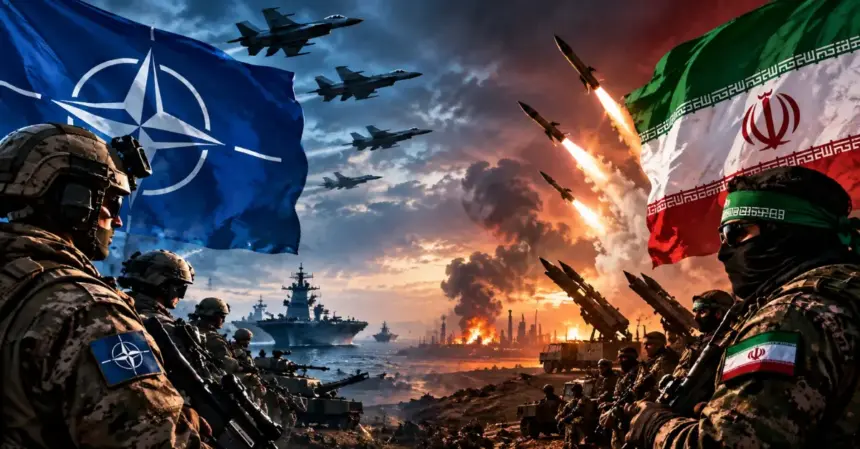
Toward a NATO-Iran war? What the red sea escalation reveals

Since February 28, 2026, Iran has been in open war with the United States and Israel, following joint US-Israeli strikes that notably killed Supreme Leader Ali Khamenei.

Foxtrot
Dernière mise à jour : 13 September 2026 16h44
Foxtrot
Partager
Vers une guerre entre l'OTAN et l'Iran ?

Since February 28, 2026, Iran has been in open war with the United States and Israel, following joint US-Israeli strikes that notably killed Supreme Leader Ali Khamenei. In retaliation, Tehran effectively closed the Strait of Hormuz, prompting an American response in the form of a naval blockade of Iran starting April 13. A ceasefire agreement signed in Versailles in mid-June held for only a few weeks: fighting resumed in early July, at a lower intensity but still real.

Sommaire
  • Why the case for Western intervention is gaining traction
  • Why nothing indicates that war is certain
  • What to watch

It is against this already explosive backdrop that a second front opened, more than 2,000 kilometers away. On September 11, 2026, after an offensive launched on September 3 that captured six districts across the Taiz and Hodeidah provinces — some 5,400 km² — Houthi rebels seized the island of Mayun (Perim), at the heart of the Bab-el-Mandeb strait, along with the entire western coast of Yemen. This chokepoint, through which a substantial share of global maritime trade normally passes, has thus fallen under the control of a Tehran ally.

The two straits flanking the Arabian Peninsula — Hormuz and Bab-el-Mandeb — are now, each in its own way, under Iranian influence. It is this convergence that is currently fueling speculation about a direct NATO intervention.

Why the case for Western intervention is gaining traction

Several factual elements feed this scenario:

  • The scale of the economic chokehold. The Strait of Hormuz alone carries roughly one-fifth of global oil and liquefied natural gas production, as well as raw materials essential to about 30% of the world’s fertilizer output. A prolonged closure of Bab-el-Mandeb, which on its own accounts for close to 15% of global maritime traffic, would add a second bottleneck to an economy already under strain.
  • Prior signals of resolve. As early as May, NATO had suggested that intervention was not off the table “if the conditions were met,” in a context where the blockage of the Strait of Hormuz had immobilized around 150 vessels and given rise to an informal toll system that could reach two million dollars per tanker.
  • Existing, though limited, Western engagement. European maritime security missions (Aspides, Atalanta) have been active in the region for several years, and some member states, including France, have previously carried out strikes against the Houthis. Expanding the mandate of these missions in response to the loss of control over Bab-el-Mandeb would amount to a gradual escalation rather than a declaration of war.
  • Domestic economic pressure. In the United States, rising prices at the pump are weighing politically on the Trump administration ahead of the midterm elections — a factor that has previously pushed Washington toward de-escalation rather than an expansion of the conflict.

Why nothing indicates that war is certain

Conversely, several factors argue for caution in any prediction:

  • Washington has so far avoided direct engagement against the Houthis, even in the face of Saudi requests. After the strike on the East-West pipeline, the US administration did not respond militarily in support of Riyadh.
  • The Houthis themselves are calibrating their moves. Their spokesman stated that navigation remained safe for all shipping companies except Saudi vessels — a sign they are seeking leverage for negotiation rather than a total, immediate blockade that would unify the entire international shipping community against them.
  • NATO has no automatic mandate. Intervention would require either a direct attack on a member state or a consensus political decision among the Alliance’s 32 countries — a consensus that is far from guaranteed, with European public opinion still divided on involvement in this conflict.
  • The precedent of the Islamabad Memorandum (June 2026) shows that a ceasefire, however fragile, remains possible once economic pressure becomes unsustainable for all parties — including Iran, whose economy is already severely weakened by the crossing blockades.

What to watch

Rather than a certain path to war, three indicators will help gauge the crisis’s real trajectory:

  1. A possible total closure of Bab-el-Mandeb (rather than the current targeted blockade of Saudi vessels only);
  2. A direct strike on a vessel or piece of infrastructure belonging to a NATO member state;
  3. The trajectory of Brent crude prices, which have already passed $106, and their political impact in both the United States and Europe.

The escalation is real, well documented, and its economic consequences are already being felt. But turning this observation into certainty of a NATO-Iran war would mean ignoring the many diplomatic, economic, and political safeguards that have, so far, kept each phase of this crisis from turning into a full-scale conflict.


Analysis based on information available as of September 13, 2026. As the situation is evolving, some elements may change rapidly.

Partager cet article
Whatsapp Whatsapp E-mail Copier le lien Imprimer
ParFoxtrot
As a defense systems and modern combat doctrines analyst, I decode for Silicon Valley the profound transformation of Morocco’s security architecture. My role is to scrutinize the integration of cutting-edge technologies — from tactical drone swarms to multilayer defense systems — that are redefining the operational superiority of the Royal Armed Forces.
Article précédent Stratégie atlantique du Maroc : 5 raisons décisives de s'émanciper de l'Europe Morocco’s Atlantic strategy: 5 decisive reasons behind the shift away from Europe
Article suivant Algérie : une fuite de 32 Go de données militaires suscite l'inquiétude Algeria: Alleged Leak of 32 GB of military data raises concern
Laisser un commentaire

Leave a Reply Cancel reply

Your email address will not be published. Required fields are marked *


Silicon Valley

Soutenez notre média gratuit !
Don tech Maroc
maroc start-up morocco annuaire directory

Vous pourriez aussi aimer

Maroc–OTAN : les enjeux de la coopération militaire
MilitaryMoroccoNATO

Morocco–NATO: the stakes of military cooperation

Par Foxtrot
L'Algérie, palestinienne de jour, israélo-américaine de nuit
AlgeriaIsraelUSA

Algeria, Palestinian by day, Israeli-American by night

Par Nadia El.
Qui est Mouad M'Ghari, le concepteur du drone IRIFI
DroneFranceMilitaryMorocco

Who is Mouad M’Ghari, the designer of the IRIFI drone

Par Reda S.
drapeau-usa-etats-unis
USA

United States: Withdrawal from the UN Human Rights Council

Par Julie - Sanchez
Silicon Valley Maroc – le mag tech marocain
Facebook X-twitter Rss Linkedin

A Propos

SiliconValley – le mag tech marocain se veut une plateforme indépendante gratuite dédiée à l’innovation, au numérique et aux nouvelles technologies au Maroc.

À la croisée de l’actualité tech internationale et des dynamiques locales, le magazine met en lumière les startups marocaines, les entrepreneurs, les talents, les innovations et les tendances qui façonnent l’écosystème tech national.

Analyses, décryptages, interviews et dossiers de fond : SiliconValley ambitionne d’informer, d’inspirer et de connecter une nouvelle génération tournée vers l’avenir, avec un regard moderne, critique et résolument marocain.

Categories

  • Dakhla
  • Casa
  • Marrakech
  • Tech
  • Rabat
  • Maroc
  • Plan du site
  • Contactez-nous

Liens Utiles

  • Bourse
  • Interview
  • MRE
  • Tests
  • Start-ups
  • Pub
  • Contact

Connectez-vous

Nom d'utilisateur ou adresse e-mail
Mot de passe


Mot de passe oublié ?