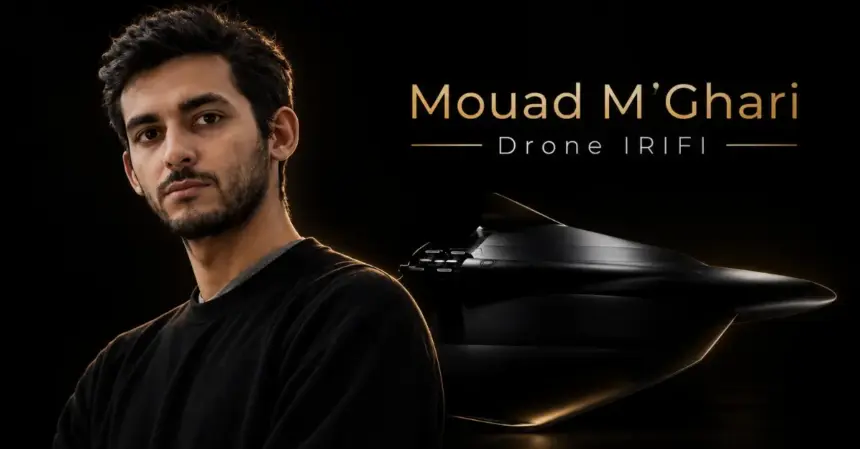
A French-Moroccan mathematician and entrepreneur, this École Polytechnique graduate embodies a fundamental paradigm shift in modern warfare: the fusion of sovereign artificial intelligence, micro-robotics and strategic strike autonomy.
An exceptional academic and strategic background
Before making his mark on the defense industry, Mouad M’Ghari followed a path of academic and technical excellence:
Mathematical rigor: A former student of the École Polytechnique (X20) who also trained at the Massachusetts Institute of Technology (MIT), he specialized early on in complex systems and intensive algorithmic processing.
Early experience: His first roles took him from quantitative finance (Quantitative Research at G-Research) to strategic consulting at Attali Associates, building his command of geopolitical and financial data.
The 2022 insight: Watching contemporary conflicts, notably in Ukraine, Mouad M’Ghari concluded that the wars of the 21st century would no longer be decided by raw firepower alone, but by algorithmic autonomy and the ability to mass-produce at low cost.
Harmattan AI and the rise of France’s first defense-tech unicorn
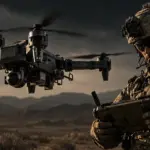
In April 2024, Mouad M’Ghari co-founded Harmattan AI. The young company first made a name for itself with the DELCO / Sonora tactical micro-drone, quickly selected by the French Army and tested during major joint exercises.
In January 2026, the start-up made industrial history by closing a $200 million funding round backed strategically by Dassault Aviation, lifting its valuation to $1.4 billion (unicorn status). The partnership seals a direct technological integration with major combat aviation platforms, notably the Rafale.
The IRIFI project, the missing link between the Shahed and the Tomahawk
On October 6, 2026, Mouad M’Ghari took a new step by unveiling the IRIFI system (“south wind” in the Amazigh language), marking Harmattan AI’s entry into the field of deep strikes.
The technological equation behind IRIFI
Mouad M’Ghari sums up the philosophy behind IRIFI as follows:
“The Shahed is affordable and produced at scale, but it is imprecise and easy to intercept. Tomahawk or Storm Shadow missiles are technological jewels with high survivability, but extremely expensive and built in small numbers. AI-driven autonomy lets us combine the best of both worlds.”
Key features of the IRIFI system
Strategic range of 2,000 km: Able to reach critical infrastructure at very long distances thanks to a mobile, agile launch container.
Operating in contested environments (anti-jamming sovereignty): The drone does not depend on American GPS (GNSS). Its navigation relies on onboard electro-optics and visual terrain recognition, allowing it to fly at low altitude beneath radar.
Controlled autonomy doctrine: IRIFI navigates and adjusts its approach fully autonomously, but follows a strict ethical framework: the final decision to fire and the prior validation of targets remain under the absolute authority of a human operator (human on the loop).
Coordinated saturation: The architecture allows a single commander to operate dozens of vehicles simultaneously, thanks to an AI that processes satellite imagery in real time.
A cross-border industrial dimension
Under Mouad M’Ghari’s leadership, Harmattan AI’s strategy has taken on an international scope. At the Marrakech Air Show 2026, a strategic letter of intent was formalized with Morocco to cover:
The acquisition of the IRIFI system by the Royal Armed Forces.
The development of a local production unit and technology transfer.
By combining academic rigor, mastery of cutting-edge algorithms and industrial speed of execution, Mouad M’Ghari stands out as the symbol of a modernized defense doctrine in which sovereign autonomy is redefining the balance of power.