

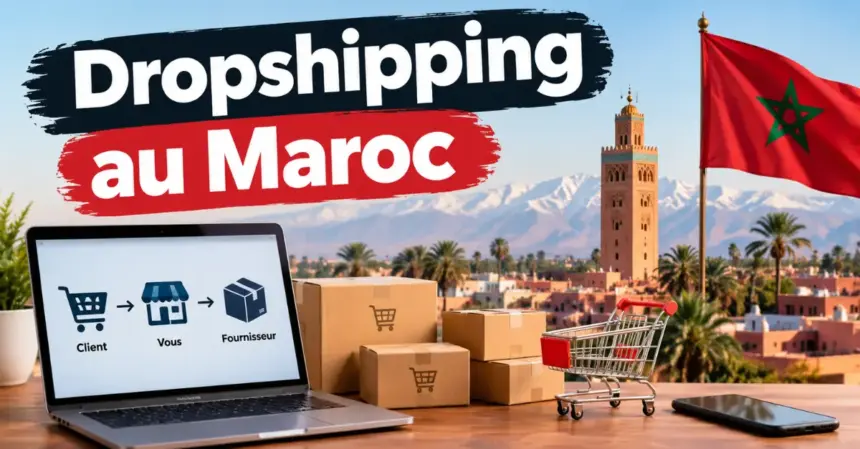
The old version — copy a product from AliExpress, launch a TikTok ad, live off the profits — is dead. What actually works now is a hybrid model: local or semi-local sourcing, your own brand, surgical handling of cash on delivery, and a properly declared legal status. I’ve been watching this market for years, and I’ll be blunt with you: eight stores out of ten that cross my desk die of the same thing, and it isn’t competition. It’s their successful delivery rate. Here’s the real picture.
What the Moroccan market has actually become
Let’s start with the good news, because it’s real. The playing field is expanding fast. In 2025, the interbank payments centre processed roughly 240 million card transactions, a growth of close to 15%, for nearly 100 billion dirhams collected by merchants, up around 13% year on year.
On online purchases specifically, the momentum is even clearer: e-commerce payments rose 20% in volume, from 32.1 to 38.5 million transactions, and 11% in value, reaching 11 billion dirhams.
In other words, the Moroccan consumer is buying online, more and more, and is starting to pay by card. The infrastructure is keeping up, carriers are professionalising, and the auto-entrepreneur status has opened the door to an entire generation: out of roughly 400,000 registered auto-entrepreneurs in 2026, online selling alone accounts for about 22% of them.
That’s the flattering photograph. Now, the X-ray.
The customs and tax wall has closed
This is the part most paid “trainings” carefully avoid. The classic model rested on a loophole: low-value parcels slipping under the customs radar. That loophole has been sealed, and the movement is accelerating everywhere.
In Europe — a destination market for plenty of Morocco-based sellers — a flat duty of 3 euros per tariff category applies since 1 July 2026 to any parcel worth less than 150 euros imported from outside the EU, a measure definitively adopted by the Council of the European Union on 11 February 2026. A parcel mixing textiles and electronics therefore pays twice.
In Morocco, the logic is identical. Since 11 June 2026, non-resident foreign platforms and companies must declare the revenue they generate in Morocco through the tax administration’s dedicated online service for digital services, accessible via the SIMPL portal. Your ad spend, your SaaS subscriptions, your hosting: all of it is gradually falling into the scope of 20% VAT.
Translation for your P&L: advertising costs more, importing costs more, and the end customer sometimes discovers a customs bill they simply refuse to pay. Every dirham of “theoretical margin” calculated on a spreadsheet in January melts by 15 to 25% once it meets reality.
Cash on delivery, the silent killer
If I could keep only one indicator, it would be this one. More than 70% of Moroccan e-commerce transactions are still settled on delivery. That means your customer commits no money whatsoever until the courier knocks on the door.
In practice, here’s what that produces on the ground:
- Ghost orders: an impulse at 11 p.m., regret the next morning, parcel refused.
- Frozen cash: you front the product, the shipping and the ads, and you’re paid back 15 to 45 days later.
- One-way return costs: outbound and inbound are on you, and the sale earns nothing.
- A sawtooth cash position: a month of strong growth can choke you harder than a quiet one.
- Total dependence on your carrier: their delivery rate effectively becomes your margin rate.
The survival threshold I keep observing sits around 75% of parcels delivered and collected. Below 65%, no advertising campaign, however brilliant, will fix the equation. The operators still standing have all industrialised the same things: systematic confirmation calls, automated WhatsApp follow-up, and a blacklist for addresses that repeatedly refuse.
Where the money still is
I’m not here to bury the model, only to kill its lazy version. Three angles still work very well in 2026.
Local and semi-local sourcing
This is the most profitable pivot of all. Negotiating with a manufacturer in Casablanca or Fès, or a wholesaler in Derb Omar, changes the whole equation: 24 to 72-hour lead times instead of three weeks, zero customs, zero currency risk, and after-sales service you can genuinely deliver. You lose a little margin per unit and you gain on the delivery rate, which is the only number that truly matters.
A brand instead of a catalogue
Selling a generic product puts you head to head with platforms that have bottomless pockets. Selling a brand — a name, packaging, a visual world, an account that posts three times a week — pulls you out of the price war. It’s slower and more demanding, but it’s the only thing that gains value over time.
Exporting from Morocco
Few people talk about this, and that’s a shame. The loosening of the foreign exchange framework points in that direction: the 2026 general instruction on foreign exchange operations, in force since 1 January, raised the allowance for start-ups labelled by the digital development agency to 2 million dirhams, up from 1 million, and created a minimum annual allowance of 50,000 dirhams for newly created or lightly taxed Moroccan companies. For an online seller invoicing in hard currency, that’s serious breathing room.
My verdict after looking inside dozens of stores
Let me tell you what strikes me most when I open the back offices people send me. The problem is never the product. It’s almost always the gap between marketing effort and operational effort. People spend 90% of their energy on ad creatives and 10% on logistics, when profitability is decided in exactly the opposite direction.
The second mistake is subtler: staying informal “just until I see how it goes”. That’s a losing calculation. The auto-entrepreneur status caps revenue at 500,000 MAD for commercial activities, with a flat discharging tax of 0.5% on collected revenue. Half a percentage point for a professional bank account, invoices your carriers will accept, and access to online payment solutions: at that price, staying off the books isn’t a saving, it’s a glass ceiling you install above your own head.
So my conviction fits in one sentence. This market is not a dead end; it has simply moved from being a lottery to being a trade. Those who treat it as a serious commercial activity — targeting gross margins around three times product cost and reviewing their delivery rate weekly — still make a very good living. Those looking for passive income are three years late.
Frequently asked questions
Is dropshipping legal in Morocco in 2026?
Yes, as a commercial intermediation activity, provided it’s declared. You need a legal status (auto-entrepreneur or company), income declarations, compliance with law 31-08 on consumer protection, and compliance with foreign exchange rules for any payment to an overseas supplier.
What budget do you need to start seriously?
Plan for 8,000 to 20,000 dirhams for a realistic first store: domain and hosting, content production, an advance on buffer stock, and above all an ad testing budget of at least 5,000 dirhams. Below that, you won’t gather enough data to validate or kill a product.
Should you target the Moroccan market or export?
The local market is easier to enter and cheaper on acquisition, but it forces you into cash on delivery. Exporting to Europe or North America gives you prepaid orders and higher basket values, at the cost of far harsher advertising competition and unforgiving quality expectations. My advice: learn the trade locally, scale through export.