

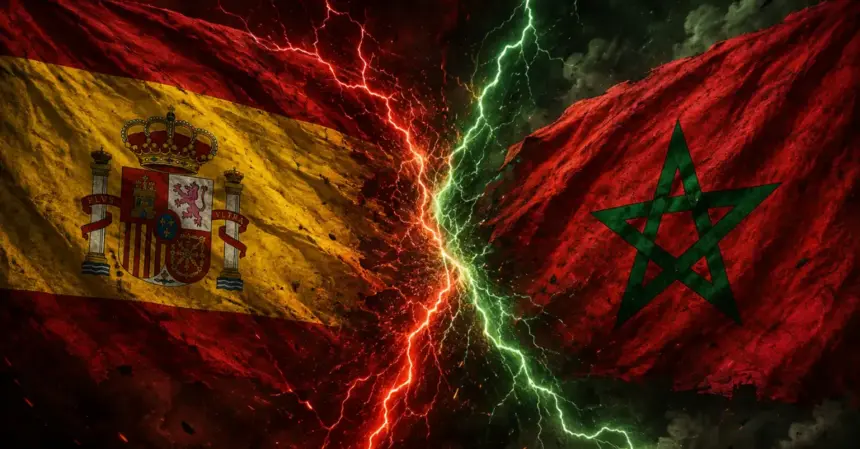
That’s a six-point rise in a single year, measured by one of Spain’s most serious strategic research centers. I’ve long been interested in how public opinion builds an image of a neighboring country, and this figure stopped me in my tracks: it doesn’t describe a communication accident, it describes a shift in perception that has been building for several years.
Understanding why a majority of Spaniards now see Rabat as an adversary rather than a partner means looking well beyond the social-media controversies of last July. It means looking at colonial history, at diplomatic wounds that were never really closed, and, more troubling still, at certain statements made at the very top of Spain’s military hierarchy.
A figure that has replaced Russia in the Spanish imagination
The Elcano poll isn’t some isolated opinion survey published by a marginal think tank. It’s the reference body that measures, year after year, how Spain sees the rest of the world. And for several editions now, Morocco has taken the place Russia used to occupy in respondents’ minds. This shift deserves to be taken seriously even before mentioning this summer’s migration crisis, because it points to a distrust that was already in place and documented well before the first incidents at Ceuta.
Why this figure is so surprising
What’s striking is the contrast between this level of suspicion and the reality of the bilateral relationship. Morocco and Spain share barely 14 kilometers of sea at the Strait of Gibraltar, considerable economic interests, and genuine security cooperation against terrorism and drug trafficking. On paper, nothing justifies this level of perceived hostility. So the answer doesn’t fit into a single sentence: it rests on several historical layers that built up over nearly a century, before all reactivating together in the summer of 2026.
A colonial wound that was never truly closed
The Rif War, a defeat Madrid never digested
Between 1921 and 1926, the Rif War was one of the darkest chapters in Spain’s colonial history. The disaster at Annual, in 1921, remains one of the worst colonial defeats of the twentieth century, inflicted by Rif forces under Abd el-Krim Khattabi. To crush this resistance, the Spanish army resorted to chemical weapons against Moroccan civilian populations. A deeply serious episode that, even so, still doesn’t occupy a place in Spain’s national memory proportional to its gravity.
Franco, a career built on Moroccan soil
There’s a paradox here that needs to be named directly. Francisco Franco built his entire military career in Morocco, as an officer in the Foreign Legion and then in the Regulares, the Moroccan troops who served the Spanish colonial army. It was from Spanish protectorate Morocco that the military uprising leading to the civil war began, on July 17, 1936. For nearly forty years, Francoism thus maintained a profoundly ambivalent relationship with Morocco: colonial contempt on open display in official discourse, alongside a very real military dependence on Moroccan troops. This historical knot was never publicly untangled in Spain. It stayed there, beneath the surface, ready to resurface.
The 1975 humiliation and the moral debt over the Sahara
The Green March, a strategic turning point
In November 1975, while Franco lay dying and power in Madrid was in a state of near-vacancy, King Hassan II mobilized 350,000 Moroccan civilians to march toward the Sahara’s border and force decolonization in Morocco’s favor. The Madrid Accords followed shortly after. For part of Spain’s military and diplomatic establishment, this episode still stands, half a century later, as a genuine strategic defeat: that of a colonial power forced to yield under pressure from a civilian mobilization organized by its own neighbor, at a moment when it no longer had the capacity to resist.
When the Spanish left builds an inverse narrative
Resentment isn’t the exclusive property of the Spanish right. Part of the left has built, on this same Saharan file, an opposite but equally structuring narrative: that of an unpaid moral debt toward a Sahrawi population that Spain allegedly abandoned without guaranteeing the promised self-determination referendum. This narrative explains the persistence of support for the Polisario Front in certain segments of the PSOE, even after Pedro Sánchez’s 2022 reversal recognizing Morocco’s autonomy plan as the most serious and credible basis. A more radical fringe, around Podemos and its satellites, goes even further, treating Morocco as a Western-aligned monarchical regional power, suspect as a matter of principle.
What matters here is that the Spanish right and left don’t dislike Morocco for the same reasons. One activates an identity-based, colonial memory. The other activates a third-worldist sense of guilt. Two opposing lineages that nonetheless converge on the same outcome: structural distrust toward Rabat.
Ceuta, the catalyst of summer 2026
It was on this old ground that the crisis of summer 2026 exploded. On July 30 and 31, several tens of thousands of people attempted to cross the Ceuta border post amid human chaos with a tragic toll. The trigger wasn’t a Moroccan political decision, but viral misinformation: social media posts falsely announcing that the crossing had opened, shared widely enough to convince thousands of young Moroccans to attempt the crossing.
Vox and far-right splinter groups seized on the affair almost immediately. The vocabulary used by certain officials at that point needed no coded language: it was open, unapologetic rhetoric, directly reviving centuries of imagery inherited from the Reconquista, in which the Moroccan neighbor functions as the foil against which Spanish national identity is constructed.
When distrust becomes doctrine
The most troubling aspect of this episode came neither from Vox nor from social media, but from the Spanish military institution itself. A former director of the Spanish armed forces’ intelligence center publicly stated that Madrid could paralyze Morocco’s military capabilities within a very short timeframe in the event of an offensive against Ceuta, describing a retaliation scenario with no geographic limit. A former chief of staff of Spain’s defense forces, for his part, stated plainly in the national press that, in his view, there was no doubt a clear threat existed on the southern flank, adding that this reading was shared at the top of the military hierarchy.
In other words, two officers who held the highest positions in the Spanish armed forces converged publicly on the same designation of Morocco as threat number one, without this triggering the slightest disqualifying scandal in Spanish public debate. This is where the real difference between these phenomena becomes visible: Vox’s rhetoric is electoral mobilization, the Elcano poll measures public opinion, but the words of former chiefs of staff directly engage the institution they once led.
Four sources of distrust that never intersect
To sum up this accumulation, four distinct dynamics can be identified as fueling Spanish distrust of Morocco, dynamics that almost never intersect within Spain’s own public debate:
- A colonial memory that has never truly been reckoned with, spanning the Rif War and the Francoist legacy
- A sense of guilt tied to the Saharan file, unresolved on both the left and the right
- Digital virality that instantly amplifies even a minor migration incident
- A military doctrine now openly asserted by certain reserve-rank officials
My own experience following this file has taught me something: it’s precisely because these four dynamics never speak to one another that Spanish distrust remains so hard to defuse politically. Each camp builds its own reading, without ever confronting the other three.
What Rabat should take away from this episode
Morocco did not build this historical framing, and it doesn’t carry eight centuries of colonial memory to answer for toward Spain: if anything, the reverse is true. What it can measure, however, is the solidity of its own position on the ground. Despite this climate of openly displayed distrust, technical cooperation between Rabat and Madrid continues to function, and the repatriation of people held at Ceuta is proceeding normally. State channels hold steady even when public discourse ignites, which proves that a country can be viewed as a threat by part of a neighbor’s public opinion and political landscape while still remaining an indispensable partner on the ground.
One question remains, and it extends well beyond this single episode: how long can a bilateral relationship stay fully functional when part of one country’s security establishment openly names the other as its principal threat, without that triggering any critical debate at home?
FAQ
Why is Morocco seen as the top threat by Spaniards in 2026? According to the 2026 Elcano barometer, 55% of Spaniards name Morocco as the leading external threat, a figure explained by the accumulation of colonial memory, the Saharan file, the Ceuta crisis, and certain recent military statements.
Was the July 2026 Ceuta crisis a Moroccan decision? No, the mass crossing attempt at the Ceuta border post on July 30 and 31, 2026, originated from viral misinformation on social media falsely announcing that the crossing had opened, not from any initiative by Moroccan authorities.
Is cooperation between Morocco and Spain threatened by these tensions? No, despite the distrust displayed by part of Spanish public opinion and the political sphere, technical and security cooperation between Rabat and Madrid continues to function on the ground.
Where does Spain’s historical distrust of Morocco come from? It has roots in the 1920s Rif War, in Morocco’s role in Franco’s career, in the humiliation of the 1975 Green March, and in the Saharan file, which remains a highly sensitive subject in Spain.