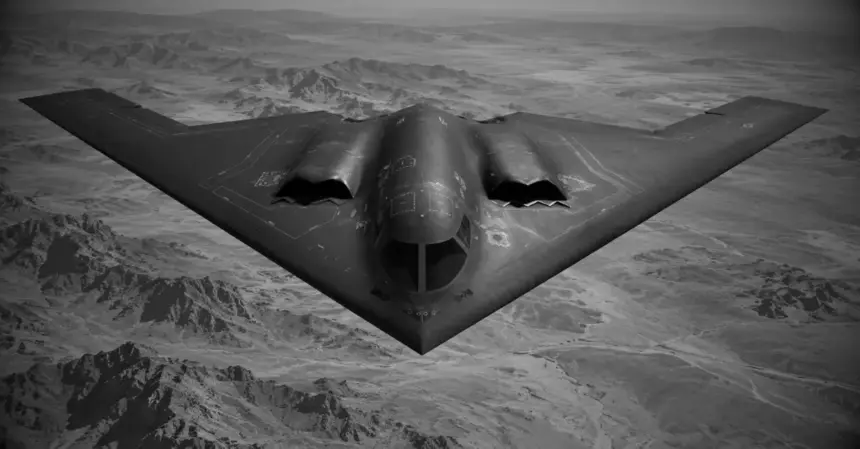
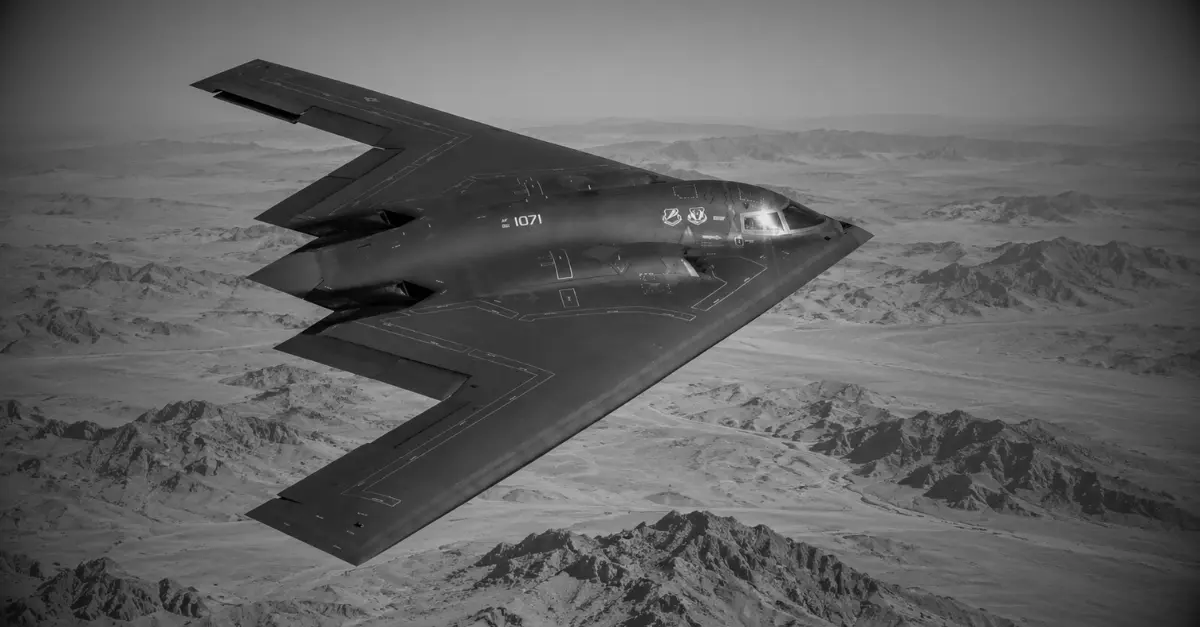
A pure wing, 172 feet (about 52 meters) across, almost flat when seen from the side. And yet this aircraft flies, changes heading and returns to base after missions of more than thirty hours. The question is not only aerodynamic. It goes to the heart of how the United States projects power over very long distances, including toward the Mediterranean basin and the Middle East, without exposing too many assets.
The absence of vertical surfaces is not an aesthetic choice. It is a stealth decision made back in the 1980s. A vertical tail reflects radar waves strongly. By removing it, Northrop Grumman drastically reduced the aircraft’s radar cross-section. The price of this shape is natural directional instability. Without constant intervention, a flying wing tends to slip sideways. Engineers therefore had to invent another way to control yaw.
Panels that create drag
At the wingtips are “split drag rudders.” These are panels that open upward and downward, like a clamshell. When they open on one side only, they generate asymmetric drag. The braked wing falls back slightly, and the nose swings in the opposite direction. Opened on both sides at once, the same panels act as airbrakes.
The lever arm is essential. The wingspan is 172 feet. The panels sit near the tips, more than 80 feet from the centerline. A modest force applied that far from the center of rotation produces a significant yawing moment. It is a simple physical principle, applied with great precision. The system is not as effective as a conventional tail at small angles. Heading changes remain relatively slow, which suits the mission profile of a strategic bomber more than that of a fighter.
Pitch and roll control is provided by elevons spread along the trailing edge. Several pairs (outer, middle and inner) move together or differentially. A central surface, sometimes called the “beaver tail” or gust load alleviation system (GLAS), helps smooth out turbulence. The four General Electric F118-GE-100 engines can also contribute through differential thrust, an option that is particularly useful when the goal is to minimize control surface deflection in order to preserve the radar signature.
Computers that fly in place of the pilot
A tailless flying wing is unstable. The B-2 relies on a quadruplex fly-by-wire flight control system. Four computer channels continuously compare sensor data (pressure, angle of attack, sideslip, attitude) and command the actuators. Technical sources and pilot accounts point to tens to hundreds of corrections per second. The pilot expresses an intention. The computers translate that intention into coordinated movements of the control surfaces, while maintaining stability.
Without this system, the aircraft could not be flown safely by a human crew. The air data sensors are integrated into the skin of the aircraft rather than mounted as protruding pitot tubes, again to limit radar reflections. This architecture made it possible, for the first time on a large scale, to field an operational flying wing. Jack Northrop’s earlier projects in the 1940s had run into instability problems for lack of computers that were fast and reliable enough.
The trade-off with stealth
When the drag panels open, they temporarily break the carefully engineered silhouette. The exposed edges and surfaces increase the radar signature during the maneuver. In high-threat areas, crews therefore try to limit abrupt heading changes and stay on a straight line as much as possible, relying on mission planning and, when necessary, on differential thrust. Stealth is not absolute. It is optimized within certain envelopes of speed, altitude and attitude.
This compromise lies at the heart of the design. Every detail, from absorbent materials to edge alignment, air intake shapes and exhaust gas routing, is designed to reduce radar, infrared and acoustic signatures. But basic maneuverability must remain possible. The flight control system constantly arbitrates between these requirements.
— Silicon Valley (@SiliconValleyMa) October 24, 2026
Strategic and economic stakes
The B-2 was designed to penetrate the densest air defenses of the Cold War era. After the fall of the Soviet Union, the program was sharply cut back. Of the 132 aircraft originally envisioned, 21 were built. The average unit cost of the program is often cited at around 2.1 billion dollars (in then-year or inflation-adjusted dollars, depending on the source), because development costs were spread over a very small number of airframes. Operating costs are also high, notably because of the upkeep of the stealth coatings.
In operations, the aircraft has demonstrated intercontinental reach. During Operation Allied Force in Kosovo in 1999, B-2s flew round-trip missions of more than thirty hours from Whiteman Air Force Base in Missouri, dropping GPS-guided bombs (JDAMs) on Serbian targets. They accounted for a tiny fraction of sorties but a notable share of precision munitions. Later, aircraft operated over Afghanistan, Iraq, Libya and, more recently, against targets in Yemen. These missions illustrate a precision strike capability from US territory or forward bases, without a massive deployment of forces in the Mediterranean region.
Criticism focuses on the cost and the small number of aircraft. With a limited fleet (around twenty in service after the loss of one airframe in 2008), availability remains constrained. Supporters stress the unique combination of stealth, range and internal payload, which makes it possible to engage hardened or protected targets with reduced risk to crews. Its successor, the B-21 Raider, aims to reproduce some of these qualities at a lower unit cost and in greater numbers.
What this changes for future designs
Other programs are exploring tailless configurations or designs with very little vertical surface area, whether drones or combat aircraft. The principle of split drag rudders, combined with ever more powerful computers, remains a viable solution. But every new design has to resolve the same trade-off: reducing reflective surfaces without sacrificing controllability or safety.
The exact radar signature data, the precise flight computer algorithms and some performance figures remain classified. Public descriptions, specifications published by Northrop Grumman and the US Air Force, and operational lessons learned nevertheless make it possible to understand the broad principles. It is not magic. It is engineering pushing the limits of aerodynamics, electronics and materials, while accepting constant compromises.
Key figures
- Wingspan: 172 feet (52.4 m)
- Length: 69 feet (21 m)
- Engines: 4 × General Electric F118-GE-100 (17,300 pounds of thrust each)
- Unrefueled range: approximately 6,000 nautical miles
- Service ceiling: 50,000 feet
- Crew: 2 (pilot and mission commander)
- Number built: 21
FAQ
Can the B-2 turn as quickly as a conventional aircraft?
No. Drag rudders are less effective than a tail at small angles, which makes heading changes more gradual. This fits its role as a strategic bomber.
Why not simply use differential engine thrust?
Differential thrust is used, notably to preserve stealth. However, the drag panels provide additional yaw authority, especially at low speed or during sharper maneuvers.
Is the flight control system reliable?
The quadruple redundancy is designed to tolerate failures. Like any complex system, it has had incidents (notably a 2008 accident linked to sensor problems), but the aircraft has accumulated thousands of operational flight hours.
Will this approach become widespread?
Similar concepts are appearing on some drones and combat aircraft projects. The combination of powerful computers and discreet control surfaces remains relevant for platforms where stealth is the priority.